


Uniqlo's latest competitor, why is it FamilyMart?

Since entering the Chinese market in 2004, FamilyMart has launched the "Convenience Wear" clothing brand and achieved significant success, with sock sales exceeding 20 million pairs and annual sales exceeding 10 million RMB. Despite the saturation of the Japanese convenience store market, FamilyMart is still exploring new products to increase per-store sales to address market challenges
Since entering the mainland China market in 2004, FamilyMart has been in business for twenty years. The slogan "FamilyMart is your home" has left a deep impression on consumers. As one of the representatives of foreign convenience stores, FamilyMart has been striving to break through the boundaries of traditional convenience stores.
About three years ago, FamilyMart first launched the "Convenience Wear" clothing brand. The brand has grown rapidly, with the classic blue and green striped socks being extremely popular. Even Japanese actor and singer Takuya Kimura and other celebrities have posted pictures on social media, sparking a buying frenzy.
According to FamilyMart, as of the end of May 2024, the sales of their socks have exceeded 20 million pairs, with an average annual sales revenue of over 10 million yuan. In the most recent fiscal year, the revenue of this product line exceeded 477 million yuan. From the results, FamilyMart's clothing business is thriving, but what is the underlying logic behind it?
Breaking through the bottleneck of single-store sales
According to the latest data from the Japan Chain Stores Association, as of August 2024, the total number of chain convenience stores in the country is 55,730. Although the total number of stores has not decreased significantly, there has been a consecutive 27-month year-on-year decline since June 2022.
From the overall market perspective, the Japanese convenience store industry led by 7-11, FamilyMart, and Lawson has shown a saturation trend. It is expected that the scale will continue to shrink in the future due to population decline. Among them, the number of FamilyMart convenience stores has remained stable at around 16,000, lacking explosive growth space.
Furthermore, the existing store distribution density is high, and opening a new store will impact surrounding stores, especially in densely populated urban areas. The disputes between franchisees and headquarters are ongoing. In this situation, it has become increasingly difficult to achieve results by opening new stores. Increasing single-store sales has become a major challenge.
In fact, in order to increase single-store sales in a saturated market, the industry has been exploring new popular products. Freshly ground coffee, popularized in the 2010s, can be considered a successful case. In contrast, donuts that emerged around 2015 ultimately failed, and the once popular oden also faded.
In the traditional track, daily food such as bento and bread has been thoroughly researched, and various private label processed food products have been introduced. It is unrealistic to focus on hot snack products that require staff attention In this case, the FamilyMart discovered business opportunities in non-food clothing.
In the past, when it came to convenience store clothing, people usually only thought of underwear and bottoms. The demand for such products is often quite singular. For example, the customer group who misses the last bus late at night usually has an urgent need and reluctantly chooses convenience store clothing. FamilyMart aims to break this "emergency" stereotype.
Since 2021, FamilyMart has teamed up with internationally renowned fashion designer Hiroshi Ochiai to initiate brand collaboration. In an interview, Hiroshi mentioned that he hopes to use Convenience Wear as an opportunity to explore new fashion values and possibilities, creating a clothing brand that "fits the convenience store image" while incorporating design and high quality.
During the development process, FamilyMart particularly emphasizes the design concept of basic items. The products released are mainly divided into men's, women's, unisex, and daily miscellaneous categories. As of now, the products cover 73 practical items ranging from basic clothing to daily necessities, including t-shirts, hoodies, sweatpants, jogging pants, socks, shorts, long-sleeved tops, tank tops, and more, and are constantly being updated.
Maximizing the advantage of store quantity
Unlike clothing stores, convenience stores have very limited sales space, not to mention spacious display space and fitting rooms. In a typical FamilyMart store, only 2-3 shelves are used to display clothing. However, if the product line is always the same, it is easy for consumers to lose their sense of freshness.
In order to comprehensively showcase new products, FamilyMart has tried to open fashion shows, music festival pop-up stores, flagship stores for new product displays, etc., to increase product display and promotion. Shubei Jianyan, head of FamilyMart's merchandise headquarters, said that the layout of clothing products poses significant challenges. In the current layout, FamilyMart is making adjustments in terms of display order, font colors of product names, packaging sizes, and other presentation methods.
Compared to professional clothing chain stores, the Convenience Wear series products appear to be lacking in color and design, losing the fun of choice in the product lineup. In addition, there is no advantage in terms of price and size selection. However, the performance of the products is acceptable, which is a major highlight. Taking the popular striped socks and pure cotton t-shirts as examples, if each SKU is allocated one piece in all stores, let's take a look at the basic situation of FamilyMart's products compared to other major clothing brands.
In general, compared to professional clothing chain stores, the only advantage of FamilyMart is the number of stores. When production reaches a certain scale, dominance can be achieved in terms of procurement prices, quality, and delivery times. However, for sales, this also means an increased risk of inventory backlog.
But precisely this point is enough to make most retailers envious. Assuming that each store has to supply a pair of socks, this alone would require 16,000 pairs. In reality, each store on average displays about 5 to 10 pairs of socks. Assuming 5 pairs are put in each time, the production quantity would be 80,000 pairs, and if 10 pairs are put in, it would require 160,000 pairs.
Based on this estimation, FamilyMart's production quantity is approximately 100,000 pairs each time. If a single store sells 300 pairs of socks per year, the total sales would be around 4.8 million pairs. FamilyMart's socks are seasonless products, so if they can be sold for 12 months, it would be enough for a single store to sell 25 pairs per month. This quantity in the current Japanese domestic market can already compete with brands like Uniqlo, GU, and Shimamura.
In other words, whether in production or sales, FamilyMart has cleverly utilized the results of its more than 16,000 stores in Japan. Rather than the design and production attitude of the products, what is more commendable is the business plan formulated by maximizing the advantage of having a large number of stores, showing remarkable conceptual thinking.
Selling clothing becomes a new means of attracting customers
Just as freshly ground coffee once redefined the product image of convenience stores, FamilyMart hopes to make the Convenience Wear series the next iconic product.
Susumu Sube, in charge of this brand line, pointed out that FamilyMart receives about 15 million customers every day, with an annual reception volume of about 5.5 billion people. Considering that customers include people of all ages and genders, their goal is no longer targeting specific groups but is dedicated to developing products that everyone can accept. This is a major strategic shift.
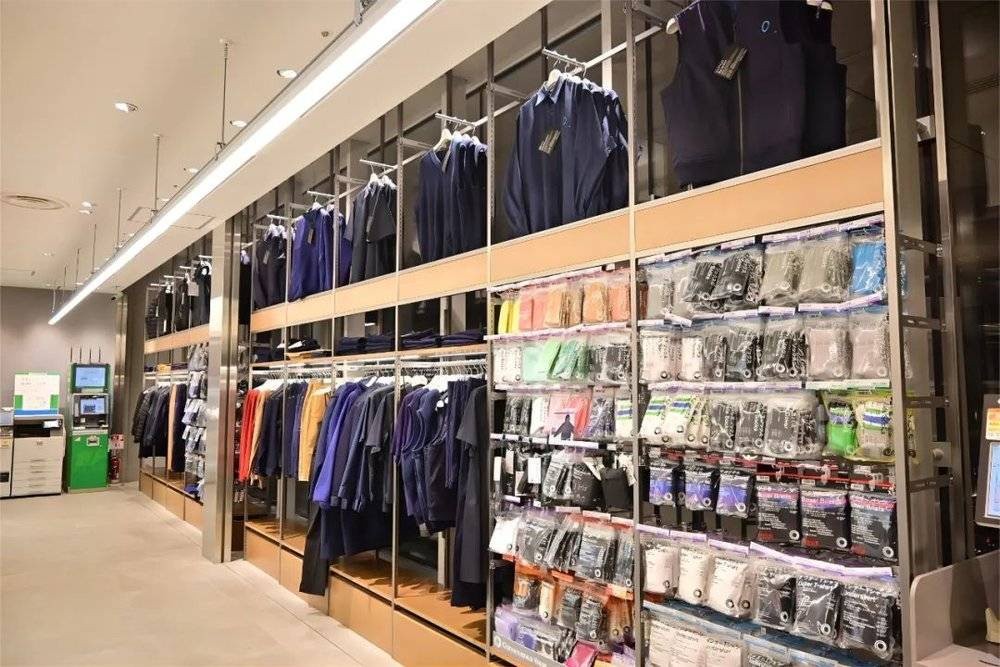
FamilyMart Azabudai Hill Store, displaying clothing on 11 shelves
FamilyMart's bold push for reform is also inseparable from the strong support of its parent company Itochu Corporation. Itochu Corporation is a comprehensive trading company with strong competitiveness in non-resource fields such as textiles and food. Supplying clothing to FamilyMart is Itochu's retail link company. This company belongs to the Energy Chemicals Division and mainly sells daily necessities and groceries to large retailers As a result, FamilyMart's clothing production has a natural advantage, and its selection of raw materials is also unique. For example, it uses recycled polyester fiber RENU. This material is made from recycled old clothes, or surplus fabrics and cutting scraps generated during the factory production process. Despite being clothing sold in convenience stores, it can still achieve comfort and environmental friendliness in wearing.
However, according to FamilyMart's February 2024 financial report, food products still account for a high proportion of sales, especially fast food and processed food. Although overall sales are trending upwards, the non-food category still accounts for a small proportion, especially clothing products, with limited growth potential.
This indicates that FamilyMart's market positioning and core competitiveness still focus on food products, and clothing products have not significantly changed the overall sales structure.
Additionally, the Convenience Wear series had sales exceeding 477 million yuan in the 2023 fiscal year, a 30% year-on-year increase. During the same period, FamilyMart's total sales were approximately 142.8 billion yuan, showing that clothing sales are only the tip of the iceberg. If we switch to the professional clothing track in Japan, this is already equivalent to the size of a medium-sized brand, accounting for one-third of the sales of the "niko and..." brand. However, compared to Uniqlo, the current scale of FamilyMart's clothing sales is not comparable.
Looking at the entire convenience store industry, although there are differences in various service offerings, the main competitive area is the food category with the highest purchase frequency. The sales growth effect brought by the clothing business is actually very small. After all, even daily clothing is not changed on a daily or weekly basis. But if operated properly, selling clothing can become a means of creating topics and attracting traffic.
In the past, 7-11 convenience stores limited clothing to emergency needs, including a product mix centered around seasonal sundries, and have already established a stable product supply. Now, FamilyMart and Lawson are looking for opportunities beyond emergency needs. The competition among the three giants continues to escalate.
For example, in April of this year, FamilyMart collaborated with the well-known stationery brand Kokuyo to release 35 co-branded products, such as Campus notebooks and erasers inspired by FamilyMart socks; in the same month, Lawson collaborated with MUJI to launch blue and pink interspersed socks and handkerchiefs to pay tribute to its classic brand colors; 7-11 also collaborated with its sister company Ito-Yokado to sell FOUND GOOD brand products starting from June this year.
In conclusion, behind FamilyMart's focus on clothing is not just developing a new product, but more importantly, how to elevate "daily necessities" into a "ideal product" with long-term stable supply. Once the clothing category is added, the original main product structure will face reduction. How to achieve efficient balance in this aspect is one of the future challenges Former President of Lawson, current President of Suntory, Shinji Sina, previously stated: "We hope to make efforts to encourage customers to buy more items." Currently, the three giants of convenience stores are facing the dilemma of declining customer traffic, and it is difficult to achieve significant breakthroughs relying solely on food products. According to the financial report of FamilyMart, since the start of the fiscal year in February 2021, its customer traffic has turned positive, achieving year-on-year growth for three consecutive fiscal years, with growth rates of 1.1%, 2.7%, and 3.3% respectively.
While clothing sales may not directly correspond to the increase in customer traffic, the new fashion title undoubtedly injects a fresh vitality into FamilyMart. In addition, this move by FamilyMart not only demonstrates its strategic vision for diversified operations, but also provides a valuable case study for chain enterprises in cross-domain development, which may become a new business opportunity
