


AUTOSTREETS: Soaring before a large lock-up expiration

AUTOSTREETS will usher in its first lock-up period in November, with the stock price experiencing an abnormal increase recently, rising by 28.57% on October 22nd. Since its listing, the stock price had dropped to HKD 3.8 and has now rebounded to HKD 17.1. Prior to the lock-up period expiration, the market is concerned about whether it can withstand selling pressure, with the buying and selling activities of retail investors and institutions attracting attention
On October 22nd, AUTOSTREETS (02443), a heavily traded stock, experienced another abnormal surge: the company surged over 40% in the afternoon, closing at 17.1 Hong Kong dollars, with an increase of 28.57%.
Since its listing in May this year, AUTOSTREETS has been trading below its IPO price for a long time, dropping to as low as 3.8 Hong Kong dollars, a decrease of over 60% from the IPO price of 10.2 Hong Kong dollars. On October 9th, the company saw a sudden surge during trading hours, soaring to 117 Hong Kong dollars at one point, with a nearly 100% increase by the closing. Subsequently, breaking away from the previous lackluster performance, the trading volume remained above 30 million shares for several consecutive trading days until a noticeable decline on October 17th.
Public information shows that the founder and chairman of AUTOSTREETS is Yang Aihua, with Changguang Investment Limited holding 12.01% of the shares and World Key Investment Trading Limited holding 6.00% of the shares, both ultimately controlled by Yang Aihua and Yang Hansong (Yang Aihua's younger brother). The second largest shareholder, the U.S. COX Group, holds 10.81% through Manheim Investments.
On the news front, November will see a significant unlocking of shares for AUTOSTREETS, marking the first unlocking period since the company went public. Given the company's fundamentals, can it withstand the selling pressure?
Accumulation of "main force" positions before the unlocking?
According to public data, the largest net sellers today are retail investors from the Shanghai-Hong Kong Stock Connect, with a net sale of 1.1894 million shares. Most of these funds entered the market after the 10th and some retail investors have now exited with profits; followed by Fuchang with a net sale of 468,000 shares, Hendra and AA selling 164,400 shares and 121,400 shares respectively. On the buying side, BOCI International and CICC bought 207,400 shares and 89,200 shares respectively, while retail investors from Futu and the Shenzhen-Hong Kong Stock Connect ranked lower.
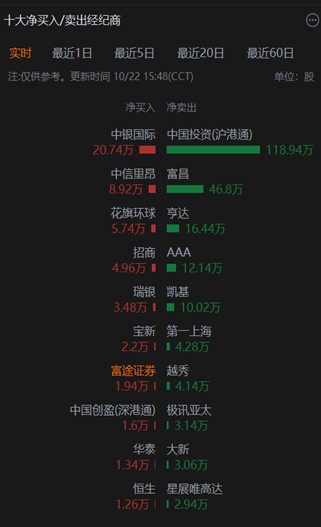
Looking at the data from the past 60 days, as of the 21st, Fosun International sold 9.444 million shares, Futu Securities, Morgan Stanley, and CMB Wing Lung Bank sold 554,000 shares, 463,200 shares, and 254,400 shares respectively; the Shanghai-Hong Kong Stock Connect and the Shenzhen-Hong Kong Stock Connect bought 7.2156 million shares and 3.8236 million shares respectively, being the largest buyers.
It is worth noting that today AUTOSTREETS saw active trading volume, with the stock price surging from 14 Hong Kong dollars to 18 Hong Kong dollars in the afternoon, accompanied by a rapid increase in trading volume. At the same time, the company's turnover rate reached 4.59%, significantly higher than similar stocks, such as the Futu Auto Index (LIST1040) turnover rate of 0.44%, the Auto Parts Index (LIST1041) turnover rate of 0.08%, and the Auto Retailer Index (LIST1269) turnover rate of 0.08% Public information shows that when AUTOSTREETS went public, it raised a total of HKD 153 million, with a global offering of 15 million shares. However, only 20% of the shares were publicly offered, resulting in a small market capitalization and no cornerstone investors, making the stock price vulnerable to manipulation and speculation.
On the news front, AUTOSTREETS will face a lock-up expiration of 550 million shares on November 27, accounting for 66.1% of the total share capital. Under the pressure of lock-up expiration selling, if there are no buyers to absorb the shares, a rapid price drop on that day is not impossible, as seen with previous cases like Lohas Health (02306) plummeting by 77.84% and Junshengtai Medicine (02511) dropping by over 61%.
With a relatively small market capitalization and unusually high turnover rate, signs of market speculation are growing. Considering the upcoming lock-up expiration date, behind the facade of rising stock prices and high trading volume, the intention of institutional investors to drive up prices to attract retail investors and then take profits is becoming increasingly apparent.
Is the industry leader's performance "less than stellar"?
According to information from the Wisdom Finance app, AUTOSTREETS is a trading intermediary connecting buyers and sellers of used cars, mainly providing a platform for second-hand car transactions through an auction model.
Based on the interim financial results previously disclosed by AUTOSTREETS, the company generated revenue of approximately RMB 191 million in the first half of this year, a decrease of 15.5% year-on-year; gross profit was about RMB 124 million, a decrease of 14.8% year-on-year; and the attributable net loss of the parent company was approximately RMB 148 million, an increase of about 1.96 times year-on-year.
The announcement stated that the decrease in revenue was mainly due to the impact of new car price declines and fluctuations, resulting in a decrease in second-hand car auction commission and service fees due to the decline in second-hand car auction transaction prices; a decrease in the number of consumer car replacement transactions and average per car income, leading to a decrease in revenue from car sales arrangements; and a decrease in demand from dealer groups and OEMs, resulting in a decrease in exhibition business revenue.
Looking at a longer time frame, AUTOSTREETS' revenue and profits have been declining in recent years, with a more pronounced downward trend in profitability.
For the years 2021 to 2024, the company's revenue is expected to be approximately RMB 678 million, RMB 468 million, and RMB 492 million respectively, with a compound annual growth rate of -14.80%; gross profit is expected to be approximately RMB 426 million, RMB 285 million, and RMB 312 million respectively, with a compound annual growth rate of -14.31%; and net profit is expected to be approximately RMB 165 million, RMB 68.98 million, and RMB 9.269 million respectively, with a compound annual growth rate of -76.30%.
In the past three years, AUTOSTREETS' gross profit margin has fluctuated around 60%, at 62.8%, 60.9%, and 63.5% respectively, while the net profit margin has declined to single digits, reaching only 1.9% in 2023, indicating poor profitability performance.
According to data from Zhoushi Consulting, in terms of trading volume in 2022, AUTOSTREETS is the largest provider of used car trading services in the country. However, based on the performance of core financial data, the halo of this industry leader AUTOSTREETS seems to have a somewhat "less than stellar" meaning. With insufficient future profit expectations, the upward potential of the company's future stock price is clearly limited
