IPO Watch | Horizon Robotics "bleeds" through the Hong Kong Stock Exchange debut, when will profitability break through the "horizon"?

China Finance Online
2024.10.23 01:43
portai
I'm PortAI, I can summarize articles.

Horizon Company plans to conduct its initial public offering (IPO) in Hong Kong, with a pricing of HKD 3.99 per share. The company is expected to debut on October 24th, with an implied market value of USD 6.7 billion. Specializing in advanced driver assistance systems and intelligent driving solutions, the funds raised will be used for technology research and operations. Despite significant revenue growth, with revenues projected to be RMB 467 million, RMB 906 million, and RMB 1.552 billion for 2021-2023, the company's losses are also increasing. Losses for the first half of 2021-2024 are estimated to range from RMB 2.06 billion to RMB 5.1 billion, primarily due to research and development expenses and changes in financial liabilities

Recently, Horizon announced plans to conduct its initial public offering (IPO) in Hong Kong. According to the trading documents, the IPO price for Horizon is set at HKD 3.99 per share, at the upper end of the price range. Prior to the exercise of the over-allotment option, this IPO will issue nearly 1.4 billion shares. The implied market value is USD 6.7 billion, with trading expected to commence on October 24th. Goldman Sachs, Morgan Stanley, and China International Capital Corporation (CICC) are the joint sponsors.

According to the official website, Horizon is a leading provider of advanced driver assistance systems (ADAS) and high-level autonomous driving (AD) solutions in the market. Their solutions integrate advanced algorithms, specialized software, and processing hardware to provide core technology for advanced driver assistance and high-level autonomous driving, thereby enhancing the safety and experience for drivers and passengers.

The prospectus indicates that the funds raised from Horizon's IPO in Hong Kong will be used for research and development of advanced driver assistance (ADAS) and high-level autonomous driving (AD) solutions and technologies, joint ventures, marketing, and operations.

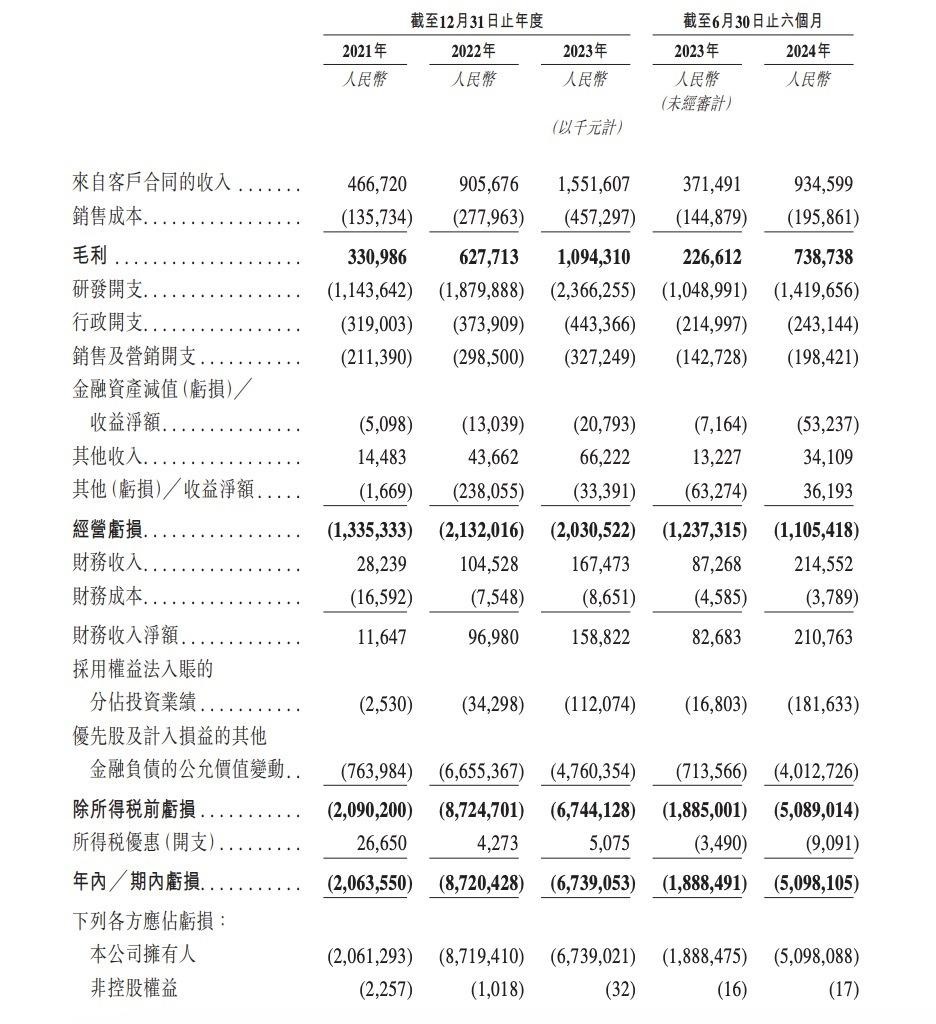
From a revenue perspective, Horizon's operations exhibit characteristics of "high revenue, high gross profit, high losses." According to financial reports, from 2021 to 2023, Horizon's revenues are projected to be RMB 467 million, RMB 906 million, and RMB 1.552 billion, with a compound annual growth rate of 82.3%. Additionally, the company's gross profit margins during the financial reporting period are 70.9%, 69.3%, and 70.5% respectively.

However, as revenue increases, the magnitude of the company's losses is also growing. Horizon incurred losses of RMB 2.06 billion, RMB 8.72 billion, RMB 6.74 billion, and RMB 5.10 billion in the first half of 2021, 2022, 2023, and 2024 respectively.

Regarding the losses, Horizon explained in the prospectus that the significant net losses were mainly due to large research and development expenses incurred to enhance key core technologies, as well as fair value changes in preferred shares and other financial liabilities.

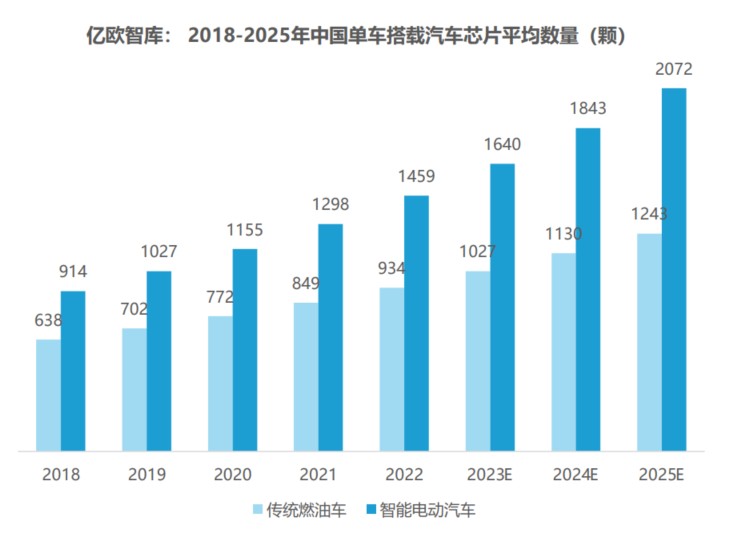
In recent years, with the development of electrification and intelligence in the automotive industry, the overall demand for automotive-grade chips is also expected to increase. According to previous statistics from EO Intelligence, as the future single-vehicle chip usage continues to rise, by 2025, the average number of chips in fuel vehicles will reach 1,243, while the average number of chips in smart electric vehicles will be as high as 2,072.

However, despite the promising market outlook for automotive-grade chips, challenges such as the difficulty of chip production, rapid demand growth, imbalanced supply and demand structure, insufficient upstream enterprise capacity, and severe inventory hoarding by automakers exist. Most Chinese domestic chip companies are still in a situation of being "big but not strong." Moreover, the high dependence on imports and the gap in core technology research and resources compared to developed countries further add uncertainties to the industry's development In this context, in order to improve the level of self-sufficiency of China's automotive-grade chips and prevent the exacerbation of technical "bottlenecks", innovative breakthroughs by Chinese automotive-grade chip companies are bound to become a trend in the future.

As of now, although the "lack of chips and soul" issue in the Chinese automotive industry still places it at a relatively low position in the global industry chain, after years of development, domestic replacements for chips in mid-to-low-end application scenarios have been initially achieved. This has led to the emergence of a group of listed automotive intelligent driving chip companies including Horizon Robotics, Black Sesame Intelligence, as well as leading companies such as Tsinghua Unigroup, Horizon Robotics, and Horizon Robotics.

Behind the IPO frenzy, loss issues are highlighted

With the previous hot trend of autonomous driving technology suppliers rushing to go public, in order to seek broader financing channels, most platforms are facing the common dilemma of losses. The vast majority of intelligent driving platforms are anxiously waiting for the dawn of profitability along with capital.

Previously, the unicorn in autonomous driving, Momenta, had a pre-IPO valuation of over $5 billion, but its net losses from 2021 to 2023 were in the tens of billions, leading to its IPO being dubbed a "bleeding" listing. Horizon Robotics, which just landed on the Hong Kong stock market on August 8th this year as the "first stock of intelligent driving chips", has achieved growth in revenue and gross profit, but has also been in losses for the past three years. In addition, according to reports, Horizon Robotics has disclosed 7 annual reports since its establishment 8 years ago, all of which have been losses, with accumulated losses exceeding $5 billion, and the company still recorded a loss of $530 million in the first half of this year.

"The industry's common dilemma is the insufficient self-sufficiency in funding and heavy financial pressure," as reported by Securities Times, "with the inability to generate profits internally and the continuous slowdown in equity investments, the survival of companies becomes a problem, and going public is an almost inevitable path and one of the few viable life-saving straws."

As another autonomous driving technology company about to enter the capital market, Horizon Robotics also struggles to break the "loss" curse. According to its prospectus, the company has accumulated net losses of 22.6 billion yuan in the past three and a half years since 2021. In comparison, Black Sesame Intelligence had losses of 9.966 billion yuan from 2021 to 2023, and achieved a gross profit of 90.075 million yuan in the first half of 2024; while Horizon Robotics' loss amount from 2021 to the first half of this year was only over 4 billion yuan. Although they are considered "brothers in adversity", Horizon Robotics' loss amount still exceeds that of many companies.

The core difficulties for Horizon Robotics' significant losses are excessive R&D investment requiring continuous iteration of technology, and the market has not fully unfolded, with commercialization challenges yet to be resolved.

According to statistics, Horizon Robotics has been investing heavily in R&D, with R&D expenses in the reporting period being 1.144 billion yuan, 1.88 billion yuan, 2.366 billion yuan, and 1.42 billion yuan, accounting for 245%, 207.6%, 152.5%, and 151.9% of the respective revenues. In addition, Horizon Robotics expects its future R&D expenses to remain at a high level High R&D investment has enabled Horizon to gradually build up technological barriers on the product side. In April 2024, the company released the new generation of in-vehicle intelligent computing solutions, the Journey® 6 series and Horizon SuperDrive™ full-scenario intelligent driving solution. The Journey® 6 series includes six versions: Journey 6B, Journey 6L, Journey 6E, Journey 6M, Journey 6H, Journey 6P. This series of products is currently the only series of computing solutions in the industry that meet the mass production requirements for full-stage intelligent driving.

However, Horizon's products have not been fully deployed in the market and still face the risk of relying on major customers. According to the prospectus, Horizon's main customers include SAIC Group, GAC Group, BYD, Li Auto, Nio, etc. Horizon is the largest supplier of intelligent driving chips for BYD and the largest and most important supplier of intelligent driving chips for Li Auto. In 2021, 2022, 2023, and the first half of this year, the total revenue generated by Horizon's top five customers was 283 million yuan, 482 million yuan, 1.067 billion yuan, and 727 million yuan, accounting for 60.7%, 53.2%, 68.8%, and 77.9% of the revenue, respectively.

This also means that the high concentration of customers makes Horizon's revenue situation highly susceptible to changes in individual customers, increasing market risks.

Furthermore, from a competitive perspective, Horizon is currently finding it difficult to "replace" overseas benchmark companies such as NVIDIA and Mobileye. According to the GAC Research Institute, the top four in the field of intelligent driving domain control chips in 2023 are Tesla FSD chip, NVIDIA Orin, Mobileye EyeQ4H, and Mobileye EyeQ5H. Since the second half of 2023, car manufacturers such as Huawei, XPeng, Xiaomi, etc., have successively released urban intelligent driving solutions based on the NVIDIA Orin chip platform, planning to deploy them in their flagship models. This also means that the window for Horizon to move towards high-end intelligent driving chips is gradually narrowing, and the distribution volume in the high-end market is difficult to fully open up.

Technological breakthroughs and profit pressures make it a double-edged sword for Horizon.

According to previous reports from financial websites, Horizon mainly targets the category of computing chips, namely automotive-grade SoC. This category of chips has wide applications in the automotive field, mainly involving the cockpit and intelligent driving. However, according to EO Intelligence's survey, there is still a gap between Chinese and overseas chips in the SoC chip field. Local SoCs have progressed to 7nm, and companies like Horizon, Black Sesame Intelligence, and CoreTech have released related products, while overseas chip manufacturers are moving faster, with NVIDIA Altan already advancing to 5nm.

Therefore, with the intensification of competition in the global SoC field, domestic manufacturers may focus their future development strategies on the R&D field to keep up with the industry's forefront. By increasing investment in technological innovation, they aim to achieve technological breakthroughs Although this move is seen as a key layout to achieve long-term development goals, it may also lead to a delay in the company's profit cycle.

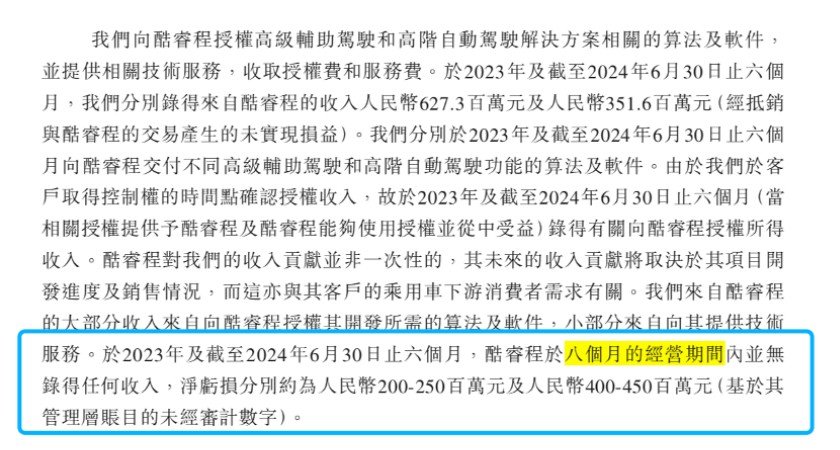
However, the investment in research and development is restraining the pace of the company's profitability, and continuous investment has also become a barrier to its "comeback". In the field of strategic investment, Horizon initiated a cooperation with Volkswagen Group (referred to as "Volkswagen") in November 2023 to establish a joint venture company, CoolRuiCheng (Beijing) Technology Co., Ltd. (referred to as "CoolRuiCheng"). Volkswagen and Horizon hold 60% and 40% equity in CoolRuiCheng, respectively. However, in the first half of 2023 and 2024, CoolRuiCheng did not generate any revenue, with net losses of approximately RMB 200 million to 250 million and RMB 400 million to 450 million, respectively (based on unaudited figures from its management accounts).

From Horizon's perspective, the cooperation with Volkswagen is more like a downward exploration of its industrial chain layout. As a supplier of advanced driver assistance systems (ADAS) and high-level autonomous driving (AD) solutions for passenger cars, Horizon, through this joint venture, directly integrates its software and hardware technical capabilities into the core R&D system of vehicle manufacturers, transforming from a chip supplier to a provider of intelligent driving full-stack solutions. This strategic adjustment not only helps Horizon further consolidate its leading position in the autonomous driving chip market but also lays a solid foundation for its future expansion in the intelligent driving solutions market. Through CoolRuiCheng, Horizon will be able to better understand the needs of vehicle manufacturers in depth, thereby providing more customized products and services that better meet market demands.

However, the profitability and market performance of CoolRuiCheng will directly impact Horizon's financial situation. As a newly established company, CoolRuiCheng is unlikely to be profitable in the short term. If CoolRuiCheng's development falls short of expectations later on, it will undoubtedly pose challenges to the stability and sustainability of the company's performance. Horizon will bear CoolRuiCheng's losses according to its shareholding ratio, further eroding Horizon's profits. At the same time, CoolRuiCheng's market performance is highly dependent on Volkswagen's performance in China. If Volkswagen's progress in China falls short of expectations, it will directly affect CoolRuiCheng's order volume and profitability, indirectly exacerbating Horizon's risk of losses.

However, looking at the current development situation, with the rise of domestic cars, the marketing pressure on traditional overseas brands led by Volkswagen is gradually increasing. Recently, Volkswagen Group announced its global sales for the third quarter, with cumulative sales in the Chinese market reaching 2.0566 million vehicles in the first three quarters, accounting for 31.5% of the total global sales, but with a year-on-year decline of 10.2%, the largest decline in sales among all markets.

Moreover, compared to Volkswagen's overall sales, the proportion of pure electric vehicle sales is still very small. In the first half of this year, the total sales of Volkswagen Group in the Chinese market were 1.345 million, with pure electric vehicles accounting for 90,600, only about 7%. This also means that as the penetration rate of new energy vehicles continues to increase, and the monthly retail penetration rate is about to exceed 50% in the Chinese market, once Volkswagen Group experiences a decline in sales of fuel vehicles, its market share is very likely to gradually decline due to the lack of structural support from pure electric vehicle sales As a partner of Volkswagen Group in China, Horizon's cooperation projects with them may face potential risks of delay or scale reduction in the future, which could in turn affect Horizon's business growth plans and market share.

References

Cai Zhongshe (2024), Horizon IPO countdown: Losses still exist, market prospects uncertain, https://finance.eastmoney.com/a/202410113203247350.html

Yan Zhaoxin (2024), Southern Metropolis Daily, Black Sesame Intelligence is about to ring the bell, continuous losses behind the sprint to become the "first stock of smart driving chips", https://www.sohu.com/a/797599156_161795

Market Observation (2024), Why can Horizon break through a market value of over one trillion after seven years of losses?, https://finance.sina.com.cn/roll/2024-10-09/doc-incryhfs9316578.shtml

Wang Xiaowei (2024), Securities Times, Balancing high R&D with commercialization, seeking survival and transformation in the competition of autonomous driving companies

Wei Wei (2024), Beijing Business Daily, Listed and broke on the first day, the worries of Black Sesame Intelligence's sprint,

Wei Lan (2024), New Energy Vehicle News, Autonomous driving sparks another wave of IPO frenzy

Wu Yuli (2024), The Paper, Wenyuan Zhixing's twists and turns in the U.S. IPO: postponed listing in the U.S. and then approved by the CSRC, https://baijiahao.baidu.com/s?id=1813168768976807772&wfr=spider&for=pc

Wang Fangran (2024), Yicai, Horizon to debut on the H-share market next week, with a valuation of 61 billion last year, can it avoid the "curse" of breaking on the first day?

Yan Qi (2024), 21st Century Business Herald, Life and death situation of autonomous driving companies in the rush to go public, venture capital

Xia Ming (2024), Guangzhou Daily, Horizon to be listed on the Hong Kong Stock Exchange for hearing, expected to significantly increase losses for the whole year, https://finance.eastmoney.com/a/202410103202141055.html

Zhang Zhao (2024), Time Weekly, The dilemma of the "first AI chip stock" with a market value of over one trillion, Horizon: huge losses exceeding 600 million in the first half of the year, nearly 5 billion spent on R&D in 4 years, https://baijiahao.baidu.com/s?id=1809175100086526921&wfr=spider&for=pc