


Jellycat, popular in Shanghai, replaced by domestic cultural and creative platforms

This article discusses how in Taiyuan, China, cultural and creative brands attract young consumers, especially adults, by selling plush toys in innovative ways. Taking a noodle stall as an example, the stall owner uses plush toys instead of traditional food to attract customers' attention. This "no physical performance" sales method reflects the changes in the toy industry, emphasizing the demand for toys among adults, especially in countries with declining birth rates like Japan, where the toy market continues to thrive
"Do you want wide noodles or thin noodles? Do you want them soft or firm? Soft? Alright, I'll cook them a bit longer for you."
Living in the city, we are accustomed to hearing such words. Usually, along with these words, you can also smell a strong and fragrant aroma, making you stop and look around, trying to find the source of the scent.
But, not necessarily anymore.
During this year's National Day holiday, if you travel to Taiyuan, Shanxi, and wander near Zhonglou Street, hearing such a conversation, you will find that the vendor shouting "knife-cut noodles" is not holding well-fermented dough, but a soft plush toy; and the vendor will solemnly "cut" the plush toy a few times in front of the customers, then pick "slices of meat," "eggs," and "vegetable leaves" from a bowl in front of you as toppings according to your preference - of course, they are also plush products.
From any perspective, this scene seems excessively absurd. In comparison, Ke Yun from "Deep in the Rain" holding an empty swaddle and shouting "the baby is crying" seems much more normal. It's no wonder that netizens with "sharp tongues" sigh that "Ke Yun was born in the wrong era," after all, to persist in this process, both buyers and sellers are a bit "eccentric."
However, no matter what product is being made, as long as it is targeted at young users, the more "eccentric" it is, the more lovable it becomes. Previously, the "eccentric king of cultural and creative industries," Gansu Provincial Museum, led the way by live-streaming the sale of plush "Tianshui Spicy Hot Pot," and now a local cultural and creative brand from Shanxi is "performing without actual products" by cutting noodles on the street... These phenomena indicate that to do well in selling toys, not only do you need to attract the attention of children, but you also need to captivate the "childlike" adults.
In Japan, just across the sea from us, the degree of declining birth rates is extremely high, yet the toy industry is thriving. This is precisely because they understand this principle well and are dedicated to creating toys that adults love - after all, in the eyes of ambitious East Asians, children who are obsessed with toys are often criticized for "losing their ambition," while these "adult children" who are already adults, have money, and are eager to "re-parent themselves," are most likely to achieve "toy freedom."
Selling plush toys to adults,
How many steps are there in total?
In English, there is a specific word to describe this phenomenon - "Kidult," a portmanteau of "Kids" and "Adult," specifically referring to adults who maintain a childlike mentality. In the English-speaking world, this term can be traced back to the turn of the millennium. Therefore, it is evident that "childlike" is not an exclusive trait of the post-90s or post-00s generation, but a universal phenomenon that has existed in previous generations.
From Disney, POP MART to McDonald's, some rely on nostalgia, some rely on creativity, but ultimately, they are all doing business with this group of Kidults. Among them, the most representative adult toy in recent years is Jellycat, which can also be said to be the originator of the current "cultural and creative playhouse" IP.
This British toy brand, founded in 1999, was initially positioned as "infant soothing toys." Selling "emotional value" is one of the brand's winning strategies. Although the elusive concept of "emotional value" is now almost synonymous with "IQ tax" on the Chinese internet, in the eyes of the brand's loyal users, This is a "must-have consumption".
According to the official brand introduction, each Jellycat plush toy comes with its own story; and positioned as a "comfort toy", Jellycat also pays attention to the materials used, "using high-density polyester fiber to enhance the smooth feel of the plush toy, and desensitizing the fabric to eliminate concerns for sensitive skin and rhinitis patients". Even if the difference is not visible to the naked eye, knowledgeable consumers can judge whether the plush toy in their hands is a genuine Jellycat just by touching it, and may even spontaneously create a "best touch list" to evaluate the styles with the best feel.
According to data from the China Toy and Juvenile Products Association, during last year's Double 11, Jellycat surpassed Disney's star plush toys, ranking first in Tmall's plush fabric category sales. It can be seen that this "young brand" established less than 30 years ago has skillfully taken over the predecessors' market share, holding a more significant meaning in the minds of consumers of the same age.
Jellycat's plush toys are usually personifications of daily necessities. Some people use it as a "travel companion" on social platforms, taking photos with it; some treat it as a trendy cultural icon, imbuing human emotions into plush toys. Even if you never cared about the topic of "healing economy", you must be familiar with this "weary eggplant". On the face of this "lively eggplant" that always wears a faint smile, people can see a hint of the fatigue and sense of loss unique to laborers, and even empathize with it.
The consumption logic of young people is always so self-consistent and contradictory: while feeling tired from life and work, laborers also need to achieve spiritual healing through consumption. It is difficult to say whether this is a mutual pursuit between the brand and consumers, or if one party intentionally does so. Taking this "lively eggplant" as an example, after becoming an icon and emotional spokesperson for contemporary people, its value has skyrocketed, with the official store frequently out of stock and items selling out in seconds. Another plush toy with a "melancholic" trait, the "sad boiled egg", is even more absurd, being once resold on second-hand platforms for thousands of yuan, nearly ten times its original price, making it the "most valuable financial product for young people".
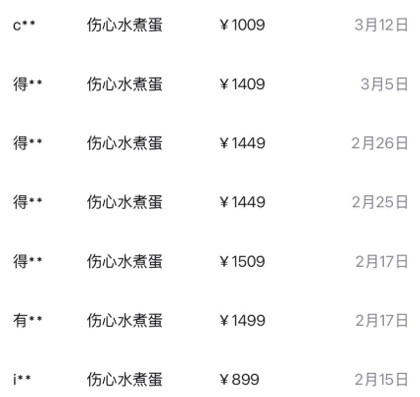
On second-hand platforms, the discontinued "sad boiled egg" has nearly increased in price tenfold. (Image/Second-hand platform screenshot)
If you are not a loyal fan of Jellycat, seeing these prices might add a sense of unnecessary sadness. Currently, these plush toys developed by domestic cultural and creative brands are the "alternative choice" for most consumers.
From Jellycat to "street cat": The Business of Emotional Value
Combining food with plush toys is not unique to Jellycat; but using their own produced plush toys to "perform" is indeed unique.
Since September last year, Jellycat's series of limited-time experiential stores have successively opened in New York, Paris, and London, combining local specialties such as fish and chips to provide customers with an "immersive" packaged performance. This year, with the landing of the "Jellycat CAFÉ" limited-time experiential store at Jing'an Kerry Center in Shanghai, this novel gameplay instantly ignited social media, and reviews of the store experience quickly spread.
According to local media reports, after consuming at the "Jellycat CAFÉ" limited-time experiential store, the staff will take out a tool resembling a cream gun, pretend to squeeze cream on the toy, wrap it in packaging paper, and hand it to the customer, with a thoughtful reminder, "Eat it soon when you get back, as the cream will not taste good once it melts."
The inherent "internet celebrity" attribute of Shanghai itself has accelerated the popularity of this spectacle. The "Jellycat CAFÉ" opened before the Mid-Autumn Festival holiday quickly attracted long queues, with the entrance "tickets" for the pop-up store being scalped online for over 400 yuan, and some consumers spending over a thousand yuan in the store, not only to purchase the "city limited edition" but also to experience the homely service in advance.
However, when a consumption activity with experience as its selling point goes mainstream, its attractiveness to people also rapidly declines—because experiences are too easily replicated, and the sense of experience is easily diluted. Around the National Day this year, various cultural and creative brands across the country successively launched "food products" with local characteristics, more or less drawing inspiration from Jellycat's marketing approach.
For example, a cultural and creative shop in Shaanxi that makes "roujiamo" would require the staff to ask customers in a Shaanxi accent whether they want fatty or lean meat, and even use a kitchen knife to chop a few times on the plush "meat patty"; based on customer suggestions, a "jianbing guozi shop" located in the former residence of Zhang Xueliang in Tianjin allows customers to choose to add fried dough sticks or pickled vegetables... In fact, both buyers and sellers understand that this is an adult version of "playing house", but the essence lies in allowing consumers to witness the "production" process—even if it is a seemingly fake performance.
More importantly, the local cultural and creative version of "Jellycat" is more grounded in terms of product selection and pricing: authentic "Tianjin jianbing guozi" for 59 yuan; "roujiamo" from Shaanxi for 49 yuan; "Yangcheng Lake hairy crab" from Suzhou Museum for 59 yuan... These cultural and creative dolls priced in the two-digit range give people a sense of peace of mind when "paying for emotions".
With the combination of specialty food and emotional value, these unique cultural and creative dolls have become more suitable for Chinese consumers, with lower barriers to entry as the "street cats".
At what age,
can one truly fall in love with strange things? From Gansu, Shanxi to Jiangsu, cultural and creative brands have successively entered the market, surrounding cities from west to east.
When the business of "emotional value" combines with our proud street food culture, it returns to the comfort zone of domestic brands. From various vlogs on social platforms, every staff member in cultural and creative product stores has received professional training, like master chefs in restaurants, selecting ingredients, preparing dishes, cutting vegetables, packaging... In this seamless set of actions, customers experience a familiar immersive feeling.
This immersive feeling is also extended by store owners to online marketing. Recently, the "Crab Yellow Yellow" plush crab doll launched by the Suzhou Museum has once again attracted attention on social platforms. In addition to the unique shape of the toy itself, the official account's "immersion" has left a deep impression on many consumers. Under a post where netizens asked "Why are all the female crabs from Suzhou Museum so fat", the official account earnestly replied, "Because the male crabs are fat and delicious when it's cold" - a ridiculous answer with a hint of reason.
But now, after this wave gradually recedes, the issue of the "originality" of cultural products has once again surfaced, "It sounds nice to call it 'China's Jellycat'; in a harsh way, isn't this just a knockoff?" Controversies surrounding these cultural and creative products are becoming more and more heated. Some people can't stand the absurd logic behind this "abstract" behavior - "Too childish for children, just right for adults" "Toys are getting weirder, is this a good thing?"
It seems true - only when people reach a certain age will they like strange things. My friend Xiao Zhao, during this year's National Day holiday, chose not to travel but to return to her hometown from Shanghai to visit her family. During those days, she frequently saw content related to Jellycat on social platforms. She originally wanted to follow the trend and bring a "Shanghai specialty" limited edition milk tea package for her 3-year-old niece, but after browsing the store, she gave up and instead chose the most common little bear backpack. "'Strange things' are just the quirks of adults, children still like cute things."
In the end, only adults resonate with "ugly-cute" strange things, heal themselves in the "ugly things" not recognized by mainstream aesthetics, and fall in love with themselves again
