The final outcome of the China-EU electric vehicle trade negotiations may affect the global automotive industry landscape

Huxiu
2024.10.25 00:42
portai
I'm PortAI, I can summarize articles.

The outcome of the China-EU electric vehicle trade negotiations may impact the global automotive industry landscape, especially the automotive trade between China and the EU. The U.S. ban on Chinese internet-connected vehicles may lead to Ford, General Motors, and other companies ceasing to export vehicles from China, affecting American companies and consumers. The draft ban will impose strict licensing and reporting requirements, expected to impose more precise restrictions on key components such as LiDAR and high-end cameras. The U.S. measures also imply that European automakers need to restructure their supply chains in advance

At the end of this month, the results of the electric car trade negotiations between China and the European Union not only involve the car trade between China and the EU, but may also affect whether the EU will ultimately cooperate with the U.S. ban on Chinese internet-connected cars, thereby potentially impacting the global automotive market landscape.

The U.S. ban on Chinese internet-connected cars is actually a 100% tariff imposed by the U.S. on Chinese new energy vehicles. After cutting off China's exports of new energy vehicles to the U.S., the U.S. is attempting to further cut off the entry of intelligent internet-connected vehicles supported by the Chinese supply chain into the U.S., and extend its influence to allied countries as much as possible.

The ban will first harm American car companies, consumers, and workers. According to Rongding Group's assessment, Ford and General Motors may have to stop exporting cars from China to the U.S.; Tesla currently does not and will not export cars from China to the U.S. in the future; BYD America may have to sell its assets in the U.S.; Volvo's board of directors will also have to reconsider whether to adjust its corporate structure if it cannot continue to operate under Geely's control, or simply give up nearly 20% of its global revenue. Multinational car companies targeting the North American market also have to painfully consider the prospects of cooperation with the Chinese supply chain.

This is only the first step by the U.S. government. The strict licensing and reporting requirements in the ban draft are designed to allow the U.S. Department of Commerce to fully grasp supply chain information for further refining restrictions, or to provide enough buffer time to mitigate spillover effects and expand the scope of containment. Rongding Group predicts that more precise restrictions will be imposed on laser radar, high-end cameras, sensors, as well as ECU and GPU, always remaining part of the U.S. government's plans. In the process of the automotive industry's transformation towards electrification and intelligence, many global car companies or first-tier suppliers have gradually tied themselves to the Chinese supply chain. Companies like Fibocom, Sunny Optical, Truly Opto-electronics, and Weltrend, which have global competitive capabilities in the Chinese supply chain, have already been put on other "blacklists".

The U.S. is also hinting that its influence will extend beyond the U.S. Currently, the U.S. has effectively warned European car companies and international first-tier suppliers to prepare for a larger-scale supply chain restructuring. According to Rongding Group, the U.S. is not satisfied with the "low" "safety standards" of partner countries. As early as the end of July, before the formal announcement of the "internet-connected car ban" text, the U.S. informed them of its "findings" and expected them to promptly report their "findings" to the U.S., including risk assessments and mitigation plans. The EU has tentatively set the deadline for this to be March next year.

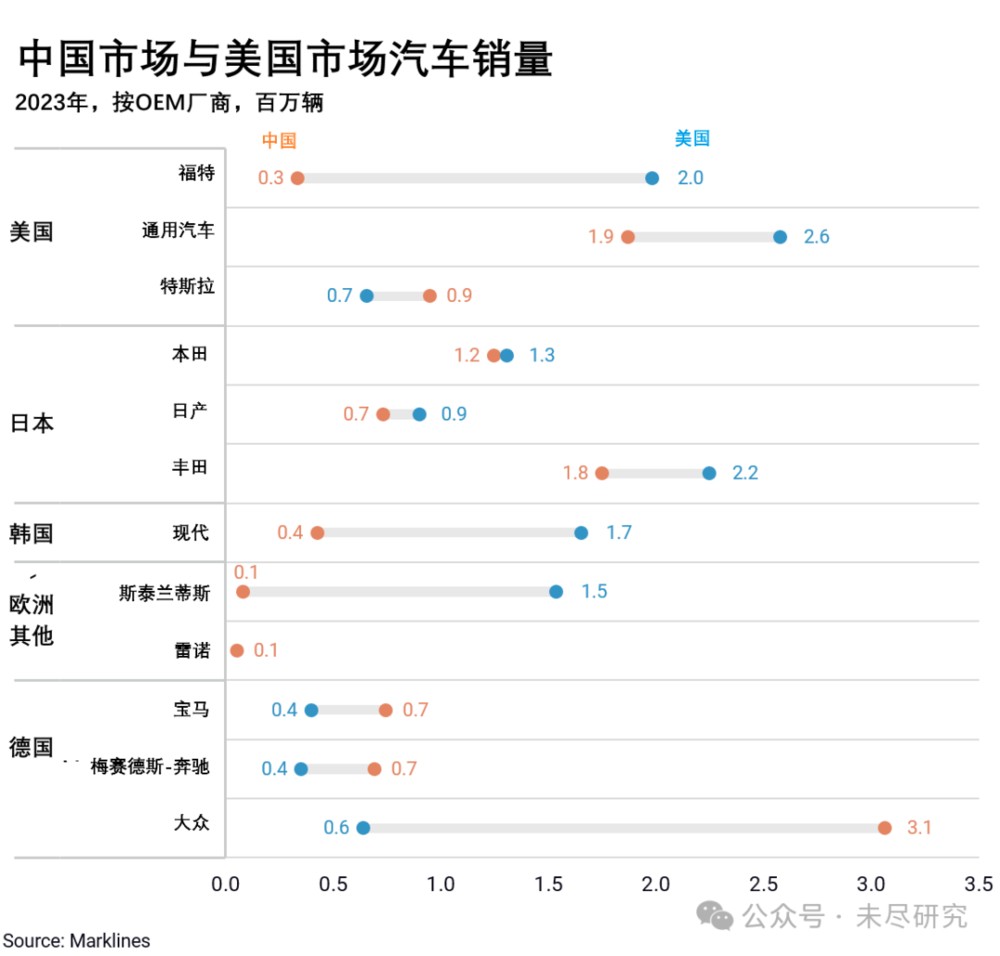
Rongding Group believes that Japanese and Korean car companies are relatively easier to deal with, as the interests of European car companies in China are too significant, especially for German car companies. The Chinese market for BMW and Mercedes is even larger than the U.S. market, especially Volkswagen, whose sales in China are already five times that of the U.S., which often puts it at odds with the U.S. government on supply chain issues.

Volkswagen's Chinese subsidiary under CARIAD, which advocates the concept of "In China, For China, From China to the World," and the plan to serve the global market with a shared software stack between European and Chinese teams, has been impacted by the U.S. "Connected Car Ban." In fact, this refers to the joint venture Coolray established by Volkswagen Group and Horizon, which has just gone public. Han Hongming, former CTO of Volkswagen China, is currently the CEO of Coolray.

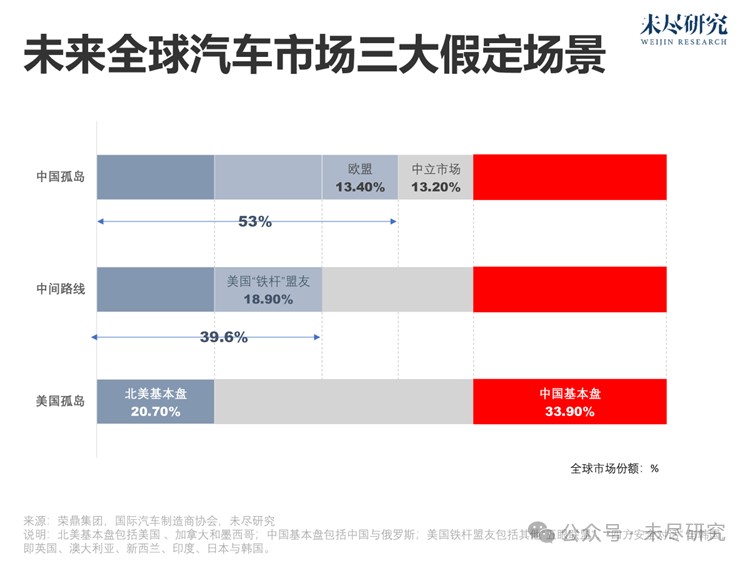
In the future, global car companies will mainly reshape their supply chains around the two major markets of China and the United States: either exclude Chinese manufacturers from the global supply chain and establish a technology and trade alliance focused on connected cars that does not include China, or utilize cost-effective and potentially more competitive Chinese technology to expand into non-U.S. markets.

Therefore, the attitude of partners, especially the position of the European Union, is crucial for the United States. If the ban on "Connected Cars" can only be implemented in North America, then the supply chain model of "In the U.S., For the U.S." will ultimately only cover 21% of the global market, which is its base in North America; while the supply chain model of "In China, For China" includes the 34% base in China and Russia.

Rongding Group believes that once partners have the ability or willingness to choose neutrality, due to economies of scale, as well as factors such as industrial competitiveness, the United States will find it difficult to compete with China in the 45% free market beyond the basic market shares of both sides. In the worst case scenario, the North American market may not necessarily become an isolated "island" in globalization, where markets outside North America choose to further strengthen the more cost-effective Chinese supply chain. Two years ago, Japan was still the largest car exporter, followed by Germany, with greater global market influence than U.S. car companies; in terms of market size, the U.S. is also not as large as China. The automotive industry is far more important to the EU and Japanese economies than the U.S., so why must they follow the "Connected Car Ban" pushed by the U.S.? The ban may be limited to North America.

Such judgments have their basis in reality. On one hand, apart from Tesla's vertical self-research, there is currently no mature "In the U.S., For the U.S." model. This week, Qualcomm released two new automotive chips, one for smart cockpits and one for autonomous driving, and chose to collaborate with its long-term partner Google in the smartphone field, but for now, it remains at the level of enhancing user experience in smart cockpits; the market believes that Google is not satisfied with just Android Auto and is venturing into mass-produced smart driving cars, as it also possesses leading advanced autonomous driving technology.

Chinese smart driving solution providers are going global with vehicle brands, partnering with global tier1 giants. Horizon's prospectus states that it has in-depth cooperation with companies such as Infineon, Bosch, Denso, Continental, and ZF Volkswagen is not only partnering with Horizon Robotics, but also intensifying cooperation with Momenta and XPeng. When considering batteries, cars tied to the Chinese supply chain have a competitive advantage even when exported to markets with high tariff protection or produced locally.

Therefore, the EU's choice may determine the global automotive market landscape. Unlike the United States, the EU tends to use conditional trade defense measures to attract Chinese supply chains or technology patents into Europe. Imposing relatively mild tariffs on electric cars exported from China can attract greenfield investments from Chinese automakers. However, if negotiations break down and a car trade war erupts between China and the EU, or if both sides subsequently open more aggressive toolboxes, the United States' ban on Chinese connected vehicles will soon follow. The EU's decision to follow the United States or seek more compatible policies will be a major variable.

Companies heavily reliant on the Chinese market, such as German, Japanese, and American automakers like General Motors and Tesla, may have to resort to dual supply chains from China and the United States, respectively, to enter markets outside of China and the United States