


Luxury consumption cools down overall, and Hermès is no exception

Luxury consumption as a whole has cooled down, with Hermès' third-quarter financial report showing a revenue growth of 11.3% to 3.7 billion euros, slightly higher than expected but with a significantly slower growth rate. In comparison, both LVMH and Kering Group saw a decline in revenue, especially Kering's Gucci brand with a sharp 25% drop in revenue. Hermès' CFO pointed out that despite the downturn in the Chinese market, high spending by loyal customers offset the impact of low foot traffic
The luxury goods business will become increasingly challenging.
According to the fashion business newsletter, French luxury goods group Hermès released its third-quarter financial report yesterday before the market opened. Revenue increased by 11.3% to 3.7 billion euros when calculated at a fixed exchange rate, slightly higher than analysts' expectations of 11%. Revenue for the first three quarters increased by 14% to 11.2 billion euros when calculated at a fixed exchange rate.
This performance, whether compared to the 13.3% in the second quarter, the 15.6% in the same period last year, or the 32.5% in the same period in 2022, has clearly slowed down, but still outperformed its peers.
LVMH, which released its financial report last week, saw a 3% decline in organic revenue to 19.07 billion euros in the third quarter. The core fashion and leather goods department recorded a sales decline for the first time since 2020, with a sharp 5% drop in sales in the third quarter, well below analysts' expectations.
Kering, which released its financial report yesterday, saw a 12% decline in revenue for the first nine months to 12.8 billion euros, with third-quarter revenue plummeting by 15% to 3.8 billion euros, a 16% decline on a comparable basis, falling short of analysts' expectations. The core brand Gucci, which accounts for half of Kering's revenue, saw a 25% drop in revenue to 1.64 billion euros in the third quarter.
Hermès CFO Eric Du Halgouet bluntly stated at the analyst meeting after the financial report that if there was anything that surprised the company in the past few quarters, it was Hermès' resilience, especially in the Chinese market, which stood in stark contrast to other brands in the industry.
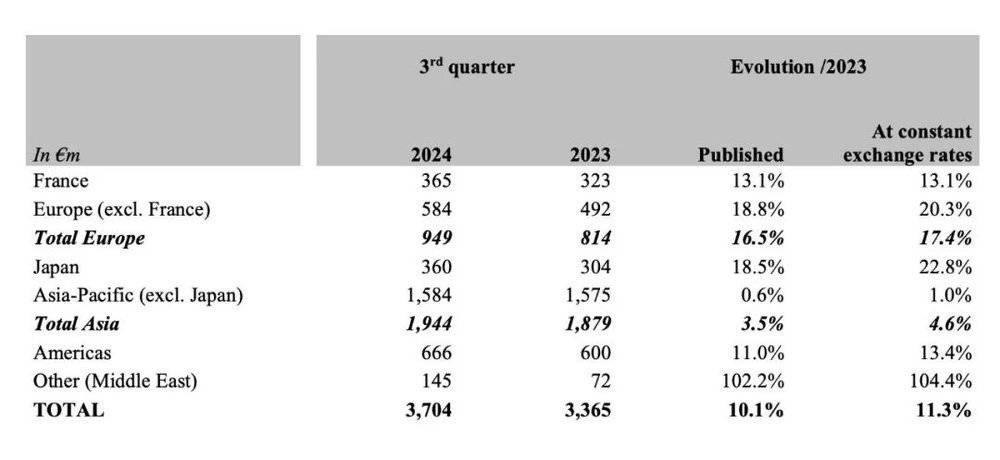
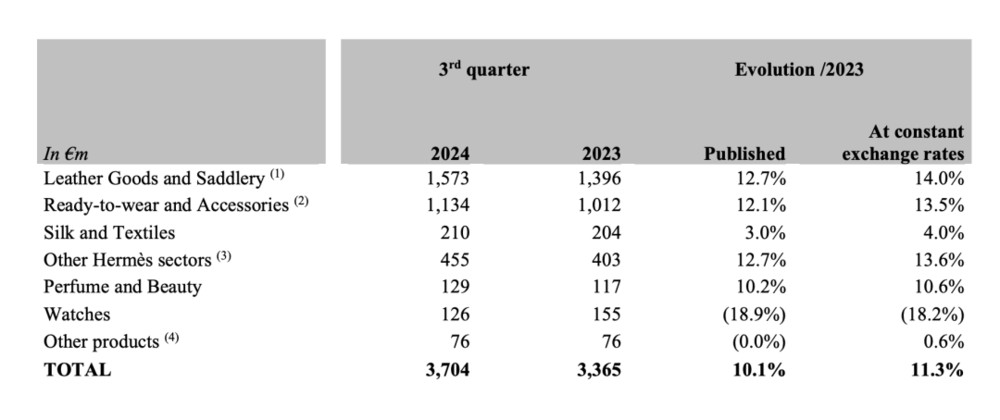
Detailed data on Hermès' third-quarter performance by region and department
However, the data shows a significant decline in performance in the Chinese market. By region, the Asian market, including China but excluding Japan, performed the worst, with only 1% growth to 1.584 billion euros when calculated at a fixed exchange rate, with South Korea, Singapore, Australia, and Thailand showing relatively outstanding performance.
Despite a significant decline in offline foot traffic in the Chinese market since the end of the Spring Festival, the group emphasized that the downward trend in foot traffic ended at the end of the second quarter and has been maintained since then. The negative impact of low foot traffic has been offset by higher average spending per loyal customer, so despite the high base in the third quarter of last year, the Chinese market still ensured positive growth.
The Japanese market surged by 23% to 380 million euros during the period, maintaining strong momentum. Hermès management emphasized that sales contributed by foreign tourists in the Japanese market are less than 10%, mainly driven by local customers Except for the French market, the European market surged by 20% to 584 million euros, mainly benefiting from steady local consumer demand and continuous growth in tourist traffic from regions such as the Middle East and the United States. The French market recorded a 13% growth to 365 million euros, despite a slight decrease in local store traffic during the Olympics, while the Americas market rose by 13% to 666 million euros, with growth rates similar to the previous two quarters.
By department, sales in the leather goods and saddlery department where Hermès Birkin bags are located increased by 14% to 1.573 billion euros at fixed exchange rates, the ready-to-wear and accessories department rose by 13.5% to 1.134 billion euros in the third quarter, other departments of Hermès covering jewelry and home goods saw a revenue increase of 13.6% to 455 million euros, and the perfume and beauty department increased by 10.6% to 129 million euros.
The silk and textile department, which performed relatively poorly, only saw a 4% increase to 200 million euros, while the watch department plummeted by 18% to 126 million euros, being the only department with negative growth.
Continuing the trend from the second quarter, Hermès once again proved in the third quarter that the sales boost from scarves, accessories, and other entry-level products is slowing down. Axel Dumas, the Executive Chairman of Hermès Group, had previously stated at an analyst meeting in the last quarter that the number of proactive consumers has decreased, especially Chinese consumers.
The new products launched in September to some extent boosted the previously lagging perfume and beauty department, including the new women's perfume Barénia designed by Christine Nagel, and the second part of the eye makeup series Le Regard, Trait Hermès.
However, the watch department is still sharply slowing down. The department had previously achieved high growth rates between 23% and 46% from 2022 to 2024, and Hermès management admitted at the meeting that the department has been somewhat affected by the overall slowdown in Swiss watch exports, prompting adjustments to watch designs as soon as possible.
Meanwhile, concerns persist in the market as small accessories like scarves are not selling well. Hermès management attributes the success of silk products to design creativity and technical know-how, and therefore will continue to invest in silk development by establishing a new production line in Pierre Beni Lyon.
It is evident that in the face of the slowdown in sales driven by entry-level products, Hermès is attempting to address this issue through product design and supply. Enhancing the attractiveness of entry-level products themselves to break away from their role as "accessories" is a development direction that management has not explicitly stated but is clear about.
This issue has now become very urgent. Although Hermès still attributes its outperformance to its unique business model, the company's reluctance to openly admit the allocation system, in fact, has begun to loosen.
According to Reuters, three consumers from California have filed a third lawsuit against the French luxury brand Hermès this month, continuing to target Hermès' controversial allocation system, alleging that Hermès forces consumers to purchase other high-priced accessories before qualifying to purchase Birkin bags, accusing the company of violating antitrust laws, engaging in false advertising, and fraudulent behavior Class action lawsuits reflect consumers' deep grievances against Hermès' distribution system.
Since the beginning of this year, luxury consumption has cooled down overall, and Hermès is also facing sales pressure. Many consumers have reported that Hermès' cash cow BKC has reduced its allocation in many markets globally this year, making it more difficult to purchase.
Although some popular color styles are still hard to obtain, compared to the situation where bags were not necessarily available before, some consumers now reveal that Hermès can negotiate allocations and purchase in-stock bags this year, showing a shift in brand attitude towards more transparency with consumers.
While this phenomenon excites many consumers who desire specific bag models, it also shakes the trust of these high-net-worth individuals in the brand's prospects and the luxury goods market. After all, Hermès' allocation is almost a barometer for the entire luxury goods market.
Different from price-sensitive consumers, Hermès' high-net-worth clients are not chasing individual items but are driven by recognition of the brand's positioning at the top of the pyramid, hence the more expensive, the more they buy. If the brand caters too much to consumers, it may lose long-term trust from this group of consumers, some of whom may quickly withdraw after obtaining their desired bags, bringing uncertainty to Hermès' future performance.
Hermès management emphasizes that the growth in brand customer spending to offset the impact of low customer traffic is not just happening in the Chinese market but is a global trend. Therefore, the question lies in how deep Hermès can dig into the wallets of loyal customers, a task that will only become increasingly challenging.
For most loyal customers, they already own more than one BKC bag most of the time. Convincing these consumers to purchase more bags is actually more difficult than persuading new users who do not yet own a platinum bag to buy their first one.
In addition, there is a certain gap between the brand's definition of loyal customers and its understanding of consumers. Not all loyal customers can follow Hermès for the long term, especially when other brands are vigorously competing for VIC core customers by providing more unique service experiences.
In this Hermès class action lawsuit, one plaintiff claims to have spent tens of thousands of dollars on products at Hermès and owns more than one platinum bag. However, when she inquired about another platinum bag at a store in 2022, she was told that the product is only sold to "customers who have always supported our business."
Therefore, although Hermès has its distribution system as a safety net for performance, its next task is still to return to developing diverse consumer demands and enhancing the appeal of non-bag products. This task is fundamentally no different from that of other luxury brands.
Treating other categories of non-bag products as allocations actually diminishes the importance of these categories by the brand itself. For example, the jewelry and watch series that the brand is vigorously developing have the potential to become Hermès' second growth curve, but many Xiaohongshu users believe they are not worth investing in, partly because these categories are seen as allocations for bag purchases.
How to optimize the appeal of ready-to-wear, jewelry, and watch categories to consumers, rather than forcing them to buy products they do not appreciate, is a problem that even Hermès, at the pinnacle of the luxury industry pyramid, has not solved In a period when platinum bags can easily drive business, Hermès may not need to worry about these issues, but as more loyal consumers familiar with the brand settle in, their demands for the brand will become more stringent.
For example, its ready-to-wear category has not made appropriate size adjustments for local consumers, especially in key Asian markets. In addition, even as the quiet luxury trend becomes the driving force behind Hermès' ready-to-wear collection, the brand, despite having a creative director and seasonal fashion show releases, has lagged behind in the competition of the past high fashion market compared to brands like The Row, Brunello Cucinelli, and Loro Piana.
Under the pressure to maintain the core position of handbags and expand into multiple categories, Hermès is also increasing production capacity and expanding its sales network according to plan.
The group's twenty-third leather goods workshop in Riom, France, opened in September to continue to increase production capacity. Incomplete statistics show that Hermès has opened new stores this year, including the Le Jardin store in Hong Kong opened in June, the Collins Street store in Melbourne opened in August, the renovated and expanded MixC Shenzhen Bay store opened in October, the Azabu Tajima and Ginza Mitsukoshi new stores opened in Japan in February and June, and the new Princeton store opened in New Jersey in April.
These measures will bring higher operating costs, and the market is closely watching whether the issue of overcapacity will arise for Hermès. According to Le Monde, a factory that collaborates with LV has been reducing production hours over the past few months, with production capacity reduced by up to 20%, and factory employee representatives have been asked by management to take leave.
With enhanced production capacity, inventory management will become an important challenge for Hermès. Regardless of the large secondary market, the growing sales network will test Hermès' control over inventory levels. This year, the brand experienced fluctuations in inventory during the Chinese New Year and in June, but management stated that inventory has now stabilized.
At the same time, Hermès management stated that this year's marketing budget reached 650 million euros, with no budget cuts in any region. In order to enhance the appeal of non-handbag products and showcase the comprehensive world of the Hermès brand, the group clearly needs to continue to strengthen its market communication.
There are indications that Hermès is trying to strengthen its brand image marketing in the Chinese market, including hosting the "Hermès, Gallop into Fantasy" fantasy theater in Shanghai last November, and the 2024 Summer Men's Collection fashion show in April this year.
So far, the act of purchasing non-handbag products purely for the appreciation of Hermès' design aesthetics is still considered puzzling in discussions on domestic social media, indicating that Hermès still has a long way to go in brand communication in this important market in China.
Of course, Hermès also has a card to raise prices, but after a 9% increase earlier this year, consumers' collective resentment towards luxury price hikes has reached its peak. The group expects the routine price increase early next year to be lower than this figure The secret of Hermès lies in its refusal to cater to the masses, instead opting for scarcity and maintaining high product quality. However, faced with shrinking wallets and an unreasonable distribution system, Hermès, with a PE ratio as high as 50 times, has no reason to be as carefree as before
