


HashKey Jeffrey: PayFi Track Panorama Interpretation - Full of Challenges, Huge Potential

Jeffrey Ding, Chief Analyst of HashKey Group, discussed the potential and challenges of PayFi (Payment Finance) at the SmartCon conference. As a new concept in the Web3 field, PayFi aims to improve capital turnover efficiency and address old issues in traditional finance. Compliance and risk management are key to the success of the project, and choosing compliant partners is crucial. With the gradual advancement of regulatory compliance, PayFi projects are expected to usher in broad development opportunities
HashKey Group Chief Analyst Jeffrey Ding
Recently, the highly anticipated SmartCon conference is being held in Hong Kong, where Dr. Xiao Feng, Chairman and CEO of HashKey Group, will deliver a keynote speech on the global payment new network for compliant stablecoins on the Main Stage. As a leading figure in Web3, his focus on payments is undoubtedly exciting, which not only signifies the vast space of the Web3 payment industry but may also hint at an imminent explosion in Web3 payments.
The prospects are broad, but challenges are numerous; this is the true portrayal of PayFi at present.
Compliance and high-level risk management are necessary conditions that determine whether a project can have long-term viability. From a long-term perspective, we need to see the positive development of current regulatory compliance, with the path to compliance gradually accelerating. For a PayFi project, in addition to innovative gameplay and strengthening risk management, selecting partners with compliant licenses is of utmost importance, whether it be stablecoins or exchanges. Once a synergy is formed, it undoubtedly opens up vast opportunities.
1. PayFi is a new concept, but it addresses an old problem
1. The efficiency of capital turnover is the core of the time value of money
PayFi (Payment Finance) is a unique concept in the Web3 field, first proposed by Lily Liu, Chair of the Solana Foundation, defined as a new financial market built around the time value of money.
In the above definition, the concept of the time value of money is relatively abstract. In simple terms, the time value of money means that money has different values at different time periods. From an economic perspective, without considering inflation, the increase in money value comes from the value appreciation brought about by the transfer of the right to use money/capital. To put it more simply, if you invest, manage, or lend 1 dollar today, at some point in the future, you will earn more money, and the money you earn is directly determined by the turnover efficiency, cost, and returns of that 1 dollar.
The next question arises: does this time value of money not exist in Web2, or are there unmet needs? The answer is clearly negative. So why is there a need for Web3 to transform payments? The conclusion can only be that the time value of money in Web2 has been greatly weakened, which involves both rising costs and declining returns, as well as a low level of convenience in accessing services.
Having understood the above scenario, we can provide a more detailed description of PayFi. PayFi **is an innovative financial market based on payment settlement scenarios, aimed at improving capital turnover efficiency, cost, and returns through blockchain technology. It is worth noting that while there are many scenarios that can enhance the time value of money,PayFi focuses more on payments and settlements rather than financial transactions, with its main enhancement of time value lying in shorter capital settlement times and faster turnover efficiency **
2 、 RWA demand may not be rigid, but PayFi is more urgent
If there is a widely recognized and enduring mainstream narrative in the Web3 industry, it is undoubtedly the key proposition of mass adoption. The RWA track is a key direction born under this narrative, while PayFi, from a broader perspective, belongs to the RWA track, as both fundamentally involve the interaction between the blockchain world and the real physical world, albeit with different modes of interaction.
The core definition of RWA is the on-chain representation of real-world assets, tokenizing/NFTing tangible real assets to enable trading on-chain, focusing on the trading of real assets on-chain and providing higher liquidity for real assets; PayFi focuses on the speed of transactions between real assets and the unmet financial needs that can be realized through blockchain.
The distinction lies in that RWA demand may not be rigid; it somewhat provides more revenue / funding sources for the blockchain world; PayFi demand is completely rigid, as it provides more revenue / funding sources for the real world. Of course, it is important to note that from the perspective of revenue enhancement, both RWA and PayFi are not one-sided; the following table is more about their essential functions.
Chart: Similarities and Differences between RWA and PayFi

Source: Self-organized
Comparing and juxtaposing RWA and PayFi, the more core consideration is: under the grand narrative of mass adoption, why is there a need for a new narrative of PayFi rather than a simple extension of the RWA concept, and why has it garnered such high attention.
The comparison of the two may provide part of the explanation: one is the migration from the real world to the blockchain world, while the other is the integration of the blockchain world into the real world. Both serve similar purposes, but from the demand perspective, the latter undoubtedly has a more urgent relevance to the real world. However, the high attention on PayFi is not only due to the urgency of the real world but also the bottlenecks within the blockchain world itself. In addition, from the operation of the blockchain world itself, whether it is second-level payment settlement or using smart contracts and on-chain DeFi liquidity pools to support the real world, the greatest time value behind it lies in improving the turnover efficiency of currency operations.
3. The development bottleneck of blockchain calls for a new narrative with real scenarios, and the upper limit of PayFi is extremely high
From the perspective of the blockchain world, the exhaustion of narratives is an undeniable fact in the current blockchain world. The phenomenon of liquidity fragmentation is almost becoming more and more severe, accompanied by the false prosperity of project data. After the Token Generation Event (TGE) of most projects, user data nearly declines linearly, along with a significant drop in token prices. This phenomenon positively reflects the rapid development of the blockchain world under capital support and gradual compliance, while negatively reflects that many current projects lack real demand scenarios, mostly being nested projects with extremely weak self-sustaining capabilities. Without capital support, they are almost “ dead on arrival .”
From the real world perspective, in an increasingly complex geopolitical environment, the increasingly cumbersome international payment and settlement system not only faces the long-standing issue of inefficiency but also suffers from doubts about neutrality and equality. Russia's exclusion from the SWIFT system is undoubtedly a precedent, but it is far from the last case. Moreover, the oligopolization and inequality in finance are rampant, and worse, this phenomenon is still intensifying.
It is hard to say that blockchain can perfectly solve the problems of the real world, and blockchain itself is also facing development bottlenecks, but it is at least one of the most likely paths at present. Whether it is Web2 giants or Web3 leaders, they undoubtedly do not want to miss the opportunity to bet on this track, such as BlackRock, JD.com, Coinbase, A16z, Sequoia, SoftBank, etc. More importantly, for the massive capital of these giants, they are less attracted by short-term limited wealth effects and pay more attention to long-term incremental space. This is also the core reason why both RWA and PayFi can attract large amounts of capital.
II. The PayFi ecosystem is taking shape, from stablecoins to exchanges, compliance is the basis for cooperation
A broader ecosystem relies on compliant partners
As analyzed earlier, the PayFi track is about leveraging the massive real-world assets in the blockchain world. In this track scenario, if one simply analyzes individual PayFi projects, it is undoubtedly a case of losing sight of the bigger picture. What is needed is to see how to form a broader synergy in such a blockchain ecosystem to create a new financial paradigm.
Chart: PayFi Ecosystem Overview
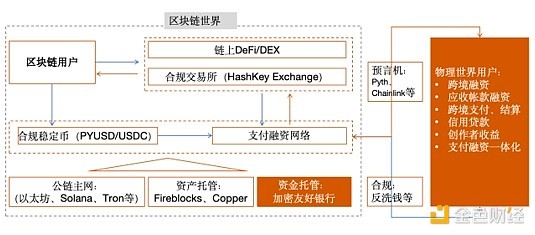 Source: Self-organized
As shown in the above diagram, the interaction between the blockchain world and the real world is not limited to the PayFi project itself; rather, PayFi serves merely as an entry and exit point. However, from the project logic of PayFi itself, it connects the capital pool of the blockchain world with the financial needs of the off-chain world, and this connection requires the integration of multiple forces.
The primary factor is that operations must be conducted in a relatively relaxed regulatory environment and in crypto-friendly cities. For example, the recently popular Huma Finance is located in San Francisco, where the early compliant exchange Kraken is also based, as well as the current situation in Hong Kong.
Secondly, the main partners currently focus on large licensed institutions that can provide a full suite of deposit and withdrawal services, liquidity provision, and compliant services for decentralized infrastructure. In fact, from this perspective, this is one of the high barriers and growth obstacles for PayFi at present.
Taking Hong Kong as an example, there are not many physical companies with certain financial strength that can provide a compliant regulatory framework for infrastructure, deposits and withdrawals, liquidity, and KYC, with only a few licensed regulatory institutions, such as HashKey Exchange, the largest licensed virtual asset exchange in Hong Kong.
As the largest licensed virtual asset exchange in Hong Kong, HashKey Exchange has entered the global TOP 10 exchanges, making it the best partner for PayFi projects. Currently, its trading volume has surpassed HKD 538 billion, and its asset accumulation has exceeded HKD 5 billion. According to the latest data from Coingecko, HashKey Exchange ranks 8th among global exchanges and is the highest-ranked licensed virtual asset exchange in Hong Kong. The benefit of collaborating with such compliant institutions lies in the breadth and depth of cooperation and the reduced difficulty of coordination, which is more conducive to the rapid establishment of projects and the expansion of visibility. Otherwise, it would require finding different partners at various stages, which, in a sense, increases the operational costs of the project.
1.1 The prototype of the track has emerged, and the future is promising
RWA is a major hotspot in this cycle, but the PayFi concept was only proposed in July of this year. It gained widespread attention under the heat of the leading project Huma Finance, which raised USD 38 million in September. In less than three months, it has become a hot and highly regarded new concept and narrative in the industry, gathering top venture capital firms, compliant exchanges, and public chain funds such as Distributed Global, HashKey Capital, and Stellar Development Foundation.
At this year's Token2049 in Singapore, the PayFi Summit showcased 12 projects in the PayFi track and the corresponding underlying modular Stack technology stack, aiming to further lower the development threshold for projects From a compliance perspective, the payment business currently has different regulatory frameworks in different regions, such as the TCSP and MSO in Hong Kong; the DPT in Singapore; and the VARA license in Dubai, all of which are regulatory frameworks that must be considered for projects entering the payment sector.
Overall, the current scale and enthusiasm of the sector cannot yet be considered mainstream; however, in the context of a lack of new narratives in the industry, the high level of attention given by the industry indirectly proves the recognition of this direction. At least under the current influence, the prototype of the sector has already taken shape, and it remains promising for the future.
1.2 Three Major Challenges of PayFi: Compliance is the Foundation for Development, Risk Control is the Guarantee for Development, and Lowering the Threshold is the Leverage for Development
Looking ahead, the most pressing issue for the development of PayFi is overcoming regulatory compliance, followed by how to manage processes that connect on-chain and off-chain scenarios, involving the following main challenges.
Challenge 1: Compliance Management of the Entire Chain. From a risk perspective, if on-chain compliance risks spread to off-chain, it could deal a fatal blow to the project. Therefore, using compliant stablecoins is just the first step; in the long run, current stablecoins are all pegged to the US dollar, and during large-scale promotion, they may face foreign exchange control risks between countries, such as South Korea's recent plans to introduce relevant regulations. Additionally, compliance in the deposit and withdrawal stages and liquidity provision plays a decisive role in the success or failure of the project, which is why collaboration with compliant exchanges like HashKey Exchange is necessary.
Challenge 2: Increased Difficulty in Managing Technical, Security, and Credit Risks. If the business model occurs purely on-chain, technical risks are relatively concentrated. The business model of PayFi determines that its technical risks exist not only in on-chain hacking attacks but also in off-chain performance verification risks. Furthermore, whether based on accounts receivable or trade, a large amount of online and offline data cross-verification is required, and without on-site offline research, this actually raises higher demands for credit risk management capabilities.
Challenge 3: User Entry Barriers Remain High. From the current PayFi projects, due to regulatory compliance considerations, the KYC and investment thresholds for users are not very suitable for widespread retail participation, being more appropriate for institutional/high-net-worth individuals. However, from a business logic perspective, institutional business is easier to develop and relatively simple in model. Still, if large-scale promotion is to follow, user thresholds remain one of the barriers.
Recommendations and Prospects: Focus on Compliance, Multi-Party Cooperation, Innovative Approaches, and Great Potential
From the perspective of PayFi's development, it is currently still in a one-way financing solution stage, seeking blockchain financing for real physical scenarios. If further developed, it could evolve into an integrated payment financing business, or a comprehensive form of PayFi + DeFi + RWA, which would expand funding sources while increasing yield sources from on-chain DeFi or exchange wealth management products. On the other hand, it also seeks breakthrough solutions for the massive financial turnover needs of offline assets Chart: PayFi Business Innovation Scenarios

Source: Self-organized
As shown in the figure above, the current PayFi capital pool does not directly come from DeFi and exchanges, but more from the capital pools built by the projects themselves. However, for underlying assets, the source of funds is irrelevant under compliant capital, especially considering the current market's liquidity fragmentation. Cooperation with DeFi protocols and compliant exchanges can be considered to fully integrate the liquidity of the blockchain world. On one hand, this can design more products with various capital risk attributes and terms, while also achieving integrated payment financing. In other words, utilizing the high efficiency of blockchain payment settlement combined with on-chain yields can seamlessly realize integrated payment financing. Essentially, the income obtained by users through LP can be used as collateral to instantly receive credit advances from the PayFi platform, which can be directly used for offline consumption.
Moreover, for centralized compliant exchanges and DeFi protocols, there is an effective means to retain user funds. One possible scenario is: for example, User A deposits and withdraws funds through HashKey Exchange. After investing in BTC and earning returns, they can invest BTC or compliant stablecoins like USDC into the exchange's wealth management products, where the underlying assets of the wealth management product are PayFi's financing projects, to earn stable returns. These returns can also be directly used for offline payments through PayFi.
In summary, from the perspective of PayFi's own development, there are many ways to combine with the blockchain world. The time value of money can be fully utilized for innovation through the efficiency of blockchain, and the shortened time can not only improve turnover efficiency but also facilitate the formation of integrated products for payment, financing, and settlement.
According to incomplete statistics, the entire payment sector, including credit cards, trade financing, and cross-border payments, has a market exceeding USD 40 trillion, while PayFi is currently only expanding into the long-tail market that traditional finance has overlooked.
Considering the increasingly compliant blockchain world, the scale of PayFi alone is roughly estimated to exceed a trillion. In the foreseeable future, if barriers to deposits and withdrawals are removed, online and offline integration deepens, and compliance accelerates, perhaps the highway from the Web2 world to the Web3 world will be truly connected, and PayFi may be the key turning point for Web3 to achieve mass adoption.
Source: Jinse Finance
