What does the investigation of the President of AstraZeneca China mean?

Huxiu
2024.11.02 07:43
portai
I'm PortAI, I can summarize articles.

AstraZeneca China President Wang Lei is under investigation, an event that has attracted widespread attention in the pharmaceutical industry. Wang Lei is the company's global vice president and has led the Chinese team to significant performance improvements. This investigation may be related to insurance fraud, marking an increase in China's anti-corruption efforts in the pharmaceutical industry, presenting new challenges for multinational pharmaceutical companies. Historically, the arrest of GSK executives triggered a storm of anti-corruption in the pharmaceutical sector, and this incident may influence the industry's direction

Eleven years ago, several senior executives of GSK China were suddenly arrested, exposing the corruption in China's pharmaceutical industry. Is history about to repeat itself?

On the last day of October, the news that "AstraZeneca China's president is under investigation" went viral in the pharmaceutical circle and sparked much discussion outside the industry.

According to AstraZeneca China's official website, the executive under investigation in China is not only the president of the company's China region but also the global executive vice president and chairman of international business. This is almost the "ceiling" for Chinese individuals working in multinational pharmaceutical companies.

This also means that, although the industry believes that Wang Lei's investigation is not a major issue, it is certainly not simple.

In fact, for a long time in China, multinational pharmaceutical companies enjoyed "super national treatment," receiving preferential treatment in pricing, taxation, and other aspects. However, with the rise of domestic pharmaceutical companies in recent years, the implementation of new policies such as centralized procurement and national negotiations, and the escalation of anti-corruption efforts, multinational pharmaceutical companies have lost their "privileges" and have been caught in the spotlight.

Despite this, it is still rare for senior executives of multinational pharmaceutical companies to be investigated.

Especially since AstraZeneca is known for being "the most knowledgeable about China," and Wang Lei is a well-known executive in the industry for his "iron-fisted" approach. He reached the position of president of the China region within just one year of joining AstraZeneca, and later led the Chinese team to significant performance increases, enhancing his status at headquarters and increasing his influence.

The last time four Chinese executives from the multinational pharmaceutical giant GlaxoSmithKline were arrested for suspected commercial bribery, it exposed the gray profit transfer chain in China's pharmaceutical industry and set off a series of anti-corruption storms in the sector. How will this incident affect the future of China's pharmaceutical industry?

Regarding the reasons for Wang Lei's investigation, AstraZeneca China did not provide further details, with a relevant person telling Huxiu: "Please refer to the official announcement on the website."

However, the industry generally believes that insurance fraud is the real reason. With this incident as a starting point, at least China's crackdown on insurance fraud will reach a new height, and the pharmaceutical market environment will inevitably face a new round of turbulence.

Will holding companies accountable become the focus of the crackdown on insurance fraud?

"It may finally be time to lay all the cards on the table," a legal professional told Huxiu.

Before AstraZeneca China's senior executives were officially brought to the forefront, many employees and former employees of the company, from frontline sales to sales directors, were under investigation and even faced criminal penalties.

From publicly available information, these cases occurred between 2019 and 2021, with investigations continuing from 2021 to the present. Many cases were adjudicated in the first half of this year, involving multiple regions including Fujian, Chongqing, Hubei, Zhejiang, Jiangsu, Jilin, Qinghai, Jiangxi, and Sichuan.

The products involved are AstraZeneca's flagship lung cancer targeted drug, Tagrisso. These types of drugs are expensive and widely used, and insurance fraud cases severely erode the medical insurance fund. According to publicly available criminal judgments and rulings from some regional courts, cases involving two or three individuals can cause losses of around 200,000 yuan to the medical insurance fund within a year or a few months Despite the sales representatives returning the defrauded funds and illegal gains, and being sentenced to prison, the pharmaceutical companies that benefited the most from such actions remain unscathed.

It is important to note that AstraZeneca has been deeply rooted in the Chinese market for 31 years, with a total workforce of over 16,000 employees. Previous reports indicated that due to its strategy of penetrating grassroots levels, the company once had teams covering 1,850 counties across 28 provinces. At the same time, there were also hundreds of sales outlets at the city level.

If this is a case of collusion, the amount involved could very likely exceed hundreds of millions or even billions. “Simply arresting individuals will not recover the losses to the medical insurance fund; the companies must also bear the costs, and it is only a matter of time before senior executives are asked to cooperate with the investigation,” a legal expert told Huxiu.

It is certain that moving forward, companies that previously benefited from insurance fraud must be cautious.

Is the case gradually becoming clearer?

Regardless of the outcomes for the relevant companies and personnel, and the truth of the matter still awaiting further official investigation, an increasing amount of public information has begun to piece together parts of the insurance fraud case involving AstraZeneca.

For pharmaceutical employees, the crackdown on insurance fraud is much harsher than anti-corruption efforts. In the early stages of anti-corruption, most pharmaceutical representatives were exempt from prosecution, whereas in the crackdown on insurance fraud, many employees who only benefited from bonuses of a few hundred or thousand yuan have faced criminal penalties. Under such high pressure, the scope of the investigation into AstraZeneca's insurance fraud in China has been continuously expanding over the past few years.

After the Shenzhen medical insurance department first discovered that AstraZeneca employees were suspected of insurance fraud in 2021, the investigation extended from frontline employees to top management, and by September of this year, a regional director had been investigated and even sentenced. Recently, major media outlets reported that Yin Min, the Chief Business Officer of BeiGene in Greater China, who has been taken away for investigation, previously served as the General Manager of the Oncology Division at AstraZeneca China.

As the investigation deepens, more relevant parties are coming into the public eye.

On October 26, several executives from Shanghai Ruian Gene were subjected to compulsory measures by public security authorities for suspected illegal business operations, including the company's actual controller, chairman, and general manager Xiong Hui, and the actual controller, director, and deputy general manager Xiong Jun, among others. The deputy general manager Xue Yuwei also previously worked at AstraZeneca.

More importantly, AstraZeneca is one of the important clients of this company.

In the annual report of Shanghai Ruian Gene, the company specifically mentioned that its PCR platform T790M provides tumor peripheral blood enrichment testing for AstraZeneca and several other companies, stating that “the detection rate is about twice that of other evaluation competitors.” They also have deep cooperation with AstraZeneca in the field of EGFR-T790M liquid biopsy, forming a “T790M model.”

“T790M” is also a key element of the insurance fraud. According to the details of the fraud revealed in the aforementioned criminal judgment and ruling: when patients wanted to buy Tagrisso, AstraZeneca would find a third-party medical laboratory with which it had a cooperative relationship to provide free genetic testing for the patients.

Because at the beginning of entering the medical insurance catalog, according to the indications, the medical insurance required that only patients who had failed first-line treatment and were positive for the T790M gene mutation could enjoy medical insurance benefits Without medical insurance reimbursement, the price per box is over ten thousand yuan higher. Medical representatives are worried that patients will give up buying the medication; once the test result is negative for the T790M gene mutation, they will alter the negative result to positive using software. In some cases, their supervisors were aware and even instructed subordinates to do so.

The most aggressive strategy has fallen into a dilemma.

In 2014, the year Wang Lei was promoted to President of AstraZeneca China, AstraZeneca CEO Pascal Soriot set what seemed like an impossible goal for the next decade—by 2023, AstraZeneca's global revenue was to reach $45 billion, nearly double the actual annual revenue at that time.

A year later, the drug involved in this case, Tagrisso, was approved for listing in the United States.

As a third-generation EGFR-TKI inhibitor, Tagrisso has been well-received by patients in clinical settings. The drug was first approved in the U.S. in November 2015 and generated $423 million in sales that year. With a large number of lung cancer patients, most of whom are related to EGFR mutations, the Chinese market was also viewed positively by the industry, with insiders predicting a sales scale of 26 billion yuan for the drug in China.

Later, Tagrisso's performance confirmed this prediction. When it first entered China in 2017, its price was over 50,000 yuan, yet it still sold 500 million yuan within nine months.

In 2018, during the first national negotiation after the establishment of the National Healthcare Security Administration, the price of Tagrisso was reduced to 15,300 yuan, and if there was medical insurance reimbursement, patients only needed to pay over 5,000 yuan out of pocket.

This also sounded the horn for AstraZeneca's rapid advance in the Chinese market.

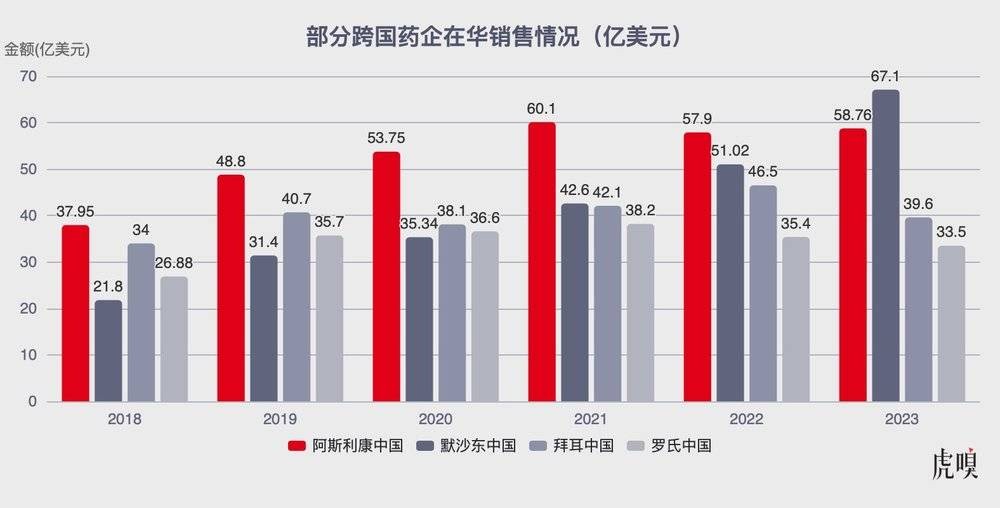
In 2019, AstraZeneca China's revenue jumped to $4.88 billion, a growth rate of 35%, far surpassing its multinational pharmaceutical peers—during the same period, other multinational pharmaceutical companies generally saw growth rates of 6% to 7%, with some even below 5%. AstraZeneca China’s sales topped the charts.

At the same time, the revenue from the China region accounted for a new high of 20% of AstraZeneca's total revenue.

Behind such achievements, Osimertinib made a significant contribution. According to data released by AstraZeneca at the time, Osimertinib's global revenue in 2019 was $3.189 billion, a year-on-year increase of 71%, with emerging markets, including China, growing at over 130%! Wang Lei himself became a legendary figure in the industry.

Data source: Public data from multinational pharmaceutical companies.

However, with the changing rules of the game in the Chinese pharmaceutical market and the rise of local pharmaceutical companies, such good days have come to an end.

As Tagrisso rapidly gained market share and AstraZeneca China's performance soared in recent years, the Chinese pharmaceutical market was also undergoing dramatic changes. Starting in 2018, centralized procurement, national healthcare negotiations, and a series of policy shifts leading to the collapse of the capital bubble in the pharmaceutical sector gradually concentrated competition among Chinese pharmaceutical companies in the fields of high-end generics and me-too drugs The market competition for EGFR-TKI inhibitors in China has become intense. There are already 5 domestic products in the third generation, namely Hansoh Pharmaceutical's Amivantamab, Elysium Pharmaceuticals' Furmonertinib, Betta Pharmaceuticals' Bafetinib, BerGenBio's Ruzasertib, and Nanjing Shenghe Pharmaceutical's Ruyatib. In addition, there are at least 7 drugs from companies like Ascentage Pharma and Johnson & Johnson that are either in research or applying for market approval.

These competitors have put pricing pressure on Tagrisso. Over the past 5 years, after several rounds of national negotiations, although its indications have expanded from second-line to first-line and postoperative adjuvant therapy, the price has also dropped to 5,580 yuan per box.

At the same time, as a "blockbuster" product—generating nearly $5.8 billion in global revenue in 2023—Tagrisso is also a key target for generics. In 2023, the first domestic generic drug was approved for market launch, produced by Jiangsu Wanbang Biopharmaceutical. In the future, as more eligible generic drugs are approved, the collective procurement price reduction for this variety will also be triggered.

More importantly, the fourth generation of EGFR-TKI inhibitors is on the way. The efficacy of EGFR-TKI inhibitors in treating eligible non-small cell lung cancer has always attracted attention, but the issue of drug resistance is also a headache. Often, when a new product that overcomes resistance issues is launched, the previous generation products lose their market advantage.

It can be seen that after the launch of Tagrisso, the market for the first two generations of drugs has sharply shrunk. This kind of iteration is also an unavoidable fate for Osimertinib. Globally, there are no fewer than 15 ongoing research projects for fourth-generation EGFR-TKI inhibitors.

For Tagrisso and AstraZeneca, the challenges mentioned above are indeed life-threatening.

What is the next ace?

Currently, the market size for third-generation EGFR-TKI inhibitors in China has long exceeded 10 billion yuan.

In fact, AstraZeneca China has already lost momentum. In 2023, Merck China surpassed AstraZeneca in sales revenue due to the strong sales of the HPV nine-valent vaccine; AstraZeneca's share of global total revenue has also dropped to 12.8%, which is less than the level in 2018.

If the insurance fraud case is indeed a "collusion case," the company may also face hefty fines—11 years ago, GSK paid 3 billion yuan just for fines related to its bribery actions in China. Additionally, if we refer to the penalties for insurance fraud against medical institutions and pharmaceutical operating units under the Social Insurance Law of the People's Republic of China, besides returning the fraudulently obtained funds, there may also be fines of 2 to 5 times the amount.

Objectively speaking, over the past 30 years, AstraZeneca has brought many new and good drugs to Chinese patients, and they actively participate in national medical insurance negotiations, making the prices of these drugs more affordable.

In the "soul bargaining" of 2019, the diabetes medication "Dapagliflozin," which was cut by 0.04 yuan due to the number "4" being considered unlucky, also came from this company. Wang Lei is also vigorously promoting AstraZeneca's localization, aiming not only to bring innovative drugs to China but also to let drugs produced in China reach the world From this perspective, AstraZeneca remains an important market player for China; for AstraZeneca, Tagrisso is still a highly valued "star product," and the Chinese market cannot be ignored—data shows that over 50% of lung cancer patients in China have EGFR mutations, significantly higher than in Europe and the United States, making them one of the main user groups for Tagrisso.

In 2023, AstraZeneca's global revenue reached $45.8 billion, fulfilling a promise made 10 years ago.

In May of this year, they announced a new revenue target, aiming to reach $80 billion by 2030, nearly doubling from 2023. This means they need to maintain a 7% growth rate each year thereafter. Breaking this down for the execution team presents a new challenge with greater pressure. What kind of trump card will they play this time?

It can be seen that in order to seek new growth points, AstraZeneca China has extended its reach into various areas such as e-commerce, internet hospitals, and chronic disease management; they are also generous in investing in new drug projects.

For more multinational pharmaceutical companies and local enterprises operating in China, as the medical insurance fund enters a tight balance era, compliance requirements are upgraded, rational drug use becomes stricter, and intelligent supervision gradually takes effect, the pressure for future performance growth will only increase. In this situation, rather than seeking new avenues, perhaps it is even more important to maintain the bottom line