


ChatGPT search? It's just okay

On October 31, OpenAI officially launched the "ChatGPT Search" feature, which is now available to ChatGPT Plus users. This feature allows users to enter search mode through a small globe icon in the chat box, providing answers that combine internet search results. Although OpenAI CEO Sam Altman praised this, some netizens believe that the feature is similar to the AI startup Perplexity and pointed out some issues with ChatGPT Search, such as inaccurate information sources
OpenAI has officially launched the search feature.
On October 31 local time, OpenAI announced the launch of "ChatGPT Search," available to ChatGPT Plus subscribers.
According to tests by Alphabet, a small globe icon has been added to the chat window for ChatGPT Plus users, which can be clicked to enter "search" mode.
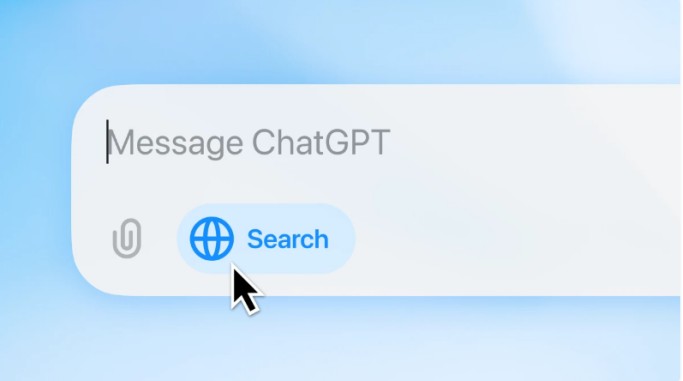
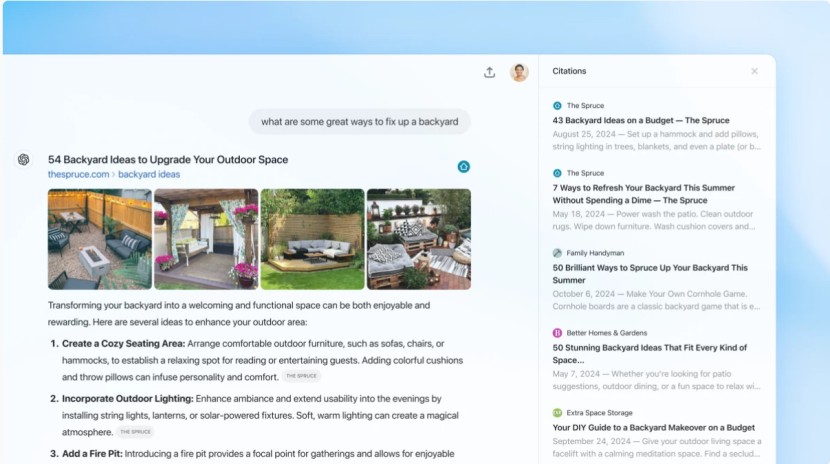
At this point, when asking questions, ChatGPT will provide integrated answers based on internet search results, along with sources.
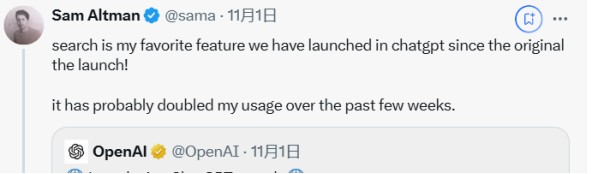
OpenAI's CEO Sam Altman praised this new feature: "This is my favorite feature since the release of ChatGPT! I have probably doubled my usage of ChatGPT in the past few weeks."
Some netizens are skeptical, bluntly stating that it is too similar to Perplexity. Perplexity launched in December 2022, just a month after ChatGPT, and is one of the hottest AI startups in Silicon Valley, recently announcing that its weekly query volume has exceeded 100 million.
Others have humorously pointed out the similarity, posting a meme in the comments section of OpenAI's announcement on X: two identical Spider-Men pointing at each other.
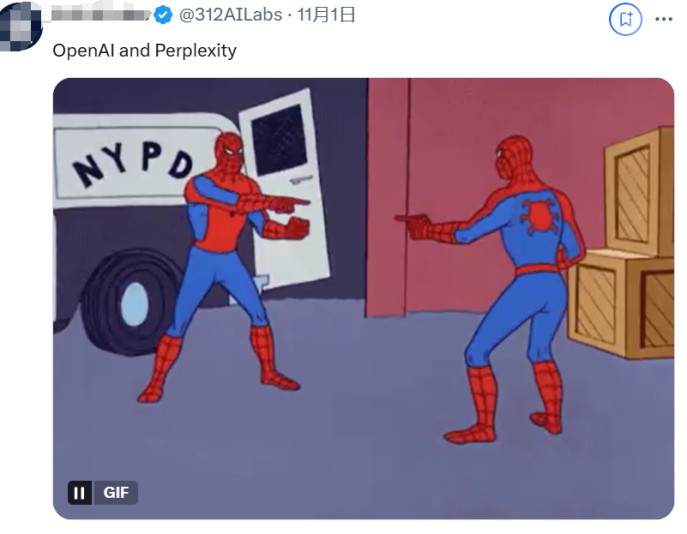
Some netizens even named the ChatGPT search feature "Bingplexity," combining Bing and Perplexity.
In fact, domestic users are not unfamiliar with this kind of AI search experience. From the demonstration of ChatGPT, it is very similar to products like Doubao, kimi, Mita Search, and Tiangong AI Ultraman also specifically added a message, recommending ChatGPT Plus users to use browser plugins to enhance their search experience. How should I put it? The Doubao and Kimi browser plugins have been used to improve web browsing experiences, including search, for quite some time now.
What's worse is that right after its launch, ChatGPT search was quickly pointed out by users for one issue after another: hallucinations are present, and some sources do not exist...
OpenAI seems to always be synonymous with "pioneering": after it released ChatGPT in November 2022, a new wave of AI enthusiasm swept the globe; when it publicly launched the text-to-video project Sora earlier this year, the field was suddenly crowded with new players.
However, when it comes to search, OpenAI appears to be late to the game. It may not be easy to carve out a share from Google.
1
To summarize the new experience of ChatGPT search, there are three keywords: natural language summary with source display, combination of text and images, and display panel.
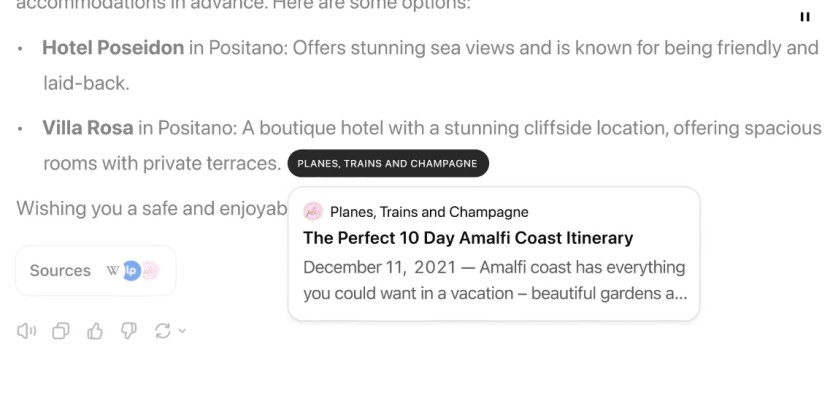
Natural language summary with source display goes without saying; this is currently the standard for AI search products. When users pose a question, the AI returns an answer written in natural language and provides information sources in a small header format. Users can click on the information sources to verify them easily.
In addition, ChatGPT's answers during searches may include images. For example, when a user asks, "Where can I go for dinner on Friday night in a certain place?" ChatGPT will provide a suggested list of restaurants, presented in text descriptions along with restaurant images, making it clear at a glance.
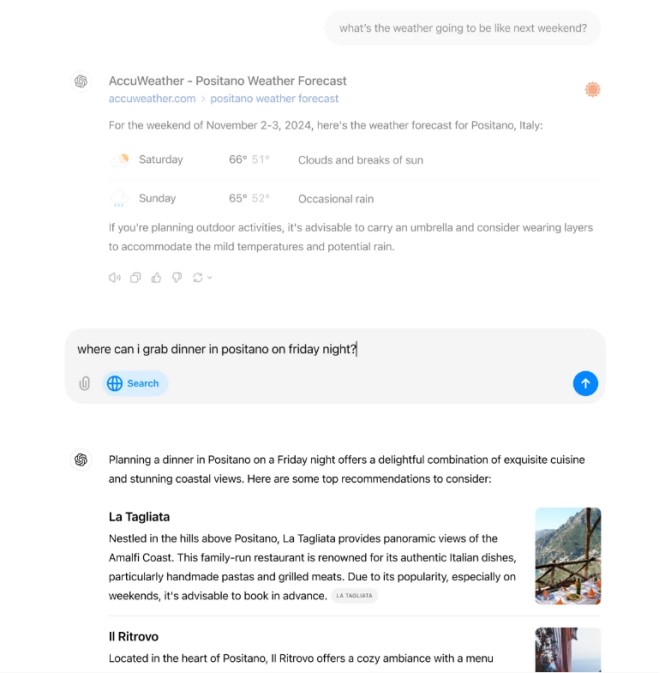
The display panel is where, when users search for information like weather, stocks, or sports events, the results returned by ChatGPT search will include an integrated panel that clearly presents the information.
From the official demonstration effects released, the experience of ChatGPT search is quite good.
However, such AI search functionality would have been stunning two years ago, but now it can only be considered mediocre.
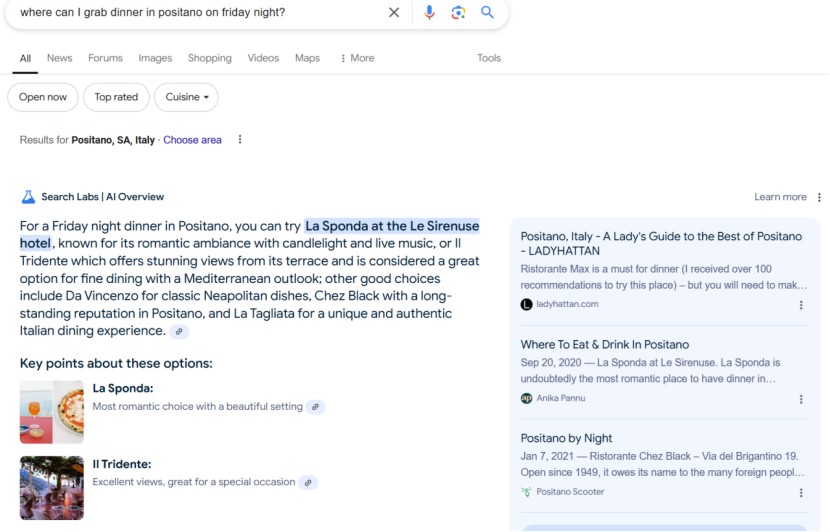
Take the search giant Google as an example. Nowadays, Google search first displays an AI summary. Using the same question from OpenAI's demonstration: "Where can I have dinner on Friday night in Positano?" entering Google search, the AI summary provides a combined text and image answer, along with source information, just like ChatGPT search
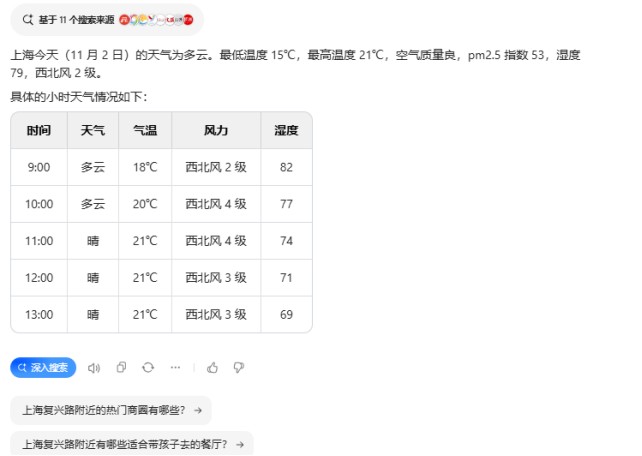
Taking ByteDance's AI product "Doubao" as an example. When logging into the Doubao web version, there is an "AI Search" entry. At this point, if you search for restaurant recommendations such as "I want to eat on Fuxing Road in Shanghai this Sunday, do you have any recommendations?", Doubao will summarize several restaurants in natural language and inform the user, providing sources of information that can be clicked to jump to. In addition, although no images are attached, some short videos of store visits are provided for reference.

When asking "What's the weather today?", you will also see a small panel integrated by AI, where the weather information is clear at a glance, although it lacks the visual design of ChatGPT.
In addition to lacking novelty, many users pointed out issues after experiencing ChatGPT search.
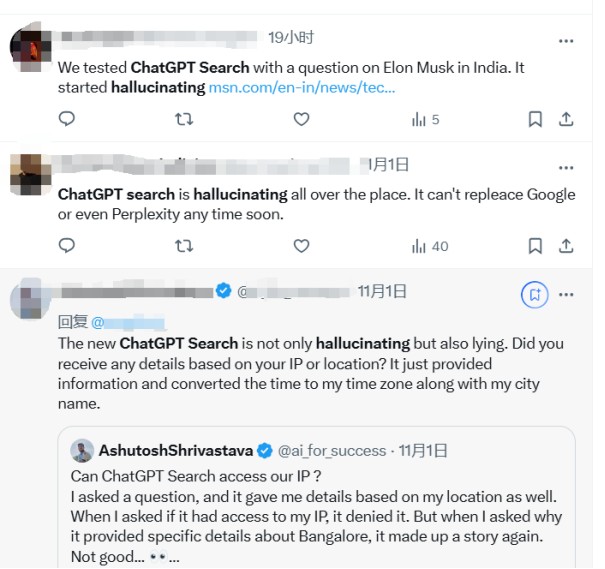
For example, ChatGPT still generates hallucinations in search mode; although it provides sources, the natural language responses still contain fabricated and incorrect information. Some even pointed out that the sources provided by ChatGPT search are irrelevant or do not exist.
Within a day of the search function going live, two completely different voices emerged. One side believes that OpenAI's move poses a threat to AI search products represented by Perplexity, and even Google should feel a sense of crisis. The other side believes that ChatGPT search is nothing and currently poses no threat to anyone.
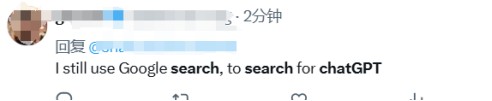 Someone sarcastically said: Am I not using Google to search for ChatGPT?
It is worth mentioning that when the Letter Ranking experienced this new feature, they found that the results returned by ChatGPT were just text written in natural language, without images, panels, or even source displays. Even when searching for "the weather in Shanghai today," they were told there was no real-time information. In other words, although you can click the small globe icon to enter the search, the search function has not actually been activated.
Given that many users have already shared their experience screenshots, which are similar to the official demonstration, it is speculated that the feature may not have been fully opened to all Plus users yet, or there may be a product bug.
OpenAI stated that in the coming months, the ChatGPT search function will gradually be opened to free users as well.
2
Users have been waiting for the search function on ChatGPT for a long time.
To understand how late this feature is, we can compare it with the launch times of competing products. Perplexity was launched as early as December 2022, with high hopes of disrupting Google. At that time, there were already rumors speculating whether OpenAI would enter the search market.
However, instead of waiting for ChatGPT to launch its own search function, people witnessed Microsoft’s high-profile revamp of its Bing search engine, introducing "New Bing," which embedded ChatGPT. Microsoft itself proclaimed a disruptive slogan, claiming to "destroy the high profit margins of Google’s search business."
In May of this year, Google also announced the integration of AI into its core search business, launching the AI summary feature, which has recently been announced to roll out in over 100 countries or regions worldwide.
In addition, the AI search arena has many players, including You.com, Brave Search, and others.
It can be said that at the moment OpenAI finally launched the search function, the AI search table is already filled with players of all sizes.
The reasons for "suppressing" OpenAI's entry into search are mainly twofold.
One reason is Microsoft's early entry. At the beginning of 2023, OpenAI was even more dependent on Microsoft than today. Microsoft was not only OpenAI's largest financial backer, investing billions of dollars, but also provided many collaboration opportunities during OpenAI's initial rise. When Microsoft launched "New Bing" in early 2023, embedding ChatGPT, it was essentially the "ChatGPT search" of that phase, and OpenAI had no reason or possibility to launch a search function to compete with New Bing at that time.
The other reason is the troubles inherent in AI search itself. A few months after the launch of ChatGPT and the global entry into the AI craze, the problems brought by AI have become increasingly prominent. In the field of AI search, troubles caused by copyright and other issues are not uncommon.
Perplexity, a representative company in AI search, is deeply embroiled in a copyright lawsuit with News Corp. In October of this year, Dow Jones Group, the parent company of The Wall Street Journal, and the New York Post filed a lawsuit against Perplexity, accusing it of "massive illegal copying" of copyrighted works and claiming it infringed trademark rights One example is that in a response from Perplexity, there are 139 words excerpted from the New York Post, but it subsequently claims five paragraphs of content that are unrelated to the original report. The plaintiffs believe this could mislead users.
The interesting part of this example is that almost all AI search tools provide answers in natural language, which includes quoted parts as well as automatically generated, summarized, and extended content. Based on this, how to avoid infringement issues is something Perplexity has not been able to answer, and it is also a question facing OpenAI: To tap into the search market, OpenAI must face more infringement risks.
OpenAI already has too many "lawsuits" against it, and it is also a target of accusations from news organizations. In addition, there have been disputes with Hollywood stars regarding the voice generated by multimodal models. Temporarily shelving ChatGPT search seems understandable.
3
However, search is ultimately a lucrative field that OpenAI cannot abandon. Google can generate hundreds of billions of dollars in revenue from its search business in a single quarter. Meanwhile, OpenAI has been facing commercialization challenges.
A widely circulated figure is that The Information estimated OpenAI's losses this year could reach as high as $5 billion. Additionally, OpenAI expects its total losses to amount to $44 billion between 2023 and 2028.
Recently, OpenAI completed a round of financing amounting to $6.6 billion, and during negotiations, investors focused on OpenAI's unique corporate structure and its commercial capabilities.
After ChatGPT, although Sora showcased impressive results, it has yet to be launched. The voice transcription tool Whisper has become popular in some institutions, especially in U.S. medical centers, but it has been found to exhibit "hallucination" phenomena: Whisper can generate non-existent conversations and erroneous information while transcribing speech into text.
In this situation, OpenAI is actively promoting collaborations with enterprise users while continuing to seek new points of leverage. OpenAI's CFO, Sarah Fertig, recently revealed that although OpenAI's enterprise business is still young, it is full of potential. However, looking at OpenAI's current revenue sources, she stated that 75% of its revenue comes from ChatGPT consumer subscriptions.
OpenAI, which needs new breakthroughs, will naturally not overlook search.
However, the search battle is not easy to fight.
The current AI boom is evident, but AI manufacturers seem more like hammer-wielders looking for nails—where are the practical applications? How to make money? Search is almost an instinctive response, which is why as soon as ChatGPT was launched, Perplexity became a star company in Silicon Valley, and Microsoft's first shot was aimed directly at Google However, despite challengers waving the AI banner to initiate challenges, Google still firmly holds the top position in the global search engine market. According to Statcounter data, in January 2023, Google accounted for 92.9% of the global search engine market share, while Bing held 3.03%. By September 2024, Google's market share was 90%, and Bing's was 3.96%. Perplexity is not on the list. Google's market share has decreased by 2.9% over more than a year and a half, and it is currently difficult to say whether this represents a downward trend or just normal fluctuations over a certain period.
In summary, it is still far from the time to "disrupt" Google Search.
The long-established search habits of users, Google's own AI-generated summaries, and its relatively mature operations are significant barriers between AI search and Google.
A similar situation exists domestically. As mentioned earlier, there are currently many products emphasizing AI search functions or focusing on AI search, such as ByteDance's Doubao, Kimi from the Dark Side of the Moon, as well as Mita Search, Tiangong AI, and so on, which offer quite impressive search experiences.
Baidu Search has indeed seen a decline in market share over the past year, but from the available statistical data, it is not AI search that is competing with it.
Using Statcounter data as an example, in 2021, Baidu could account for as much as 86.82% of the Chinese search engine market share. However, by 2024, it has dropped to around 60%. In contrast, Bing's market share has risen, reaching 30% in July of this year. It is important to note that the domestic Bing search engine does not include AI search.
But this does not mean that OpenAI's entry is meaningless, nor does it mean that Google can rest easy forever.
In addition to OpenAI officially launching the ChatGPT search function, two other pieces of news have emerged:
One is that Meta is also eyeing search. According to The Information, Meta is developing its own AI search engine, a project that has been secretly underway for eight months.
The other is that Apple is also focusing on search. According to Bloomberg's Mark Gurman, Apple is about to expand its internal search engine to the Apple App Store and other applications.
Google also experienced copyright disputes in its early days and gradually cultivated a generation's internet search habits from scratch. AI search may indeed have a chance to compete for a future. However, whether that future belongs to OpenAI is uncertain
