


Is the baking business of retailers thriving?

Retailers are performing strongly in the baking market, with Sam's Swiss Roll achieving annual sales exceeding 1 billion yuan, becoming a hot product. In stark contrast to the decline of offline baking stores, retailers such as Hema and DingDong continue to launch new products to capture market share. Despite the frequent closures of offline stores, retailers are rapidly rising due to their high cost-performance ratio and convenience, reflecting changes in consumer trends in the baking industry
In the must-buy list at Sam's Club, there must be Member's Mark baked products.
"Many members even get a membership card just to buy croissants," Sam's official admitted in an interview, noting that its private label Member's Mark baked goods have always been one of the most popular categories, with extremely high penetration and repurchase rates.
Taking Sam's Swiss roll as an example. According to reports, after its launch in 2019, Sam's Swiss roll quickly became a hot product due to its absolute cost-effectiveness, accounting for 8% to 10% of the monthly sales of some stores, with annual sales once exceeding 1 billion yuan.
This is just a snapshot of consumer preferences, reflecting the phenomenon that retailers are starting to "compete" for business in the baking sector. In addition to Sam's, Costco, Hema, DingDong, Pang Donglai, and even traditional supermarkets are continuously launching new products in the baking sector to create big items.
In contrast to the "booming" of retailers in the baking sector, offline baking stores have been increasingly quiet in recent years, especially as many "internet celebrity bakeries" explode in the market for a short time and then disappear. Multiple market reports on the baking industry and financial reports from baking companies indicate that offline baking stores are showing a downward trend in the channels through which consumers purchase baked goods.
Why are retailers able to quickly gain momentum in baking? What advantages do retailers have over offline baking stores?
In this regard, FBIF interviewed retailers such as Hema and DingDong in an attempt to find answers to these questions.
A Tale of Two Extremes
In recent years, there has been a stark contrast between the "ice" of offline baking stores and the "fire" of retail supermarkets in the freshly made baking sector.
On one hand, news of offline baking store closures and withdrawals is frequent.
In recent years, whether positioned in new-style Chinese snacks or Western pastries, both local and foreign brands have been continuously closing stores, withdrawing, or even exiting regional or national markets. For example, at the beginning of 2022, 85°C completely withdrew from the Wuhan market; in March 2024, the internet celebrity brand Panda No Walk Cake was reported to be in debt and closing stores; during the same period, local brand Li Song Zhi Pin saw a large number of store closures.
A report from Huafu Securities shows that the number of baking stores in China decreased from 479,000 in 2019 to 437,000 in October 2023. At the same time, baking stores are updated and iterated quickly, with a low survival rate. According to data from Meituan, the average survival duration of baking stores in China is 32 months, with 57.7% of stores closing within 2 years, and only 23.8% of baking stores surviving for more than 4 years.
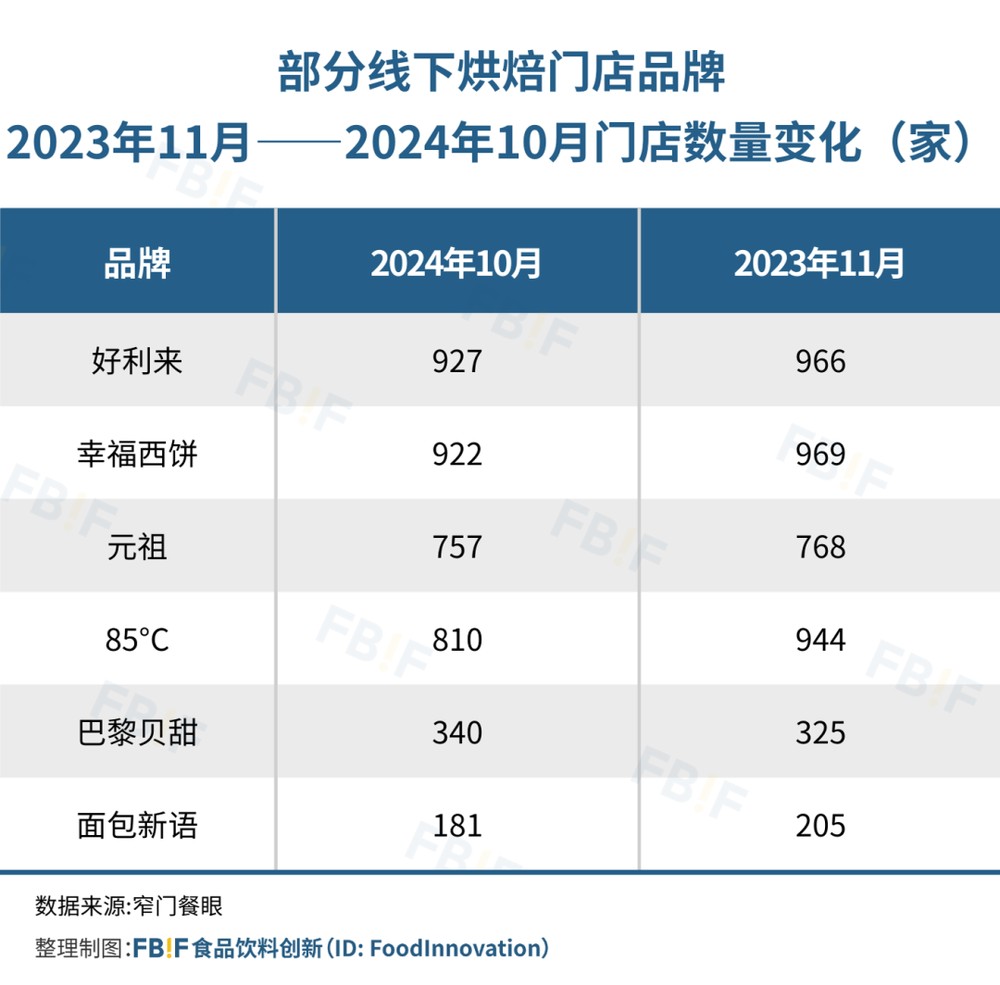
There are even more typical cases—once extremely popular and continuously invested in by capital, Mo Mo Dim Sum and Hu Tou Ju Standard Bakery currently have only a few stores left in their home cities In 2019, MoMo Dim Sum gained popularity with its original Chinese-style mochi, even igniting the concept of "new Chinese baking." Consumers flocked to buy mochi, with many willing to spend time and effort waiting in long lines.
Today, consumers still maintain their enthusiasm for mochi, but the purchasing channels have shifted from traditional pastry shops to retailers like Sam's Club, Costco, and Hema. On social media, discussions about mochi have made Sam's Club and Hema key terms in posts, and mochi is commonly found on consumers' self-made lists of must-buy bakery items.
In recent years, the share of baking stores in the baking food channel in China has declined. According to Euromonitor International data, the sales share of Chinese baked goods in the Food/drink/tobacco specialists retail channel dropped from 55% in 2018 to 51.3% in 2022.
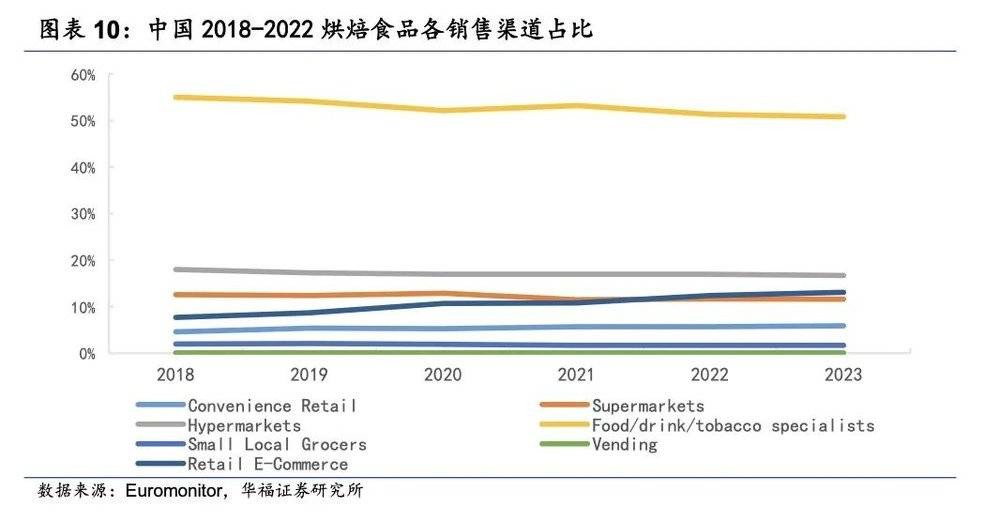
Image source: Huafu Securities
In contrast to the sluggish state of offline baking stores, retailers like Sam's Club, Hema, and DingDong are gaining increasing popularity in the baking sector, with hot-selling products being snatched up by consumers and sparking significant discussions. The hotspots and best-selling products in the baking industry are gradually shifting from offline baking stores to supermarkets and other retailers.
For example, RT-Mart's "potato bread," with its interesting shape and packaging, has sparked discussions among netizens on social media, leading to sold-out products in many regions upon launch, with some netizens even choosing to buy at a markup on Xianyu; there’s also the durian mille-feuille, which has been snatched up by consumers amid a "price war" between Hema and Sam's Club, also selling out immediately upon release.
Against the backdrop of frequent hot-selling products, the baking business of retailers is thriving. Reports indicate that Sam's mochi and Swiss rolls have consistently stable sales exceeding 100 million, with an average of 300 boxes of Swiss rolls taken home for every 1,000 Sam's customers.
Additionally, in an interview with FBIF, DingDong stated that its own baking brand "Bao Luo Workshop" was established in October 2021 and launched in early 2022, growing from initial monthly sales of over one million to tens of millions by the end of the year, achieving nearly 19 times growth on the DingDong platform within a year.
Although offline baking stores and retailers are experiencing vastly different fortunes in the baking business, it is noteworthy that the baking channel is still primarily dominated by traditional pastry shops, but the supermarket channel is developing rapidly and may become mainstream in the future.
Where does the appeal of retailers' baking products lie?
Compared to offline baking stores, what exactly makes retailers' baking products appealing?
- A wide variety of products, with billion-yuan best-sellers emerging frequently Baking stores often need to have a clear positioning, but retailers are not limited by positioning.
Baking stores need to have precise customer group positioning, or focus on specific categories such as new-style Chinese pastries or Western-style desserts. For example, MoMo Dim Sum Bureau is positioned in new-style Chinese pastries, while Holiland and Happy West Cake lean more towards Western-style desserts.
According to FBIF's interviews with industry insiders, an ordinary bakery typically has about 50-60 SKUs. Additionally, under the premise of clear consumer positioning, the products launched by offline baking stores tend to be more focused. Due to the increasing competition in the baking market, brands' product strategies are also beginning to show a trend of "extreme segmentation," with many brands establishing their product systems around a specific flagship item.
However, retailers engaging in baking target the customer base of the channel itself and can launch a variety of products. For instance, Hema's baking focuses on four main product categories: bread, cakes, pastries, and light meals. DingDong's own baking brand "BaoLuo Workshop" divides its products into two main categories: toast/bread and cakes/pastries. According to FBIF statistics, there are 97 products listed under Hema's baking section on the Hema APP; "BaoLuo Workshop" has about 90 products.
Even Sam's Club, which primarily focuses on selected SKUs, has about 40 Member's Mark baking products, categorized into four main types: cakes, bread, toast, and pastries.
Additionally, retailers can leverage foot traffic advantages through fresh-baked bread tastings, aroma marketing, etc., to help products gain volume, generating single products worth over 100 million or even over 1 billion. In contrast, in the distribution channel for pastry shops, achieving tens of millions in sales for a single category from a single manufacturer is already considered successful.
During interviews, both DingDong and Hema mentioned that the efficient feedback mechanism of the channel can quickly create explosive products and continuously iterate and innovate on products based on this foundation.
"DingDong's existing online data accumulation and rapid perception of consumer trends make the path of product development - feedback - upgrade optimization faster and more efficient," DingDong told FBIF.
- "One-stop shopping"
Compared to offline baking stores, retailers have a significant advantage in baking, which is that consumers are more accustomed to "one-stop shopping."
The difference lies in that consumers will only enter a baking store after they have the desire to eat baked products. However, supermarkets have a more comprehensive range of categories and serve as places for consumers' daily consumption, making them suitable for "one-stop shopping." When consumers enter a supermarket, they can be attracted to the baking area by the aroma of baked goods and tastings.
Moreover, in recent years, retailers have been launching their own brand strategies, which are gradually becoming known and recognized by consumers. Their private brands, like baking store brands, possess brand power. For instance, the previously "hard-to-find" DL mooncakes, under the retail brand Pang Donglai and its own brand DL, have even become scarce items due to the brand power.
When discussing the differences from offline baking stores, DingDong stated that it positions itself as a sales platform for naturally short-shelf-life fresh products. As an instant fresh e-commerce platform with a pre-storage model, users have a high frequency of use, and they are more enthusiastic about fresh ingredients that can be bought and eaten immediately. Therefore, BaoLuo Workshop will leverage this characteristic to establish keywords like quality, freshness, and health in users' minds, becoming a long-term competitive advantage for DingDong's baking products 3. Price
One more important reason why retailers are popular in baking is the price.
FBIF randomly selected a location in the Minhang District of Shanghai and searched for "Swiss roll" on major retail supermarket apps and delivery platforms, creating the following table.
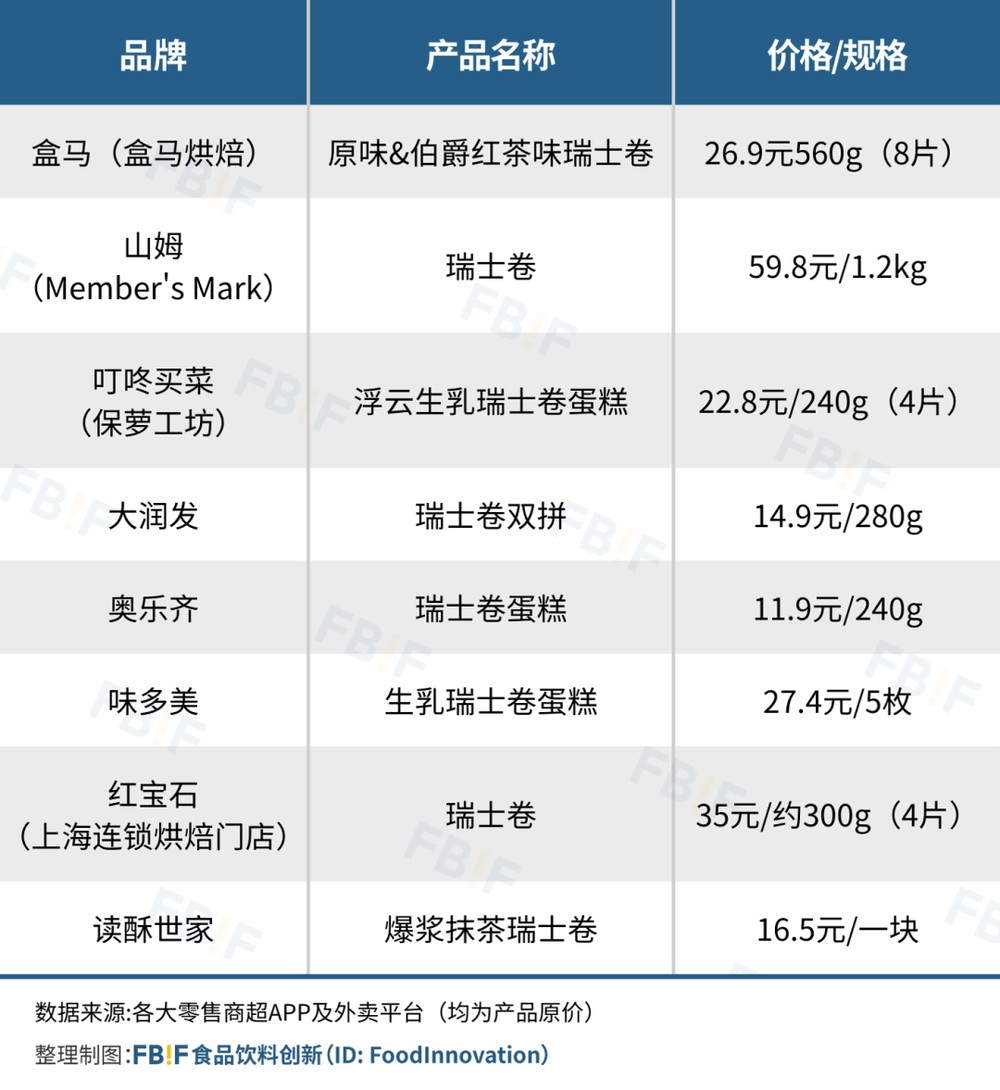
From the comparison, it is not difficult to find that the prices of most retailers' private label Swiss rolls are lower than those of offline baking stores. While the price of Swiss rolls at offline baking stores is mostly around 10 yuan per piece, some retailers have lowered the price to 5 yuan per piece, or even 3 yuan.
Products like these are not rare. In supermarkets, you can find baguettes priced at 15 yuan for two, but at offline baking stores, 15 yuan can only buy one baguette.
Consumers are also highly sensitive to baking prices. Currently, on social media, the most complained issue by consumers regarding offline baking stores is "expensive." NetEase Data once conducted a survey showing that bread priced below 10 yuan is gradually "disappearing."
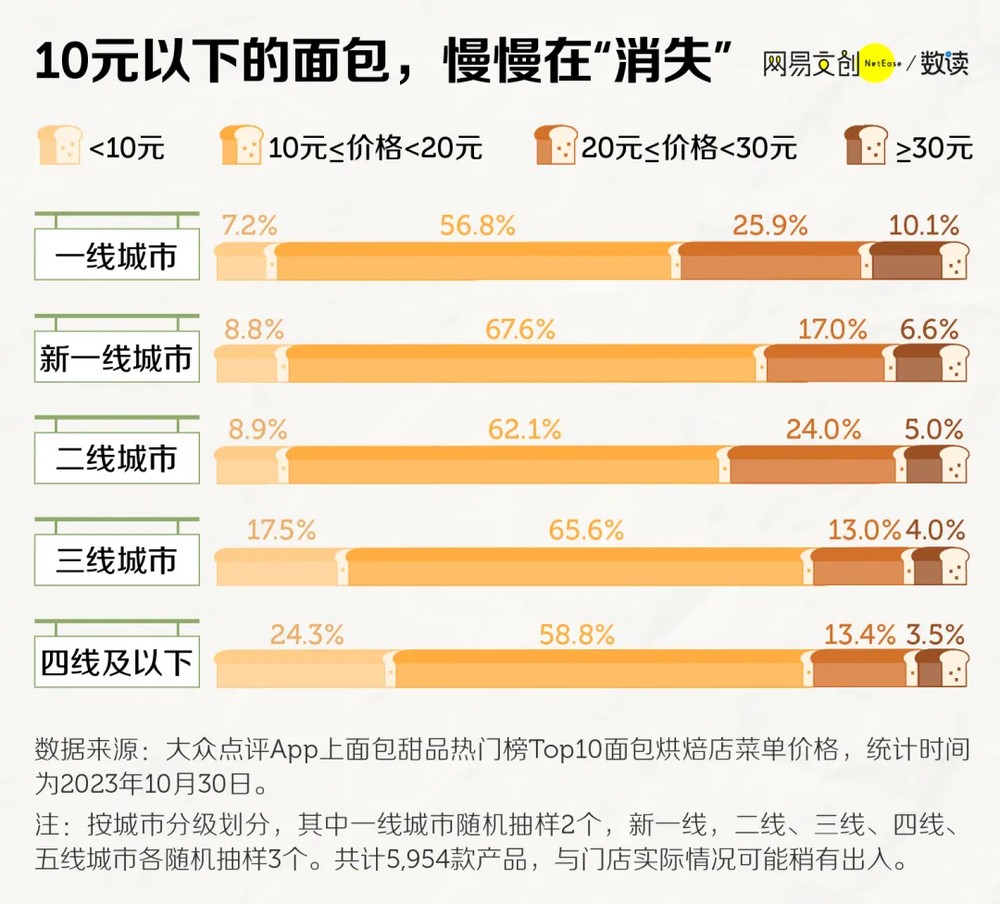
Image source: NetEase Data
In the context of similar categories and not much difference in taste, the relatively low prices of retailers' baking products, or the perception of higher cost-effectiveness by consumers, lead them to start "voting with their feet."
How do retailers create "low prices" in baking?
Since low prices are one of the important advantages for retailers in baking, why can retailers do it while offline baking stores cannot?
The fundamental reason lies in the different profit models.
The basic profit model of offline baking stores mainly relies on retail baking products, achieving profits through sales, which is usually reflected in the price difference between cost and selling price. Retailers, on the other hand, focus more on sales per square meter, emphasizing high turnover rates and sales volume to achieve higher overall profitability.
Simply put, the former "walks price," while the latter "walks volume," leading to different pricing strategies for the products.
From the production model perspective, offline baking stores and retailers also differ. Currently, baking products are mainly divided into two models: "front store and back factory" and "central factory + (wholesale/chain stores/e-commerce + offline delivery)."
The "front store and back factory" model is represented by brands like Bao Shifu and Mo Mo Dim Sum Bureau, characterized by fresh products and relatively good taste, but low production efficiency. Most retailers adopt the "central factory +" model, which can enhance baking processing efficiency and optimize costs. It is worth noting that many offline baking stores, such as BreadTalk, Yuan Zuo, and Paris Baguette, also use the "central factory +" model Against this backdrop, retailers are continuously "rolling back prices" in this round of retail transformation.
This brings to mind the price war between Sam's Club and Hema over the "Durian Mille-Feuille." In August 2023, one of Sam's popular baked products, the "Durian Mille-Feuille Cake," was priced at 128 yuan, while Hema offered it for only 99 yuan.
Sam's immediately lowered the price to 98.9 yuan. In the following days, Sam's and Hema engaged in a back-and-forth price war over the durian mille-feuille cake. Hema adjusted the price to 89 yuan, prompting Sam's to drop it by 1 yuan, then Hema lowered it again to 86 yuan, and Sam's followed suit with another 1 yuan reduction.
In the end, the 1-kilogram durian mille-feuille cake was priced at 85 yuan at Sam's, while Hema's price was 79 yuan. Subsequently, Hema also launched a 470g durian mille-feuille for just 47.5 yuan.
Currently, Hema still offers two types of durian mille-feuille cakes: the Musang King durian mille-feuille priced at 49.9 yuan and the Sultan King durian mille-feuille cake priced at 99 yuan. Sam's product has been updated to the Sultan King durian mille-feuille, priced at 109 yuan.
Why are retailers still able to continuously roll back prices in a relatively "low-price" environment?
Conclusion
As consumers' demands for the freshness of baked goods continue to rise, freshly baked, short-shelf-life products have replaced traditional long-shelf-life items and become the market mainstream.
Compared to offline baking stores primarily located in commercial districts, retailers offer higher convenience and faster access, making them one of the main channels for consumers' baking purchases.
However, in the large baking market, there has yet to be a baking giant formed, and the industry scale continues to grow at a high speed. Each brand and channel can serve its users well, creating its own uniqueness through distinctive products and services
