


As international retail brands struggle in China, Lululemon shines in the East while the West falters

The development speed and market performance of the well-known brand Lululemon Athletica in the Chinese market are noteworthy
According to the Zhitong Finance APP, the development speed and market performance of the well-known brand Lululemon Athletica (LULU.US) in the Chinese market are noteworthy. In 2018, when the General Manager for China, Huang Shanyan (San Yan Ng), just started working at Lululemon Athletica (LULU.US), the yoga apparel manufacturer had only about 10 stores locally and was still struggling to figure out how to operate on e-commerce platforms. This year, the company has over 130 stores in China, with sales reaching $1 billion for the first time, and China is expected to become the second-largest market after the United States.
As consumers cut back on spending amid the economic slowdown following the COVID-19 pandemic, China is unlikely to be a place where Western luxury brands seek growth. Global retail giants, from LVMH (LVMH.US) to Starbucks (SBUX.US), have been impacted, leading some companies to reconsider their strategies in China.
Lululemon is not only combating economic downturns but also seems to be facing a different Chinese market. In the first two quarters of this year, sales not only grew by 40%, but the products sold were also more expensive, with overall pricing 20% higher than in the United States. While competitors are considering scaling back in the Chinese market, most of the stores Lululemon opened this year are in mainland China. HSBC estimates that by 2026, China will account for one-fifth of Lululemon's nearly $13 billion total sales globally, which will make Lululemon more dependent on China compared to Apple (AAPL.US), Nike (NKE.US), or Starbucks (SBUX.US).
Its success in China sharply contrasts with the slowdown in North America. Due to competitors capturing market share and ongoing inflation suppressing demand, the company lowered its full-year sales forecast in August. The company's stock price has fallen more than 30% this year, while the Nasdaq 100 index has risen by 25% during the same period.
But on the other side of the globe, Lululemon is thriving. Morgan Stanley stated last month that it has become the third-largest foreign sportswear brand in China. Lululemon is a leader among niche sports and leisure brands, including outdoor equipment manufacturer Arc'teryx, footwear company Hoka, and ski apparel brand Descente. According to analysis from Hangzhou Zhiyi Technology, the brand's store sales on Alibaba's main platform, Tmall, grew by about 15% to 40% in the 12 months ending in September. Nike's $600 jackets and $150 yoga pants are selling well in the market, even amid a flood of cheap local brands selling "knockoff" versions of the company's apparel at one-third the price.
Niche Sports Going Big
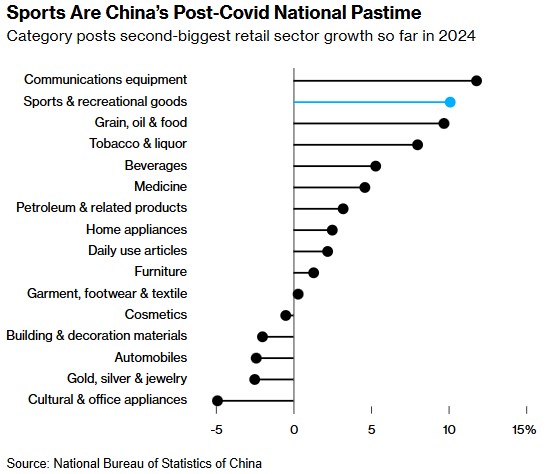
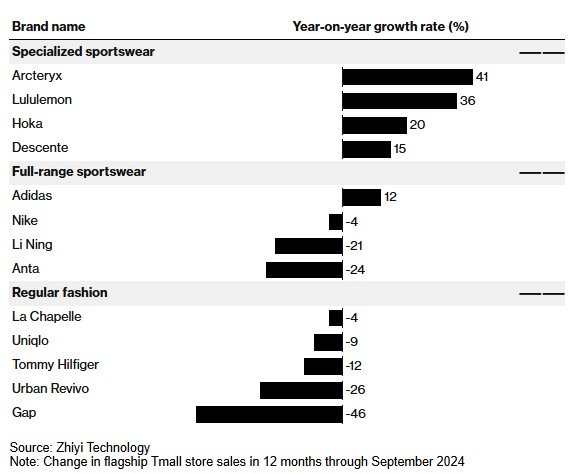 These brands benefit from a deeper shift in Chinese consumer behavior away from ostentatious consumption, driven by regulatory crackdowns, the collapse of the real estate market, and the deep anxiety brought about by punitive COVID-19 rules. Social media accounts that once flaunted $5,000 handbags and five-star resorts are now boasting about fitness plans and meditation mantras. The work-from-home habits established during the pandemic have also ushered in an era of relaxed comfort, promoting the growth of activewear brands around the world.
Jessica Gleeson, CEO of retail consulting firm BrighterBeauty in Shanghai, stated, "Health and wellness are the new luxury categories in China." Even the financial capital, once a cutting-edge hub of office fashion, is transforming into a "sneaker and athleisure capital."
No brand has leveraged these favorable factors better than Lululemon, whose strategy offers insight into how Western brands can succeed in China. Lululemon has rapidly localized its products, doubling down on offerings that cater to local consumer interests, and has capitalized on the characteristic of Chinese consumers who do not have fixed ideas about the use of their clothing compared to North American consumers.
Rogier Bikker, Managing Director of Monks Greater China, said, "Lululemon has been building its business in China city by city, gym by gym," adding, "They are at their peak in China right now. Now they need to work hard to maintain this situation."
Last month, the company flew to Shanghai for a three-hour meeting with analysts, where CEO Calvin McDonald and his team described how their strategy of tailoring products for the local market has been effective. General Manager Ng noted that up to 35% of sales in China come from products customized for the Chinese market.
This includes the Hike series designed to respond to the post-COVID hiking and outdoor activity boom in China, as well as capsule collections specifically created for the Chinese Lunar New Year and Qixi Festival (China's Valentine's Day). Additionally, the Asia Fit series is sold in the region to accommodate slimmer and smaller body types.
Akshay Gupta, a consumer research analyst at HSBC, stated that China is expected to become a source of future profits for Lululemon, as prices are about 20% higher than in the U.S.
Data from analysis firm Moojing shows that nearly half of the top 30 outdoor sports brands on Tmall and Taobao have seen average prices rise over the past year, while retail sectors like luxury goods and footwear have faced sluggishness. American Sports Inc. reported over 60% revenue growth in the Greater China region during the Golden Week holiday, primarily driven by accelerated sales of brands like Arc'teryx, ski boot brand Salomon, and tennis racket manufacturer Wilson These brands, like Lululemon, are considered essential products for the Chinese middle class. On Holding AG, a sneaker company supported by Roger Federer, stated that driven by China and Japan, revenue in the Asia-Pacific region grew by 74% in the second quarter.
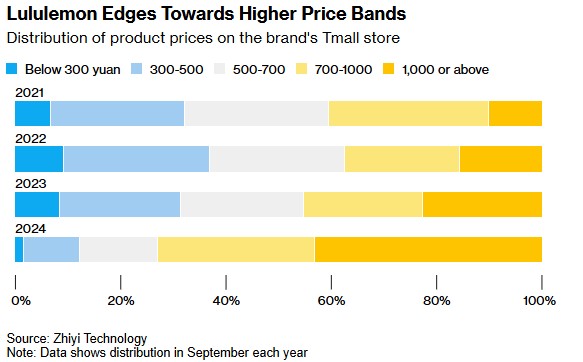
In September, products priced above RMB 1,000 (approximately USD 140) accounted for over 40% of its sales on Tmall, compared to just 10% in the same period three years ago, highlighting Lululemon's adaptability to new trends among Chinese consumers.
A spokesperson for Lululemon in China stated that the company does not disclose sales data by regional channels.
Impact of "Affordable Alternatives"
Lululemon's entry into the Chinese market has been relatively short, and it has just begun to compete with much larger sportswear giants that have been in the Chinese mainland for years. As it develops towards the mass market, it faces not only international predecessors like Nike but also local giants such as Anta Sports Products Ltd. and Li-Ning Co., which have a broad following among Chinese consumers loyal to domestic brands.
The shift from being a pillar of urban elites to efforts to penetrate the mainstream market, particularly ambitious moves into second- and third-tier cities in mainland China, may dilute its image and provoke more competition from similar Chinese manufacturers that have been producing high-quality replicas known as "affordable alternatives," ranging from Nike running shoes to Ralph Lauren polo shirts.
Suppliers of yoga apparel working for affordable brands have stated that they have been striving to replicate Lululemon's high-tech fabrics, which are often too time-consuming or expensive to learn. However, they indicate that these brands remain at the top of the "must replicate" list, and an increasing number of low-cost alternative brands are willing to try. After all, the previous generation of Western retailers, from LVMH to Starbucks, also thrived in China before losing some market share to local competitors.
"Like all other multinational retailers, their global headquarters remain key decision-makers, and Lululemon may find it difficult to remain agile like local Chinese brands," said Christine Tsui, founder of the Lengyun Fashion Community. "Lululemon was born with yoga, achieved success through yoga products, and is likely constrained by its yoga image. It is rooted in its DNA, making it hard to change."
More Than Just Yoga
Today, the products sold in China far exceed the scope of yoga apparel, ranging from golf and tennis equipment to lightweight pants suitable for office wear. Data shows that in September, yoga products accounted for only 32% of Lululemon's total sales on Tmall, down from over 50% in the same month of 2021. For most of this year, their share of the company's total sales on Tmall has been less than 40%, whereas in 2021, this figure was typically 50% or 60%.
Ng cited the company's China Health Report, stating that in China, "versatility is a key unmet need in the market, with over 30% of consumers expressing dissatisfaction with products that cannot be worn in different settings."
Men's wear has become an important growth driver, attracting Chinese men who previously thought Lululemon was primarily for women, and advertising campaigns are now focused on the well-being of everyone. This year, the company launched its first men's shoes in mainland China. Previously, the brand had conducted pop-up events in cities without physical stores, showcasing men's jackets in Harbin.
Last year, Martin Chen tried on Lululemon's ABC Trousers for the first time when his wife, a loyal fan of the brand's yoga leggings, tossed a pair of these casual men's pants into her online shopping cart. The Beijing resident, who works in finance, quickly became a regular buyer of men's items like moisture-wicking polo shirts. In the summer, when he walks from the train to the office, the moisture-wicking polo shirt helps cover up stains.
38-year-old Chen said, "The brand is a surprise to me," but also noted that if the company wants to convince Chinese men that it is a gender-neutral brand, there is still much work to be done. He added, "Many of my male friends still say 'No way, that's a women's brand' when they hear 'Lululemon.'"
33-year-old Shanghai white-collar worker Mila Li said she is willing to spend more on Lululemon because it performs better than its competitors. She said, "The prices are too high, but so far, I can't find any cheaper options that provide enough support for sports. Only by wearing the best pants do I feel motivated to work out."
