


1 in 6 Chinese people uses AI! CNNIC's latest report: Intelligent agents have become a mainstream application form
The recently released "Generative Artificial Intelligence Application Development Report" states that the user scale of generative AI products in our country has reached 230 million people. The role of AI in the field of content creation is becoming increasingly significant, and the scale of related industries and the number of products are also rapidly increasing. Intelligent agents have become one of the main application forms, and in the future, deep learning frameworks will be the key to the iteration of AI systems
Author: Li Xiaoyin
Source: Hard AI
On November 30, the China Internet Network Information Center (CNNIC) released the "Generative Artificial Intelligence Application Development Report (2024)" (hereinafter referred to as the "Report").
The "Report" shows that currently, generative artificial intelligence products have formed a certain user scale among internet users, with significant growth potential in the future. As of June this year, the user scale of generative artificial intelligence products in China reached 230 million, accounting for 16.4% of the total population.
This means that almost one in every six Chinese people is using AI products.
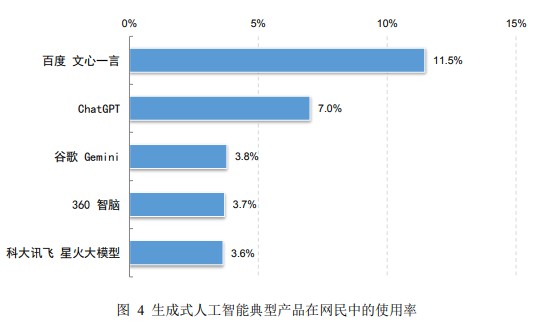
In terms of products, Baidu Wenxin Yiyan ranks first in the usage rate of typical generative AI products among domestic internet users, accounting for 11.5%, while OpenAI's ChatGPT and Google's Gemini rank second and third, with market shares of 7% and 3.8%, respectively.
Young and Highly Educated Internet Users as Main Users
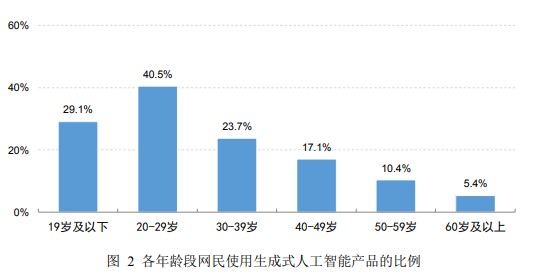
In terms of users, young internet users are the main users of AI products. By age group, the proportion of internet users aged 20-29 using generative AI products is the highest, reaching 40.5%, followed by users aged 19 and below, with a proportion of 29.1%.
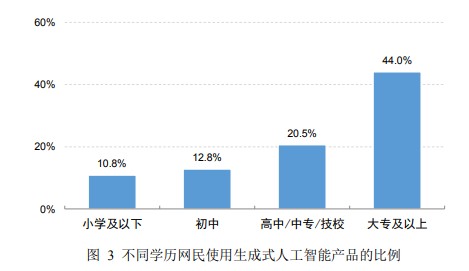
From the perspective of different education levels, internet users with a college degree or higher have a significantly higher usage rate of generative artificial intelligence products, reaching 44.0%; while users with an education level below college have a usage rate of 14.1%.
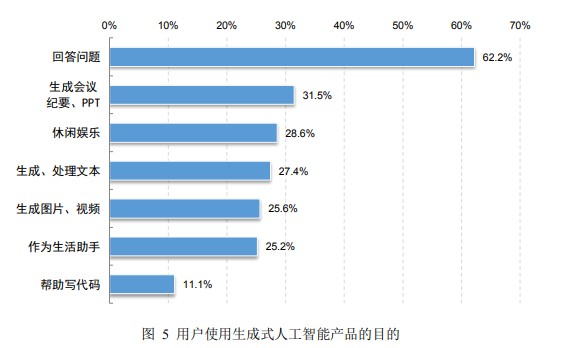
In terms of usage, large models are playing an increasingly significant role in content creation. The report shows that nearly two-thirds of users use LLM (Large Language Model) services to answer questions, while one-third rely on them as work assistants to generate meeting minutes and slides.
Intelligent Agents Have Become a Mainstream Application Form
On the industrial side, the application of generative artificial intelligence is also becoming increasingly widespread. The report states that cost reduction and efficiency enhancement are the core driving forces for various industries to choose to apply large models, and enterprises often prioritize intelligent upgrades in research and development and service sectors.
By region, developed areas have become the leaders in the AI industry. According to the report, as of November 2024, there are a total of 309 generative artificial intelligence products registered in China, with the number of registered generative artificial intelligence products in Beijing, Shanghai, and Guangdong accounting for 31.1%, 27.2%, and 11.7%, respectively
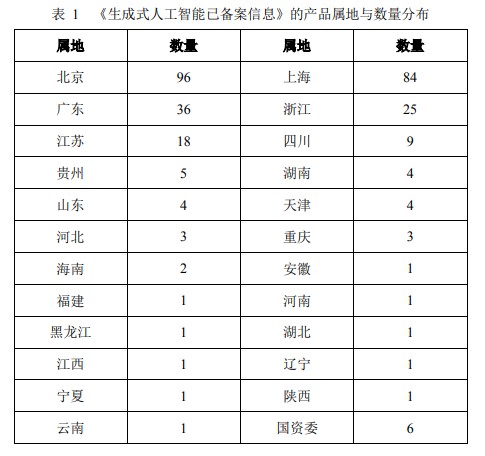
In terms of application areas, the report states that intelligent agents have become one of the mainstream forms of generative artificial intelligence applications, serving as a new bridge connecting users with various services.
The report mentions that intelligent agents can work collaboratively as assistants to humans or independently complete complex tasks. At the same time, intelligent agents are not limited to a single software form; they can call tools and collaborate with other entities, becoming a more powerful intelligent network.
Regarding the technology itself, the report points out that deep learning frameworks will become the key to the iteration of generative artificial intelligence.
As the "operating system" of generative artificial intelligence, deep learning frameworks support various business models and industry applications while connecting to intelligent computing chips, possessing dual dominance in driving industrial applications and hardware adaptation, and have become the core focus for promoting the rapid iteration and upgrade of artificial intelligence software and hardware.
Looking ahead, the report states that understanding, generation, logic, and memory will become the key foundational capabilities for large models to advance towards artificial general intelligence (AGI).
The comprehensive application of these four foundational capabilities forms the ability of multimodal large models to process, create, plan, and make decisions based on multiple types of data inputs in complex task scenarios. The report believes that the stronger these four capabilities are, the closer multimodal large models will be to the goal of artificial general intelligence.
According to an analysis by Xinhua News, the large model industry will enter a year of application explosion in 2024. In the domestic core battlefield of large models, comprehensive capabilities, user scale, and call volume of general large models are the basic factors for large model vendors to compete, determining whether they can reach the endgame.
AI Talent Gap Widening
As AI technology continues to innovate, the demand for high-end technical talent is also increasing. During the 2023 World Artificial Intelligence Conference, Qiu Xin, Secretary of the Party Committee of Fudan University, stated:
“The total talent gap in the domestic artificial intelligence field is as high as 5 million, with an expected demand of 400,000 in Shanghai by 2025, while the number of students in related majors at local universities is only 40,000.”
This report also specifically mentions the issue of the widening AI talent gap.
The report states that as the talent gap widens, universities lack high-level curriculum development experience in artificial intelligence-related education, leading to a certain discrepancy between the professional knowledge students learn and actual employment. Additionally, there is insufficient education and training for minors, whose main channel for acquiring information is "browsing relevant knowledge online" rather than through school education courses.
According to previous reports by Southern Metropolis Daily, a survey released by iiMedia Consulting in June showed that 91.3% of surveyed companies face a shortage of artificial intelligence talent. However, the talent cultivation of some universities is disconnected from real-world needs, with uneven faculty levels and insufficient teaching conditions.
To address the talent gap, the report proposes improving the support and guarantee mechanisms for the introduction and return of overseas talent, as well as conducting practical generative AI education in universities, while incorporating basic knowledge of artificial intelligence into the primary and secondary education system
