


Uncertain Interest Rate Outlook: UK Long-Dated Bond Yields Approach 26-Year High

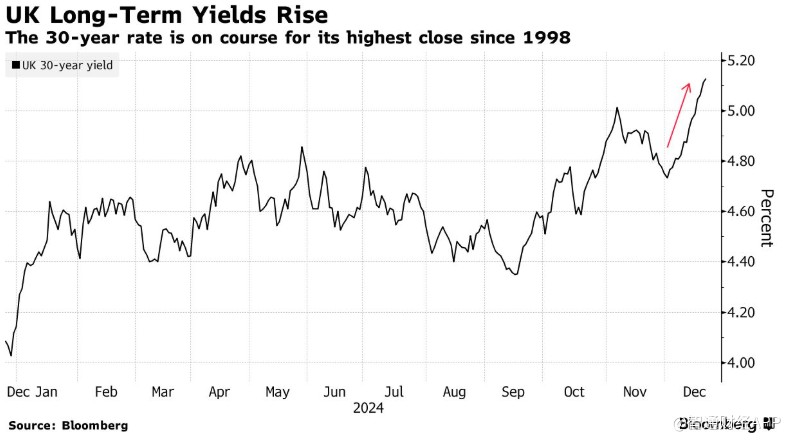
The UK government's long-term borrowing costs are close to their highest level since 1998, with the 30-year government bond yield rising to 5.16%. Due to the unclear expectations of investors regarding the Bank of England's interest rate cuts next year, market bets on the number of rate cuts have changed frequently. Policymakers are facing the dilemma of inflationary pressures and sluggish economic growth, making 2025 an important year for the UK government bond market. The Governor of the Bank of England stated that economic uncertainty has intensified, making it impossible to commit to the timing and extent of interest rate cuts
According to the Zhitong Finance APP, due to investors' difficulty in predicting how much the Bank of England will cut interest rates next year, the UK government's long-term borrowing costs are approaching their highest level since 1998. The yield on UK 30-year government bonds rose to 5.16% on Friday after increasing for seven consecutive trading days. In just one week, the market shifted from betting on four rate cuts by the Bank of England next year to betting on fewer than two cuts, and then to betting on three cuts.
The unclear interest rate outlook has once again hit UK government bond investors, who have already lost over 4% in 2024 due to an expected increase in bond issuance next year. The crux of the issue is how policymakers will respond to the persistent inflation pressures and weak economic growth in the UK.
Ed Hutchings, head of rates at Aviva Investors, stated, "Whether from the perspective of issuance or assessing the trend of year-end yields, 2025 will be an important year for the UK government bond market."
The yield on UK 30-year government bonds is approaching its highest level since 1998.
On Thursday, a third of the members of the Bank of England's Monetary Policy Committee voted against a rate cut, surprising the market. Bank of England Governor Andrew Bailey stated that "increased economic uncertainty" is the reason he "cannot commit to when or how much to cut rates next year."
The UK economy is shrinking, and a Bank of England survey shows that the labor market is weakening, while data released this week indicated that wage growth exceeded expectations. Meanwhile, U.S. policies are having spillover effects on the global economy. The Federal Reserve hinted on Wednesday that it would refocus on price risks, while U.S. President Donald Trump threatened to impose tariffs on the EU.
Matthew Ryan, head of market strategy at Ebury, remarked, "The divergence among Bank of England officials regarding the future direction of UK interest rates seems greater than ever." This reflects the "complex outlook for the UK economy, as weak consumer demand is offset by the inflationary impacts of the autumn budget and Trump's tariff policies."
