


HERBS GROUP, which has dropped 35%: The hot subscription and stock price trend diverge, raising doubts about the "over-subscription king" value?

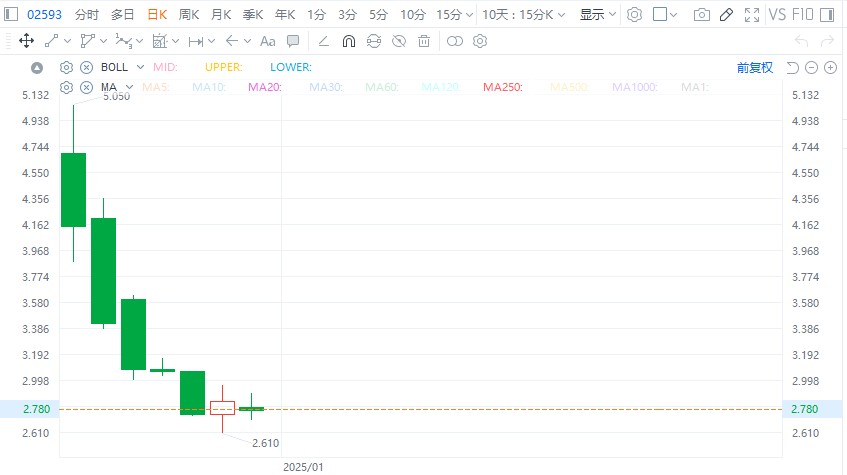
HERBS GROUP's performance in the Hong Kong stock market sharply contrasts with its oversubscription fame, with the current stock price at HKD 2.78, down nearly 35% from the offering price of HKD 3.75. Despite a subscription multiple as high as 6083.63 times, the stock price continues to decline, and its market value has fallen below HKD 400 million. Compared to other oversubscribed companies, HERBS GROUP's performance appears unsatisfactory, raising doubts in the market about the authenticity of its subscription multiple
This year's "super subscription king" in the Hong Kong stock market—HERBS GROUP (02593) is now also "cold at the door and rare in horses."
As of the time of writing, the stock is priced at HKD 2.78, down nearly 35% from the offering price of HKD 3.75, with a total market value falling below the HKD 400 million threshold, approximately HKD 371 million.
Under the fame of 6083.63 times subscription, is it really difficult to live up to?
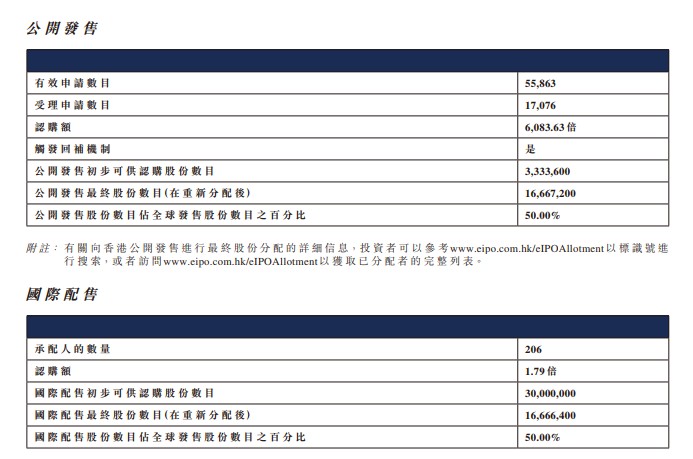
Under the star effect, during the public offering phase, HERBS GROUP's public offering subscription amount reached 6083.63 times, and the international offering subscription amount reached 1.79 times, surpassing the 5677.83 times subscription of Jinko Electronics Colored Pencils, claiming the title of this year's "super subscription king" for Hong Kong IPOs.
Due to the triggering of the reallocation mechanism, after redistribution, the number of shares for public offering reached 16.6672 million shares, and the number of international placement shares was 16.6664 million shares, which objectively increased the chips in the hands of retail investors, resulting in greater losses amid the decline in stock prices.
Zhitong Finance APP noted that, under the hot subscription, most of the "super subscription kings" in Hong Kong stock history performed quite well. For example, Maokai Kwai Chung, which topped the Hong Kong IPO "super subscription king" throne with a subscription of 6289 times, saw a first-day increase of 431.67%.
Compared to its "predecessors," HERBS GROUP's moment of glory seems a bit too short.
HERBS GROUP was listed on the first day (December 19), and after the market opened, it once surged to HKD 5.05, ultimately closing up 10.4% at HKD 4.14. Based on the first day's closing, a single lot of 800 shares would yield a paper profit of HKD 312; however, the next day, HERBS GROUP experienced a significant decline, dropping over 18% at one point. On December 23, HERBS GROUP's stock price continued to fall, closing down 9.94% at HKD 3.08, having fallen below the issuance price of HKD 3.75 per share.
In fact, even during the offering phase, there were voices in the market suggesting that the subscription multiple for HERBS GROUP might be inflated.
The public account "Wandering Bay Curve" stated in "HERBS GROUP's oversubscription of 5316 times, why didn't I participate?" that "the margin multiple is just a relative indicator; what ultimately matters is the financing amount. In fact, HERBS GROUP's 5316 times (frozen capital of HKD 73.5 billion) is even less than half of Maogeping's 826 times (frozen capital of HKD 173.8 billion)."

(Screenshot from the public account: Wandering Bay Curve)
On Xueqiu, some investors expressed that this time when subscribing to HERBS GROUP, Futu, Tiger Brokers, Hafu, and Huatai all provided 100 times financing, allowing a principal of HKD 70,000 to subscribe for the new stock


Why are brokerages willing to offer high leverage for margin trading? Mainly under the FINI system, they only need to prepay the actual amount of the public subscription part. If there is oversubscription, they only need to prepay the maximum amount of public fundraising.
For example, in the case of HERBS GROUP, the oversubscription was 5,316 times with 73.5 billion (data source: TradeGo). The brokerage does not actually need to prepay this much; they only need to prepay 69.1 million after a 50% clawback, because the maximum public offering is limited to this amount. Regardless of how much clients subscribe, the winning amount will not exceed this figure. For large brokerages, with more clients, the overall subscription amount will exceed 69.1 million, and the excess only needs to be recorded without actual payment to the Hong Kong Stock Exchange.
The high oversubscription indicates that a large number of investors are optimistic about HERBS GROUP's performance after listing, but the subsequent sharp decline in stock prices and the phenomenon of oversubscription being sought after are contradictory, undoubtedly raising doubts among investors about the inflated oversubscription figures.
Interestingly, under the prolonged decline in HERBS GROUP's stock price, a large number of shares were forced to stop-loss, and there were signs of some funds accumulating at the bottom. A large number of shares are piling up at the bottom, with the cost distribution concentrated at low levels forming a single peak. As of December 31, the distribution of shares shows that 70% of the shares are concentrated in the range of HKD 2.88 to HKD 4.62. Compared to December 20, when 70% of the shares were concentrated in the range of HKD 3.74 to HKD 4.82, the average cost has decreased from HKD 4.26 to HKD 3.80, and the overlap of the range has increased from 72% to 83.65%.
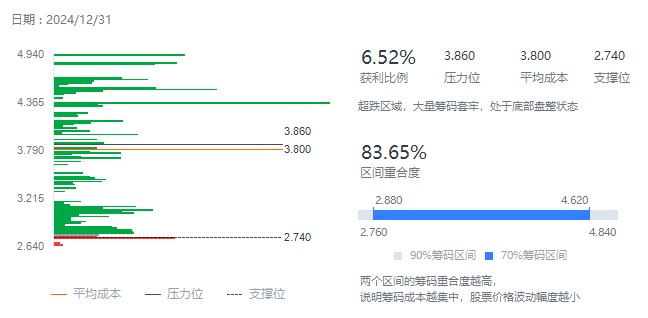
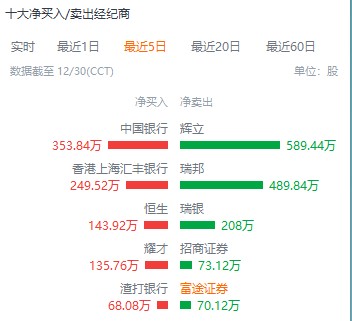
Once the stock price breaks through the single peak concentration with increased volume, it will be a sign of an upward trend. Currently, the single peak low-level concentration pattern of HERBS GROUP seems to be taking shape. Once the trading volume and turnover rate increase, the stock's upward trend is expected to begin. In the past five days, the "bottom-fishing" funds included a total of 7.4728 million shares taken up by trading seats from Bank of China, HSBC, Hang Seng, etc. The source of these funds is currently unknown.
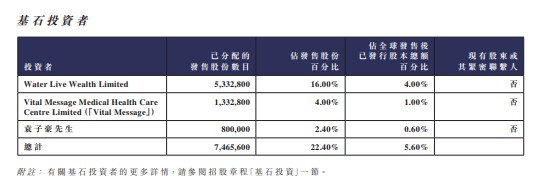
Zhitong Finance APP notes that the recent sharp decline in HERBS GROUP has also led to significant losses for the company's cornerstone investors. The cornerstone investors introduced in HERBS GROUP's Hong Kong IPO include Water Live Wealth Limited (wholly owned by Mr. Lu Zhiwei), Vital Message (wholly owned by Guangdong Yuewei Edible Fungus Technology Co., Ltd.), and Mr. Yuan Zihao The investors collectively subscribed to approximately 7.4656 million shares of HERBS GROUP (approximately HKD 12.8 million). Based on this, cornerstone investors have incurred a floating loss of over HKD 7.24 million.
Health supplement business with a gross margin close to 75% shows hidden worries
The prospectus shows that HERBS GROUP is a diversified supplier of health supplements and beauty and skincare products rooted in Hong Kong for over twenty years, adopting a multi-channel sales model and focusing on the development, sales, and marketing of its own brand products. As of November 24, 2024, HERBS GROUP operates a total of eight proprietary brands, namely HERBS, ZINO, Zheng Tong, Mei Wu, Nan Bu, Nan Ji, Green Kang Ying, and En Chong.
Under the star halo, HERBS GROUP's performance is commendable. From 2021 to the first half of 2024 (hereinafter referred to as the reporting period), the company's revenue was HKD 189 million, HKD 208 million, HKD 251 million, and HKD 118 million, with a compound annual growth rate of approximately 15.4% from 2021 to 2023, while the first half of 2024 saw a slight year-on-year decline. The net profit during the same period was HKD 23.181 million, HKD 27.972 million, HKD 39.502 million, and HKD 7.483 million, with a compound annual growth rate of approximately 30.5% from 2021 to 2023, and a slight year-on-year decline in the first half of 2024, consistent with the revenue trend.
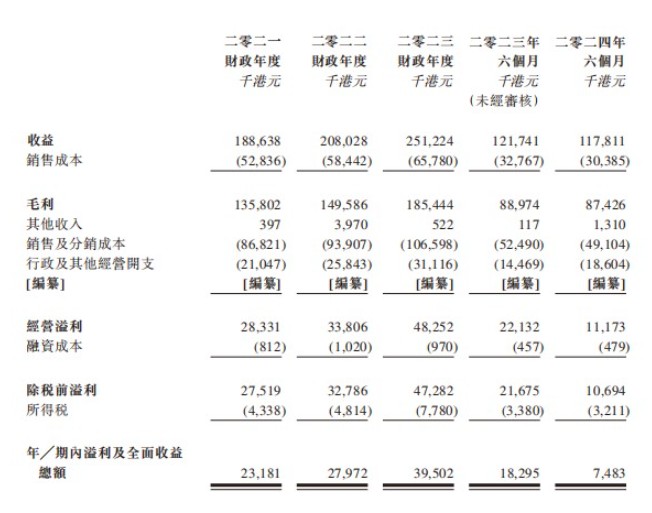
It is worth mentioning that HERBS GROUP's gross margin is relatively stable. During the reporting period, the company's gross margin was approximately 72.0%, 71.9%, 73.8%, and 74.2%, showing a general upward trend. In comparison to another leading health supplement company, Tong Chen Bei Jian, this gross margin level can be measured more intuitively: from 2021 to 2023, Tong Chen Bei Jian's gross margin was 66.06%, 68.28%, and 68.89%, respectively. This indicates how profitable HERBS GROUP's business is.
However, HERBS GROUP's business growth largely depends on a few customers and marketing activities.
The prospectus shows that during the past performance period, HERBS GROUP relied on a chain retail customer (i.e., Customer A) from its wholesale business to resell our products to end customers. The revenue from sales to Customer A during the reporting period was approximately HKD 90.3 million, HKD 90.2 million, HKD 111 million, and HKD 43.8 million, accounting for approximately 47.9%, 43.3%, 44.0%, and 37.2% of the total revenue for each corresponding year/period.
Reliance on a single customer has led to instability in the company's operations. In 2024, the company's performance showed a downward trend, revealing signs of insufficient growth momentum for HERBS GROUP During the past performance period, the group's credit concentration risk was also at a relatively high level. In the reporting period, the total trade receivables from customer A accounted for approximately 85.5%, 84.7%, and 86.8% of the group's total trade receivables, respectively. HERBS GROUP stated that it cannot guarantee that customer A will not default in the future. If customer A fails to fulfill its obligations, it may have a significant adverse impact on the group's business financial condition or operating performance.
In addition, from a long-term perspective, health supplement brands still need to focus on core products. In Hong Kong, the century-old brand Yuen Po Tang, which has a higher market share than HERBS GROUP, is famous for its traditional Chinese medicine and tonics. Its An Gong Niu Huang Wan, Yang Yin Wan, and Lingzhi Spore Oil have established a relatively high level of recognition among consumers. Not only is its local market share difficult to shake, but in recent years it has also been expanding its presence in mainland China through social media and offline store openings.
Focusing on HERBS GROUP, it has no research and development personnel and no R&D expenditure. If this continues, can health supplements supported solely by marketing maintain their market position?
Comprehensive fundamental analysis shows that HERBS GROUP has made a splash in the high-margin health supplement business. However, whether health supplements supported solely by marketing can become a perennial performer remains a question mark. In addition, the company's cold reception after going public also reflects the market's pessimistic sentiment. In the short term, investors may consider formulating trading strategies based on changes in trading volume and market sentiment, waiting for the washout to end and the stock price to stabilize
