AI consumes more electricity? Existing predictions are too conservative! The U.S. Department of Energy predicts that power demand for data centers will increase by about 2-3 times before 2028

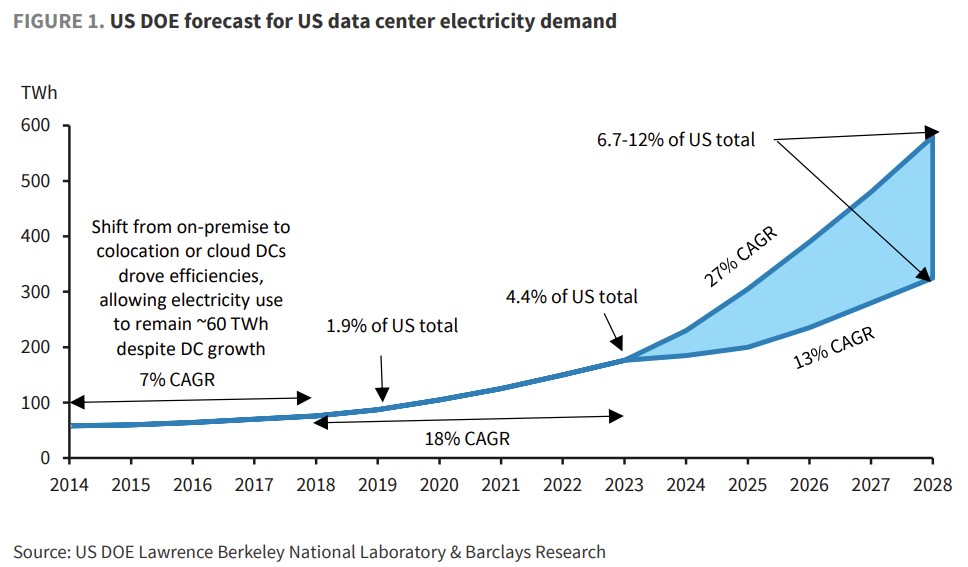
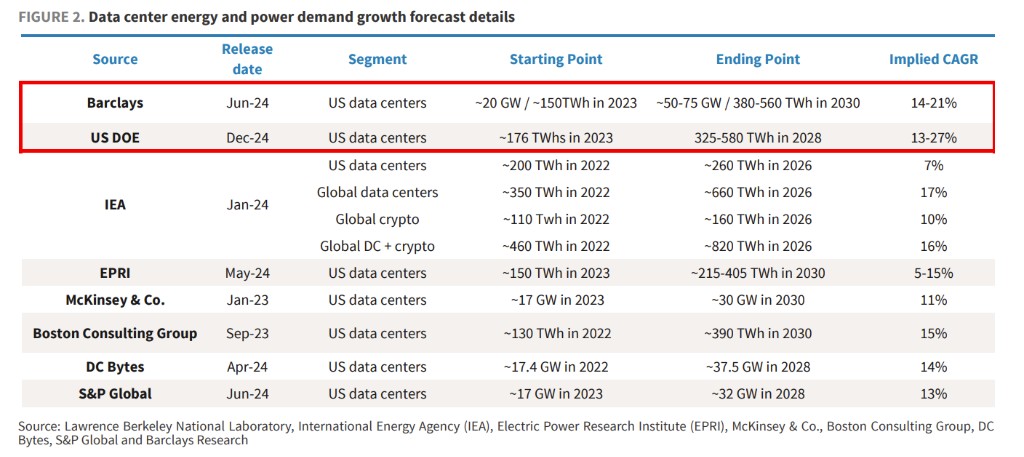
Considering the growth in demand for AI servers, the U.S. Department of Energy predicts that from 2023 to 2028, the electricity demand of data centers in the United States is expected to grow by 13-27% annually, higher than the 15% forecasted by many institutions
The market still underestimates the electricity-hungry AI.
On January 3rd, Barclays analyst William Thompson and his team released a report analyzing and summarizing the approximately 70-page congressional authorization research report published by the U.S. Department of Energy (DOE). The U.S. Department of Energy predicts that starting in 2023, the electricity demand of U.S. data centers (excluding cryptocurrency) will increase by approximately 13-27% annually, reaching 325-580 TWh (1 terawatt-hour = 1 billion kilowatt-hours) by 2028, accounting for 6.7%-12% of the total electricity demand in the U.S. According to this prediction, the electricity demand of U.S. data centers is expected to grow 2-3 times from 2023 to 2028.

Barclays stated that this growth forecast is significantly higher than the 15% predicted by many institutions and also exceeds Barclays' previous report, "Powering AI: Calibrating US Data Center Energy Demand," which anticipated a growth of 14-21%. However, Barclays pointed out in this report that there is uncertainty in the predictions due to rapid changes in data center deployment, equipment types, operational practices, and cooling systems.
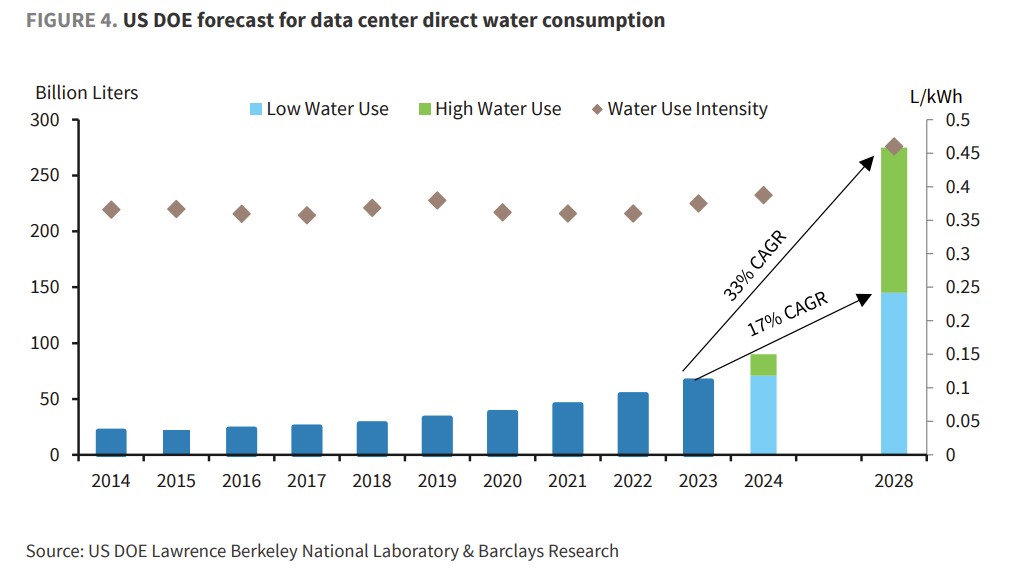
Additionally, the U.S. Department of Energy also predicts that in the coming years, the water consumption of U.S. data centers will grow faster than the growth in electricity demand. Currently, direct water consumption has surged from 21 billion liters in 2014 to 66 billion liters in 2023, and it is expected to increase by about 2-4 times by 2028.
Data Center Energy Demand Growth Exceeds Market Expectations
The U.S. Department of Energy report shows that the electricity consumption of U.S. data centers in 2023 is 176 TWh, accounting for 4.4% of the total electricity demand in the U.S. It is expected that by 2028, electricity demand will increase to 325-580 TWh, accounting for 6.7%-12% of the total electricity demand in the U.S.

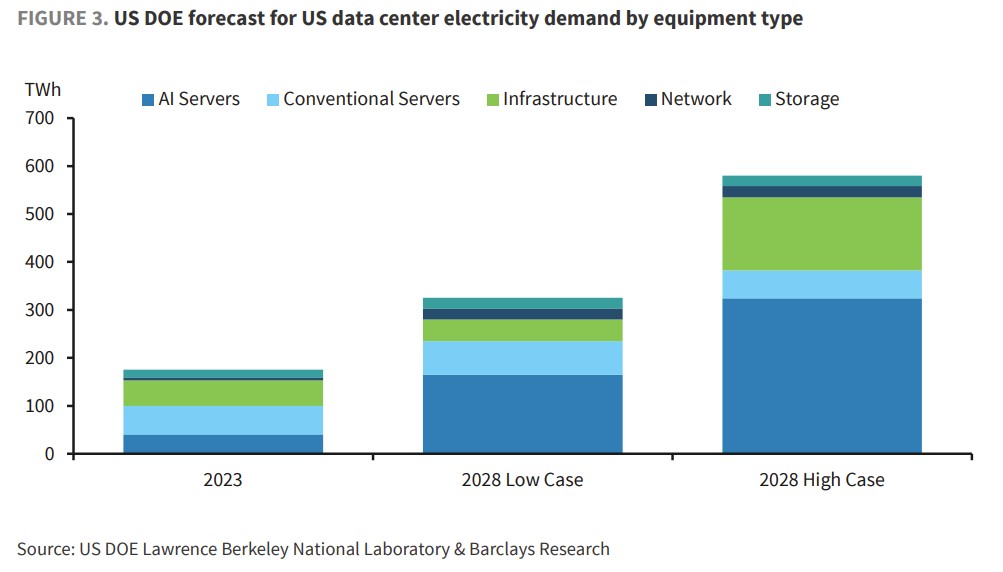
According to the Department of Energy's research, AI servers are the main driver of electricity demand growth.
According to the report, the electricity demand of AI servers is expected to increase from approximately 40 TWh in 2023 to about 165 TWh (low estimate) to 325 TWh (high estimate) by 2028, growing approximately 4-8 times. The research indicates that by 2028, AI training consumption will exceed AI inference demand, accounting for 50-53% of the total energy consumption of AI servers, as more high-power GPUs will be used for AI training.
As for the electricity demand of traditional servers, the U.S. Department of Energy expects little change, increasing from approximately 60 TWh in 2023 to about 60 TWh (low estimate) to 70 TWh (high estimate) by 2028

Water Consumption in Data Centers Will Outpace Electricity Demand Growth
The Department of Energy's research also indicates that the direct water consumption of data centers in the United States (primarily related to cooling) has surged from 21 billion liters in 2014 to 66 billion liters in 2023, and is expected to grow by about 2-4 times by 2028, reaching approximately 145-275 billion liters.
Interestingly, the report also suggests that the direct water intensity (water usage per kilowatt-hour) is expected to increase from about 0.38L/kWh in 2023 to approximately 0.45-0.48L/kWh by 2028. Barclays assumes this reflects a change in the proportion of water-cooled chillers—used to cope with the increasing energy density of AI data centers.
It is noteworthy that the report's forecasts do not include nearly 80 billion liters of indirect water consumption, which is the water used to generate electricity, such as for nuclear power and steam in coal-fired power plants. When accounting for this portion of water usage, it would add approximately 4.5 liters of water consumption per kilowatt-hour.