


Due to relatively delayed deliveries, the Bank of England is selling gold at a discount

Due to market concerns that the United States may impose new tariffs, global traders are eager to ship gold to the U.S., resulting in a discount on the gold price in the Bank of England's vault, which is more than $5 below the London spot gold price, with withdrawal waiting times extended to several weeks. This phenomenon is rare, mainly because traders hope to obtain a higher premium before the tariffs are implemented. The surge in demand for gold withdrawals from the Bank of England has led to a decrease in its gold's attractiveness in the market
According to the Zhitong Finance APP, recently, due to market concerns about a new round of tariffs that U.S. President Trump may impose, global traders are rushing to ship gold to the United States. This surge in demand has led to a discount on the gold prices in the Bank of England (BOE) vault, with waiting times for gold withdrawals extending to several weeks.
Insiders have revealed that the gold in the Bank of England vault is currently priced more than $5 below the London spot gold price, a level of price discrepancy that is extremely rare. Typically, the gold prices stored by the BOE should align with those of other major vaults in the London market, such as JP Morgan and HSBC. Traders have noted that past fluctuations in gold prices influenced by central bank trading activities usually do not exceed a few cents per ounce.
The primary reason for this anomaly is that global traders are eager to transport gold to the United States before the tariffs are implemented to secure higher premiums. Although Trump has not yet imposed tariffs specifically on precious metals, traders are concerned that gold may fall under the broad tariffs he has threatened to impose.
In light of this urgent situation, staff at the Bank of England are struggling to cope with the surge in gold withdrawal requests, and the increased waiting times have made the gold in its vault less attractive compared to that in other commercial vaults in London, such as JP Morgan and HSBC.
The Bank of England holds over 400,000 gold bars, with a total value exceeding $450 billion, most of which belongs to various central banks, with a small portion held by major gold traders. However, according to data from the London Bullion Market Association (LBMA), the total gold reserves in the London market exceed 8,000 tons, a significant amount of which is held by ETFs, central banks, and long-term investors, and has not entered the circulating market.
Due to market concerns about tariffs, gold prices on the New York Mercantile Exchange have been significantly higher than international benchmark prices over the past few months. Previously, traders sold gold futures at high prices, but now they need to purchase gold on the spot market to fulfill delivery obligations, leading to tight supplies of circulating gold in the London market.
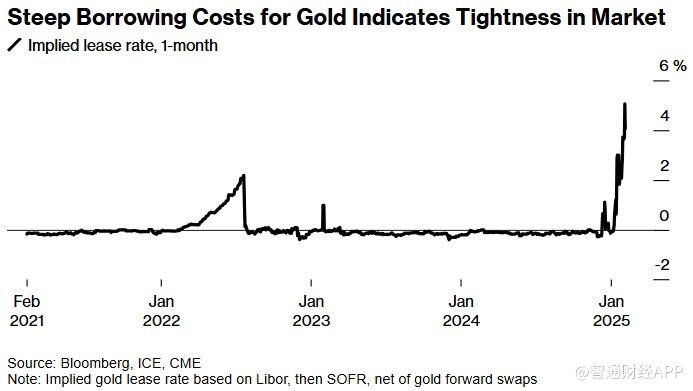
This tension is particularly evident in the gold leasing market: one-month gold leasing rates have surged to 4.7%, far above the typically near-zero rates. This means that investors holding gold can achieve higher returns, attracting some central banks to borrow gold through the Bank of England to earn additional income. The forward price of gold is lower than the spot price (known as backwardation), a phenomenon that is extremely rare in the gold market, indicating market concerns about a short-term gold shortage.
Some central banks typically borrow gold through the Bank of England when interest rates rise, thus becoming an important source of liquidity during market tightness. However, this situation is unique; due to the surge in gold demand, the Bank of England has been unable to process a large number of withdrawal requests in a timely manner, leading to a mismatch in supply and demand in the market.
Former JP Morgan precious metals trader Robert Gottlieb pointed out that the delays at the Bank of England are primarily due to a large number of gold traders borrowing from the central bank, but the BOE itself is not a commercial vault and lacks efficient commercial operational capabilities, ultimately creating a "bottleneck."
 Another issue is that the 400-ounce gold bars traded in London cannot be directly delivered to New York; traders must first refine them into 100-ounce or kilogram gold bars in places like Switzerland before airlifting them to the United States, which further drives up the gold premium. At one point, the gold premium reached as high as $50 per ounce, making arbitrage trading exceptionally lucrative.
This is not the first time that withdrawal delays have occurred at the Bank of England's vault. John Reade, senior market strategist at the World Gold Council, stated, "Some investors may begin to regret choosing the Bank of England to store their gold and may reconsider whether to store gold in more easily accessible commercial vaults in the future, despite the higher costs."
The London Bullion Market Association (LBMA) has indicated that it is aware of the "market dynamics triggered by U.S. tariffs" and is closely communicating with market infrastructure providers, industry associations, and regulatory agencies to clarify the potential impact of tariff policies on the market
