Tech giants like Amazon are firmly pursuing their dreams in AI, betting on funds as the "AI ASIC wave" approaches

American tech giants such as Amazon are increasing their investments in the field of artificial intelligence, with expected investments of up to $100 billion, primarily for data centers and AI chip development. Nevertheless, Amazon's cloud computing division AWS may face capacity constraints that could hinder its ability to meet the growing demand for AI computing power. CEO Andy Jassy warned that growth may be volatile, and limitations related to hardware procurement and power supply could impact its development
According to the Zhitong Finance APP, executives from the American tech giant Amazon (AMZN.US) stated during an earnings conference call with investors that despite plans to invest up to $100 billion this year—most of which will be used for data center construction, collaborating with chip manufacturers to launch AI chips, and other equipment investments to provide artificial intelligence computing power resources services, they emphasized that its cloud computing division AWS may still face capacity constraints—that is, the infrastructure may still be unable to meet the incredibly strong AI computing power demands of cloud customers. Meanwhile, as American tech giants continue to pour money into the artificial intelligence sector, the market is pricing in real money that the two major AI ASIC giants may be the biggest winners of this cash-burning frenzy.
CEO Andy Jassy is committed to transforming Amazon into his latest vision of an "AI superstore," making significant investments to maintain the tech giant's absolute leading position in the cloud computing services sector. However, he warned that growth could experience "significant fluctuations" and hinted that Amazon may face AI capacity issues related to hardware procurement delays and insufficient power supply.
Jassy stated during the conference following the release of the fourth-quarter financial report on Thursday local time: "Without some capacity constraints, or limitations in production capacity, our growth could be much faster than expected."
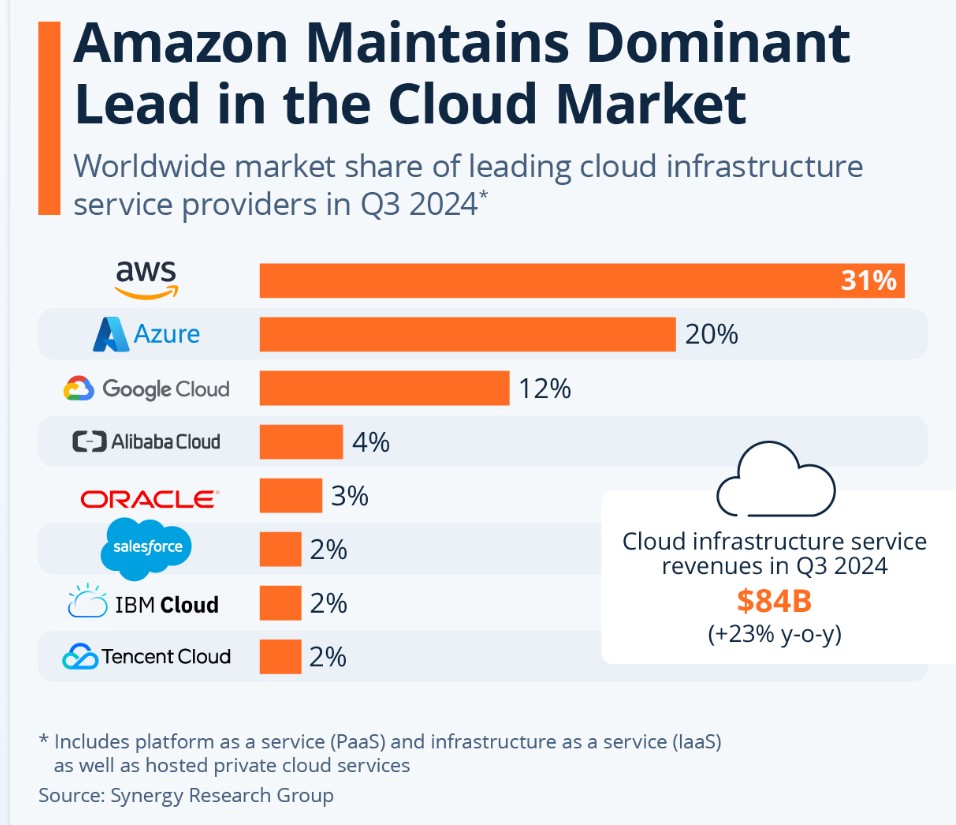
Amazon, Microsoft, Meta, and Google are all in agreement, stating that they cannot meet the explosive demand for AI computing power. Amazon's concerns are largely similar to those of its strongest competitor in the cloud computing field, Microsoft. The market shares of AWS and Microsoft Azure, the two cloud computing giants, far exceed those of other cloud participants, with their combined share exceeding 50%.

Last week, Microsoft stated that its cloud business sales growth was significantly negatively impacted due to a lack of sufficient data centers to meet the enormous AI computing power demands of its AI developer platform and cloud inference end.
Undoubtedly, as the "new paradigm of low-cost computing power" led by DeepSeek sweeps the globe—with an extremely low investment cost of less than $6 million and under the conditions of 2048 H800 chips with performance far below H100 and Blackwell, DeepSeek trained an open-source AI model with performance comparable to OpenAI's o1, the costs of AI training and application inference are increasingly declining.
However, the latest financial reports and performance outlooks indicate that American tech giants such as Amazon, Microsoft, and Google remain committed to their massive spending plans in the artificial intelligence sector, with the core logic being that they bet the new paradigm of low-cost computing power will drive the accelerated penetration of AI applications into various industries worldwide, leading to exponential growth in the demand for inference-end AI computing power, thus requiring more resources to meet market computing power needs. This is also why ASML, the giant in lithography machines, emphasized during its earnings meeting that the reduction in artificial intelligence costs means the application scope of AI is expected to expand significantly.**
From the recent global capital flows and stock market dynamics, the biggest winner benefiting from the massive AI spending by American tech giants is not the "AI chip leader" NVIDIA, but the two major AI ASIC giants—Broadcom and Marvell.
The core logic of this latest investment trend lies in the fact that as generative AI software and cutting-edge AI applications like AI agents become widely adopted in the future, the demand for AI computing power at the cloud inference end will become increasingly enormous. Coupled with the new paradigm created by DeepSeek that significantly reduces inference costs, the self-developed AI ASICs created by cloud giants in collaboration with Broadcom or Marvell, focusing on efficient and massive-scale neural network parallel computing in the AI inference field, have hardware performance, cost, and energy consumption advantages that are far superior to NVIDIA's AI GPUs.
Therefore, the rapid expansion of the AI chip market at the inference end provides tremendous growth opportunities for chip companies like Broadcom and Marvell, and their stock price trends are expected to enter a "NVIDIA-style surge curve."
To achieve the "grand vision of artificial intelligence," American tech giants continue to burn cash
Amazon's leader Jassy stated that the supply of AI chips—whether from third parties like NVIDIA or Amazon's own chip design and R&D departments, as well as power supply capacity—is limiting AWS's ability to officially operate some newly established large-scale data centers. He mentioned that as resources are integrated into AI projects, these limitations may ease in the second half of 2025.
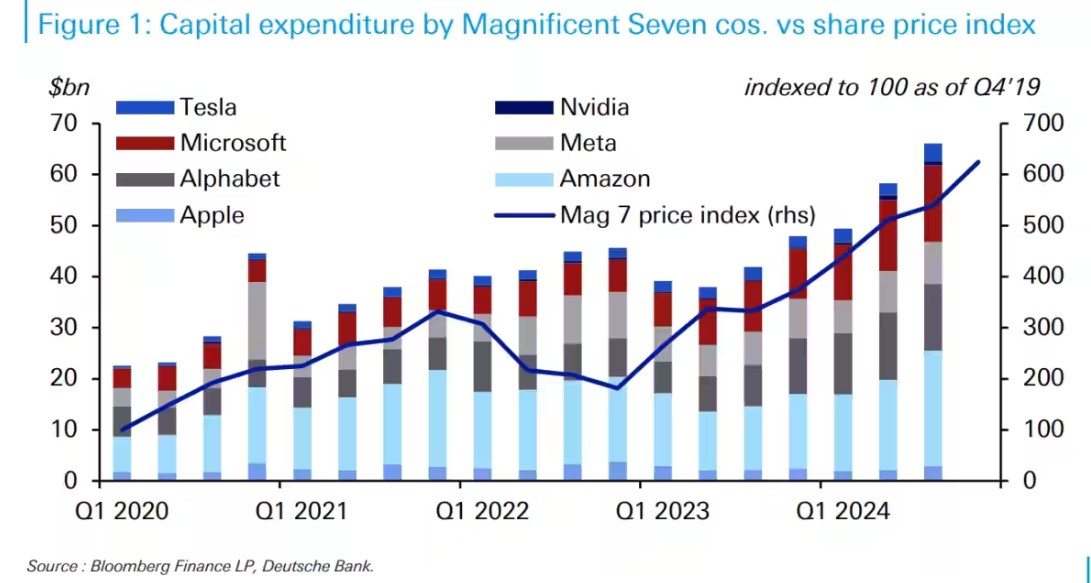
In the last three months of 2024, Amazon's capital expenditure was approximately $26.3 billion, with the vast majority allocated to AI-related projects in Amazon's cloud computing division, AWS, and leaning towards self-developed ASICs rather than purchasing NVIDIA AI GPUs. Jassy told analysts during the earnings call that this amount reasonably represents the company's planned spending pace for 2025.
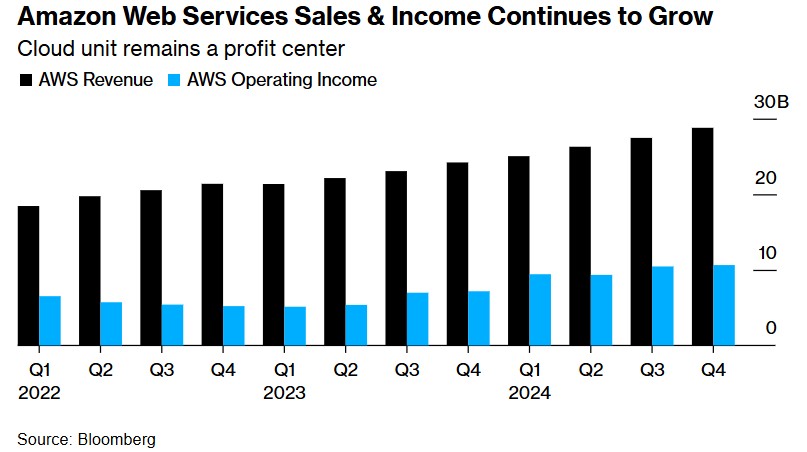
The company's earnings report stated that for the financial quarter ending December 31, AWS's revenue surged by 19% to $28.8 billion. This marks the third consecutive quarter of the cloud computing division achieving growth rates exceeding or reaching 19%. The operating profit of the AWS cloud computing division, which is the focus of the market, reached $10.6 billion, surpassing the market's general expectation of $10 billion, and achieved a significant year-on-year growth of 47%, reflecting the expansion of the cloud computing customer base and the increasing number of cloud customers flocking to AWS's AI application software developer ecosystem—Amazon Bedrock, which aims to greatly simplify the one-stop deployment of applications based on large AI models and provide AI inference computing power resources to support AI workloads.
Amazon AWS Sales and Profits Continue to Grow - Cloud Computing Division Remains Profit Center
Analyst Sky Canaves from eMarketer stated, "The growth of AWS has failed to accelerate, remaining flat compared to the third quarter, indicating that the company faces the same AI computing resource constraints as competitors Google and Microsoft, unable to meet the growing AI computing demands of customers."
As of Friday's market close in New York, Amazon's stock price was $238.83. Due to performance outlooks falling short of expectations, Amazon's stock price dropped over 4% in after-hours trading. Year-to-date, Amazon's stock price has risen 8.9%, and it has increased 44% in 2024.
Analysts are beginning to worry that the "AI cash-burning competition" will inevitably impact profits. In its performance outlook, Amazon stated that for the financial quarter ending in March, it expects operating profits to be between $14 billion and $18 billion, while the average analyst expectation is $18.2 billion; Amazon anticipates that overall revenue for the quarter will reach a maximum of $155.5 billion, while the average analyst expectation is approximately $158.6 billion.
"Although Amazon's overall quarterly performance is positive, investors' immediate focus is on the first quarter guidance being below expectations, primarily due to currency drag and negative impacts from spending," said analyst Gil Luria from DA Davidson & Co.
With the significant reduction in AI training costs led by DeepSeek, and the sharp decrease in inference token costs, AI agents and generative AI software are expected to accelerate penetration across various industries. From the responses of Western tech giants like Microsoft, Meta, and ASML, they have praised DeepSeek's innovation but remain undeterred in their commitment to large-scale AI investments. They believe that the new technological path led by DeepSeek is likely to bring about an overall decline in AI costs, which will inevitably create more opportunities and significantly larger demands for AI applications and inference computing power.
Regarding the spending plan for 2025, Amazon's management expects it to reach $100 billion, and Amazon believes that the emergence of DeepSeek signifies a substantial expansion in future inference AI computing demands, thus increasing spending to support AI business development. CEO Jassy stated, "We will not procure without seeing significant demand signals. When AWS expands its capital expenditures, especially in a once-in-a-lifetime business opportunity like AI, I think this is a very good signal for the medium to long-term development of the AWS business."
Last week, the three giants Google, Microsoft, and Meta insisted on investing heavily in the field of artificial intelligence. Despite facing the low-cost shockwaves brought by DeepSeek, these tech giants firmly believe that large-scale investments will lay a significant foundation for the future enormous demands for inference AI computing power.
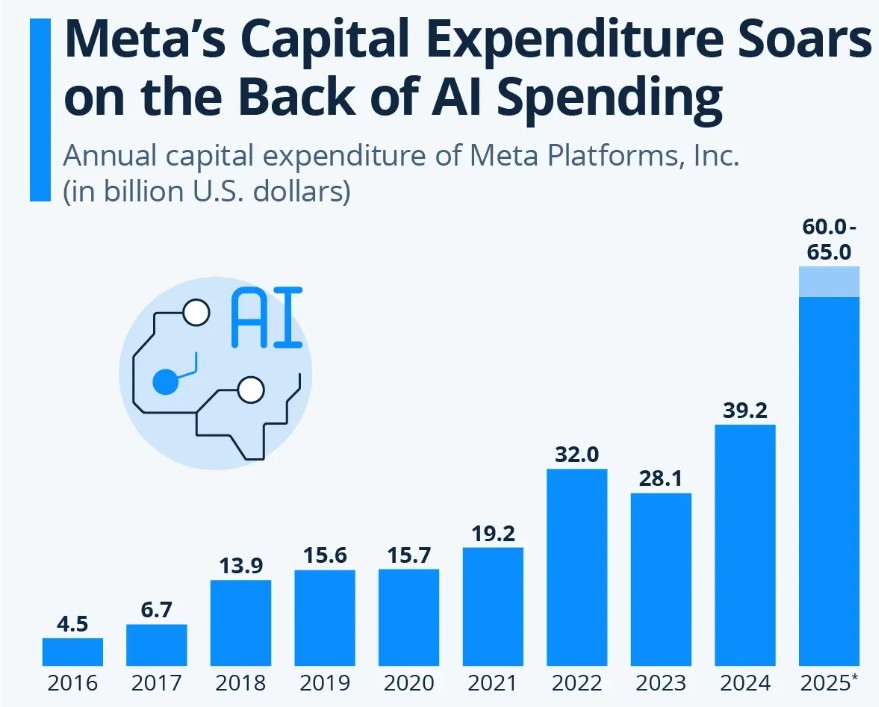
According to Visible Alpha's forecast, Microsoft's capital expenditure in 2025 is expected to exceed $90 billion, accounting for more than 30% of its revenue. Meta, the parent company of Facebook, has also significantly increased its investment plans, recently announcing a plan to raise its capital expenditure for 2025 by more than 60%, up to $65 billion, which also accounts for more than 30% of its revenue. This plan is aimed at projects closely related to artificial intelligence, indicating that after spending over $38 billion on cutting-edge technology fields such as AI in 2024, Meta will continue to invest heavily in AI this year. Google plans to invest $75 billion in capital expenditures related to AI and other projects in 2025, a significant increase from last year's expenditure of $52.5 billion, far exceeding the average of less than 13% over the past decade.

The market begins to price the biggest winners of the tech giants' "burning money frenzy": AI ASIC
As American tech giants firmly invest heavily in the field of artificial intelligence, the biggest beneficiaries may be the two AI ASIC giants—Broadcom and Marvell. With their technological leadership in inter-chip communication and high-speed data transmission between chips, Broadcom and Marvell have become the core forces in the AI ASIC market in recent years.
Microsoft, Amazon, Google, and Meta, as well as generative AI leader OpenAI, are all collaborating with Broadcom or Marvell to develop AI ASIC chips for massive deployment of AI computing power at the inference end. Therefore, the future market share expansion of AI ASIC is expected to significantly outperform AI GPUs, tending towards equal shares rather than the current situation where AI GPUs dominate—holding up to 90% of the AI chip market. This is also why recently, Broadcom and Marvell's stock prices have risen more than those of NVIDIA and AMD.
Morgan Stanley's recent research report shows that the AI ASIC market size will grow from $12 billion in 2024 to $30 billion in 2027, with a compound annual growth rate of 34%. However, Morgan Stanley stated that the rise of AI ASIC does not mean a cliff-like decline in the prospects of NVIDIA's AI GPUs. The institution believes that these two chip systems will coexist in the long term, providing solutions that combine the advantages of both for end-demand scenarios. Another Wall Street firm, Citigroup, indicated that AI ASICs may ultimately be more closely related to inference, and as the demand for AI computing power at the inference end continues to increase, the market share of AI ASICs will continue to expand.
In addition, Morgan Stanley compared the cost-effectiveness of AI ASICs and AI GPUs in AI training and inference tasks using the TCO model, showing that ASICs have lower initial costs, making them particularly suitable for cloud service providers with limited budgets. Therefore, Morgan Stanley is optimistic about the stock price prospects of Broadcom and Marvell, believing they will benefit from the "DeepSeek shockwave." The demand for reasoning computing power has surged.
During the earnings calls of Google and Meta, Sundar Pichai and Mark Zuckerberg both stated that they would intensify efforts to collaborate with chip manufacturer Broadcom to launch self-developed AI ASICs. The AI ASIC technology partners of these two giants are both leaders in the customized chip field, such as the TPU (Tensor Processing Unit) developed by Google in collaboration with Broadcom, which is a typical example of an AI ASIC. Meta previously co-designed the first and second generations of AI training/inference acceleration processors with Broadcom, and it is expected that Meta and Broadcom will accelerate the development of Meta's next-generation AI chip MTIA 3 by 2025. OpenAI, which received a massive investment from Microsoft and established deep cooperation, announced last October that it would collaborate with Broadcom to develop OpenAI's first AI ASIC chip.
Amazon's management stated that it would deploy AI ASIC computing power infrastructure on a larger scale, with Marvell as Amazon AWS's AI ASIC technology partner. In December last year, Marvell announced a five-year agreement with Amazon AWS to further expand their strategic partnership in AI ASICs, and Marvell will work with Amazon to launch multiple generations of data center AI chip products over the next five years.
Looking ahead to the future of AI computing power, the emergence of DeepSeek R1 also heavily announces the arrival of a new low-cost paradigm characterized by "extreme compression + efficient reinforcement training + significant simplification of AI inference computing power," marking the dawn of the AI ASIC era. After the launch of DeepSeek R1, global tech stock investors and AI enthusiasts in the tech community have shown significant cracks in their faith in NVIDIA's high-performance AI GPUs (Hopper architecture and Blackwell architecture GPUs), leading investors to question: Isn't it much more cost-effective for major companies to collaborate with Broadcom/Marvell to launch self-developed AI ASICs (i.e., customized AI chips)?
As large model architectures gradually converge towards several mature paradigms (such as standardized Transformer decoders and Diffusion model pipelines), ASICs can more easily handle mainstream inference computing loads. Additionally, some cloud service providers or industry giants may deeply couple their software stacks, making ASICs compatible with common network operators and providing excellent developer tools, which will accelerate the adoption of ASIC inference in normalized/massive scenarios.
Looking ahead to the future of computing power, NVIDIA's AI GPUs may focus more on ultra-large-scale frontier exploratory training, rapidly changing multimodal or new structure rapid experimentation, as well as general computing power for HPC, graphics rendering, and visual analytics. AI ASICs, on the other hand, focus on extreme optimization for deep learning-specific operators/data flows, excelling in stable structure inference, high throughput, and high energy efficiency. For example, if a cloud platform's AI workload heavily utilizes common operators in CNN/Transformer (such as matrix multiplication, convolution, LayerNorm, Attention, etc.), most AI ASICs will be deeply customized for these operators; Image recognition (ResNet series, ViT), Transformer-based automatic speech recognition (Transformer ASR), Transformer Decoder-only, and partially fixed multimodal pipelines can all be extremely optimized based on ASIC.
ASICs typically adopt dataflow architecture or tensor processing units to highly optimize matrix multiplication, convolution, activation functions, attention layers, etc. Once certain large model architectures stabilize in commercial scenarios and the inference call volume is extremely high, dedicated custom hardware based on ASIC can significantly outperform general-purpose GPUs in terms of unit energy consumption and unit cost (usually achieving energy efficiency improvements of 2 to 10 times). Therefore, as the inference side increasingly focuses on cost and energy efficiency, AI ASICs have greater prospects for large-scale deployment, especially in the normalization and batch processing of AI inference tasks where neural network structures gradually solidify.
As predicted by Morgan Stanley, in the long run, both will coexist harmoniously, and the market share of AI ASICs is expected to expand significantly in the medium term. NVIDIA's general-purpose GPUs will focus on complex and variable scenarios and cutting-edge research, while ASICs will focus on high-frequency stability, large-scale AI inference loads, and some mature and stable solidified training processes