


On the eve of the AI agent explosion, decoding the next generation of technological revolution and wealth code backed by capital

2025 will be the inaugural year for the commercialization of AI Agents, and investment in the AI industry chain in the capital market is accelerating. According to statistics, since 2024, global financing for AI Agents has exceeded 66.5 billion yuan. In 2024, American AI startups received approximately 97 billion dollars in venture capital, setting a new record. As intelligent entities, AI Agents can autonomously understand and execute tasks, gradually becoming the core engine of industrial transformation. Major tech giants are entering the field, driving the development of AI Agents
As global tech giants fiercely compete in the fields of computing power chips and foundational models, a group of keen investors is quietly laying out plans for the "ultimate application layer" of the AI industry chain—the AI Agent track. This field, referred to as the "super interface of the AI era" by OpenAI CEO Sam Altman, is stirring up structural trends in the capital market. According to statistics from consulting firm LaiMi PEVC, since 2024, the financing amount for the global AI Agent track has exceeded 66.5 billion yuan. In 2024, American AI startups received approximately $97 billion in venture capital funding, setting a new record. Among them, AI companies like xAI, OpenAI, and Anthropic received billions of dollars in massive investments; Musk's xAI completed a $6 billion financing round in December 2024, with investors including a16z.
Driven by the dual forces of capital frenzy and technological iteration, AI Agents are transforming from laboratory concepts into the core engine of industrial change.
Major tech giants are entering the field, and AI Agents welcome their commercialization year
According to Zhitong Finance APP, the so-called AI Agent refers to an intelligent entity capable of perceiving the environment, autonomously understanding, making decisions, and executing actions. Simply put, it is a computer program based on large language models that can gradually achieve given goals through independent thinking and tool invocation. In terms of categories, AI Agents can currently be divided into Autonomous Agents and Generative Agents.
The difference between AI Agents and large models (LLM) lies in the interaction between large models and humans, which is achieved through prompts. The clarity and specificity of user prompts affect the effectiveness of the large model's responses. In contrast, an AI Agent only needs a given goal to independently think and take action towards that goal. Agents can reflect on past data and actions, learn from mistakes, and correct future actions, thereby adapting to the environment, executing tasks more effectively, and successfully achieving goals.
Since the emergence of Microsoft's Copilot assistant in 2023, AI applications are expected to undergo three stages:
-
Chatbot Era (2023-2024): This stage is primarily focused on experiments and applications for specific scenarios, with few breakthrough results at the application layer. Aside from ChatGPT and MetaAI (both with over 200 million monthly active users), there are almost no large-scale success stories. However, technologies like Gemini and Claude are showing potential.
-
Consumer and Enterprise AI Agent Era (2025-2026): It is expected that during this stage, AI will have the capability to complete entire tasks with limited human intervention, with consumer AI assistants and enterprise intelligent agents becoming mainstream. Additionally, voice interaction and multimodal AI technologies may be widely integrated into various products, similar to Google's breakthrough success with NotebookLM
-
The Era of AI Employees and Consumer Robots (2027-2028): By this stage, digital employees and consumer robots are expected to fully participate in the operations of society and enterprises.
Driven by large models like ChatGPT, in October 2024, Microsoft announced the integration of 10 autonomous AI Agents into Dynamics 365, which can automatically execute business processes such as customer service, sales, finance, and warehousing. These AI Agents support OpenAI's o1 model and possess autonomous learning capabilities, allowing them to execute ultra-complex business tasks across platforms automatically. For example, the well-known American telecommunications company Lumen can save $50 million annually through AI Agents, equivalent to adding 187 full-time employees.
On January 24, 2025, OpenAI launched its first AI Agent—Operator, which can automatically perform various complex operations, including coding, booking travel, and automated e-commerce shopping. On February 2, it officially launched the Deep Research feature aimed at deep research fields. This feature can complete professional reports in 5-30 minutes, supporting high-intensity knowledge workers across multiple fields, powered by the o3 model, and trained through end-to-end reinforcement learning with four modules working in collaboration. It has been launched on ChatGPT, with plans to expand data sources and combine with Operator to execute complex tasks in the future.
In January 2025, Anthropic released the Agent Best Practices Guide, aimed at enhancing the efficiency and flexibility of AI Agents across multiple application scenarios. It also plans to launch the virtual collaborator "AI Colleague" in 2025, capable of writing and testing code. Its flagship product, Claude 3.5 Sonnet, scored first among AI models in computer usage ability in OSWorld testing.
In addition to the frequent actions of foreign giants, domestically, Alibaba Cloud Tongyi Qianwen also launched the ultra-large-scale MoE model Qwen2.5-Max on January 29. This model has pre-training data exceeding 20 trillion tokens and performs excellently in multiple benchmark tests, with overall performance surpassing DeepSeek V3. Tongyi Qianwen has also open-sourced a new visual model Qwen2.5-VL, releasing three size versions: 3B, 7B, and 72B. Qwen2.5-VL and 2.5MAX not only achieve significant performance improvements but also demonstrate strong application potential in AI Agents, especially in computer use. For example, Qwen2.5-VL can operate directly as a visual Agent, reasoning and dynamically using tools to support the completion of multi-step complex tasks on computers and mobile phones, such as automatically checking the weather, booking flights, and sending messages.
On the eve of the Spring Festival, the entry of AI company DeepSeek accelerated the commercialization process of this technological revolution. It is understood that DeepSeek-R1 employs large-scale reinforcement learning technology in the post-training phase, significantly enhancing reasoning capabilities even in cases where labeled data is extremely scarce With this technological advancement, DeepSeek-R1 has demonstrated performance on par with OpenAI's latest version across multiple tasks such as mathematics, coding, and natural language reasoning, and has truly achieved open-source status. This marks a significant step forward in the AI field towards a "low-cost + high-performance" direction.
The continuous development of large models is driving rapid growth in the AI Agent industry. LLM algorithms are continuously iterating and optimizing, while AI Agents supplement the execution capabilities of LLM algorithms, which is an essential path to AGI. The LLM Agent infrastructure generally consists of five components: LLM, perception, planning, memory, and action, with LLM serving as the "brain" of the Agent, providing reasoning and planning capabilities within this system. The cost of inference for large models continues to decline, which is expected to promote the ongoing development of AI Agents. According to Root analysis, the global AI Agent market size is projected to grow from USD 5.29 billion in 2024 to USD 216.8 billion by 2035, with a compound annual growth rate of 40.15% during the forecast period from 2024 to 2035.

Currently, AI Agents have been applied in various scenarios, such as customer service, programming, content creation, knowledge acquisition, finance, mobile assistants, and industrial manufacturing. The emergence of artificial intelligence agents signifies a shift from simple rule matching and computational simulation to a higher level of autonomous intelligence, enhancing productivity and transforming production methods, thus opening up new horizons for human understanding and reshaping the world.
With the continuous advancement of AI technology, AI Agents are no longer limited to simple task execution; they can autonomously work based on complex logic, helping people improve efficiency and achieve leapfrog innovation from 0 to 1. From the current performance across various fields, 2025 is expected to be the inaugural year for the commercialization of AI Agents, with the practical application of agents occurring much faster than anticipated, indicating that AI Agent technology is on the verge of explosive growth.
New Opportunities for ToB SaaS in Various Fields, AI Agents Accelerate Enterprise Intelligence
Currently, AI Agents are profoundly impacting the digital transformation of enterprises, driving SaaS platforms to evolve from simple business management tools into engines for intelligent business.
According to a report by Jiemian News on November 21, 2024, Jensen Huang, CEO of NVIDIA, stated in an interview with two well-known Silicon Valley venture capitalists that modern computing is transitioning from traditional data centers to "AI factories." These factories are not merely facilities for storing and processing data but are important places for generating AI and agents. In the future, these AI factories will become a crucial component of social infrastructure, widely applied across various industries. He specifically mentioned that SaaS platforms will not be disrupted by AI; rather, they will become fertile ground for nurturing agent innovations. "They (SaaS companies) are sitting on a gold mine," Huang stated, "and millions of AI agents will emerge to drive more efficient intelligent management for enterprises in specific tasks." Recently, the well-known North American venture capital firm Y Combinator released a communication video, pointing out that as AI models continue to rapidly improve and compete with each other, a new business model is emerging: Vertical AI Agents.
Looking at specific industries, AI Agents have shown tremendous commercial potential and application prospects in various fields, including e-commerce, education, and intelligent customer service.
I. E-commerce Field
-
Personalized Recommendation Systems: AI Agents can provide personalized product recommendations based on users' shopping history, browsing behavior, and preferences, thereby improving user satisfaction and sales.
-
Intelligent Customer Service and Support: Through natural language processing and machine learning technologies, AI Agents can automatically answer user inquiries, handle order issues, and process return requests, improving customer service efficiency.
-
Voice Assistants and Shopping Experience: AI Agents integrated into smart speakers and mobile applications allow users to shop through voice commands, enhancing shopping convenience.
-
Content Generation and Marketing: Helping businesses generate engaging product descriptions, marketing copy, and social media content to improve marketing effectiveness.
-
Inventory Management and Demand Forecasting: Utilizing big data analysis and machine learning to predict product demand and optimize inventory levels.
II. Education Field
-
Personalized Learning Platforms: Providing personalized learning resources and tutoring based on students' learning progress, interests, and abilities.
-
Intelligent Tutoring and Q&A: Offering 24/7 online Q&A services to help students solve problems encountered in their studies.
-
Adaptive Assessment Systems: Automatically grading assignments and exams, providing instant feedback, and generating personalized learning reports and suggestions.
III. Customer Service Field
-
Automated Customer Service: Automatically handling customer inquiries through natural language processing and machine learning technologies, improving response speed and accuracy.
-
Multi-channel Integration: Integrating various communication channels such as phone, email, and social media to provide a consistent service experience.
As more industries are empowered by AI, the demand for AI Agents will grow rapidly, and the corresponding demand for SAAS companies will also increase significantly.
Leading Technology Companies Quietly Enter the C-end Market, Gradually Forming a Model Ecosystem
In the internet era, C-end users achieve functionality by voluntarily inputting commands into applications; in the era of intelligent agents (AI agents), C-end users can input commands to models to achieve functionality and receive two-way feedback from the models, which interact better with hardware through natural language. This changes the distribution of traffic entry points, as intelligent agent models will replace applications and compete with hardware for traffic entry.
In the ToC field, several technology companies, including Microsoft, Baidu, and Xiaomi, have integrated large models into their flagship products, prompting adjustments in application ecosystem interfaces. Leading technology companies are quietly entering the C-end market, launching self-developed AI Agents, and integrating large models into new flagship products, gradually forming a model ecosystem
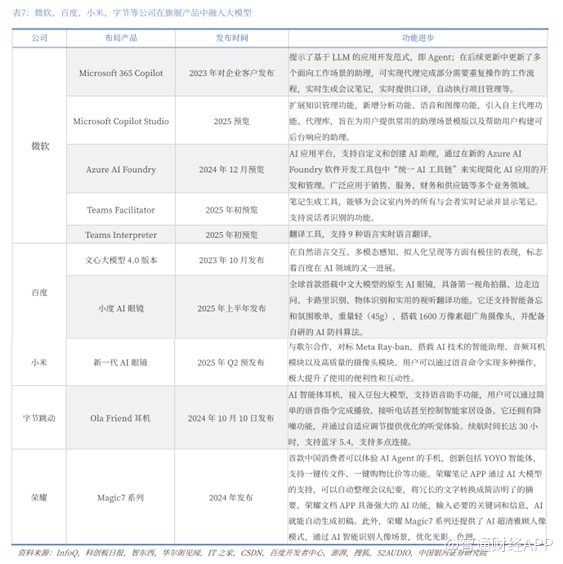
AI smartphones, AIPC, AI glasses, and other edge AI can solve user pain points and usher in significant development opportunities.
The hardware upgrade of AI smartphones is accelerating, with the industry's innovation focus in 2024 centering on edge AI applications. Huawei's HarmonyOS has built a native intelligent architecture through the integration of software, hardware, and cloud, deeply merging AI with the operating system. Users can directly process text, images, and documents through a global drag-and-drop method, achieving functions such as summarization, polishing, and table extraction; OPPO has taken the lead in integrating edge AIGC elimination and AI call summary functions in the FindX7 series; vivo has launched different scales of edge models ranging from 1 billion to 175 billion parameters, constructing a relatively complete AI capability matrix; Xiaomi 14 Ultra is equipped with the first AI large model computing photography platform AISP, applying AIGC technology to real-time processing of digital zoom by integrating CPU, GPU, NPU, and ISP.
The operation of mobile interfaces by AI agents is a complex task, and this challenge is being addressed through the combination of AI and edge computing. The edge-cloud combination allows smartphones to utilize both edge models and cloud models, completing operations using agent methods to balance performance, parameters, and energy consumption shortcomings. Huawei's AI assistant Xiaoyi, equipped with the Pangu large model, now possesses memory perception capabilities for 23 types of TOP scenarios, achieving a task success rate of 90% and seamless integration with over 300 key services.
AIPC smart acceleration brings revolutionary breakthroughs. Intel's Core Ultra processors, equipped with the Intel vPro platform, have achieved leaps in productivity, security, manageability, and stability. AI performance can be improved by up to 2.2 times, with productivity increasing by 47%, and performance in professional applications can even reach 12 times. It features AI Chatbot, AIPC assistant, AI Office assistant, AI local knowledge base, AI image and video processing, and AIPC management functions. Intel has introduced NPU to the desktop, providing up to 13 TOPS of AI computing power, with the platform's overall computing power reaching up to 36 TOPS. It also integrates WiFi 6E, Bluetooth 5.3, and supports WiFi 7 and Bluetooth 5.4.
For wired connections, it has integrated Thunderbolt 4 for the first time. Lenovo's Yoga Pro9i and Yoga9i 2-in-1 devices are equipped with the latest Intel Core Ultra processors and Lenovo AI chips, featuring Yoga Creator Zone generative AI software that can convert text-based descriptions or sketches into images; the Aura series, co-developed by Lenovo and Intel, is characterized by "lightweight, powerful, and AI," embedding the "Tianxi Personal Intelligent System," which has capabilities for natural interaction and perception, intention understanding, and task planning AI glasses equipped with large models are gradually becoming more functional, ushering in new development opportunities. Gyges Labs' self-developed DigiWindow technology is based on retinal projection principles, creating the world's lightest and smallest near-eye display optical solution, enabling smart glasses to be truly wearable all day long. These AI glasses are not only compact and lightweight but also reduce power consumption and achieve complete optical compatibility for myopia and hyperopia. Gyges Labs integrates collaborative AI into the technology, endowing wearable hardware devices with perception and interaction capabilities, thereby further expanding their commercial value. The AI glasses from Gyges Labs realize bidirectional synchronous translation functions and connect to multiple large models, such as Tongyi Qianwen and Baidu Wenxin Yiyan, providing multi-task processing capabilities for object recognition, text translation, and solving mathematical problems. Additionally, users can receive and send information without obstructing their line of sight; these AI glasses can also intelligently provide information prompts based on user needs and the environment, such as schedule reminders and weather information.
Related Stocks
Compared to the C-end, the B-end will benefit more significantly in the short term, and B-end software companies will have opportunities for revaluation.
In terms of individual stocks, Kingdee International (00268): a leading domestic ERP company, established in 1993, has undergone multiple business expansions and transformations. It is currently in a critical period of cloud transformation, with cloud revenue expected to exceed 80% in the first half of 2024, and ARR growing by 24.2% year-on-year, validating the smooth progress of cloud transformation. As a top global ERP player, Kingdee possesses deep industry understanding and development experience, mastering data and metadata in different business scenarios of ERP. In 2024, it will release multiple AI agents and gradually deepen AI applications according to the "Cangqiong APP (mobile end) + AI Agent + Agent development platform (enterprises can quickly build intelligent agents)" model. Against the backdrop of economic stabilization and innovation-driven growth, its performance inflection point is approaching, and AI applications are expected to bring greater development space.
China Software International (00354) is a large comprehensive software and information service enterprise in China, providing "end-to-end" software and information services from consulting, solutions, outsourcing services to IT talent training. In May 2023, it established the AIGC Research Institute, focusing on the AI Agent field, and has developed core capabilities for building AI Agent applications, including agent application orchestration capabilities, structured data usage capabilities, and unstructured knowledge usage capabilities. The JointPilot (Lingxi) AI application platform enables rapid and flexible customization of complex tasks; the Lingxi Wenshu product improves NL2SQL accuracy and end-to-end accuracy in scenarios, reaching SOTA levels; Lingxi Wenzhi addresses challenges in processing unstructured knowledge documents. There are currently 12 agents, with plans to expand to 50 by the end of the year. Collaborating with Huawei Cloud's AI native application engine to create the "Wen series" AI Agent products. Partnering with Huawei Cloud's AI native engine and binding sales channels, it is expected to achieve large-scale promotion of Agent products by 2026.
Kingsoft Cloud (03896): Founded in 2012, leveraging Kingsoft Group's enterprise-level service experience, it has built a complete cloud computing infrastructure and operational system, providing over 150 multi-domain solutions and serving more than 500 quality clients In 2023, fully embrace AI and build a full-stack public cloud infrastructure for the entire industry. On February 8, 2025, it was announced that DeepSeek - R1/V3 would be supported in public cloud scenarios and state-owned cloud/government cloud scenarios, with public cloud providing image services for distilled models, and relevant models being listed on the state-owned cloud/government cloud platform, integrating self-developed content security services
