


2024 Global Pharmaceutical Giants' Self-Insurance Business Ranking TOP 10

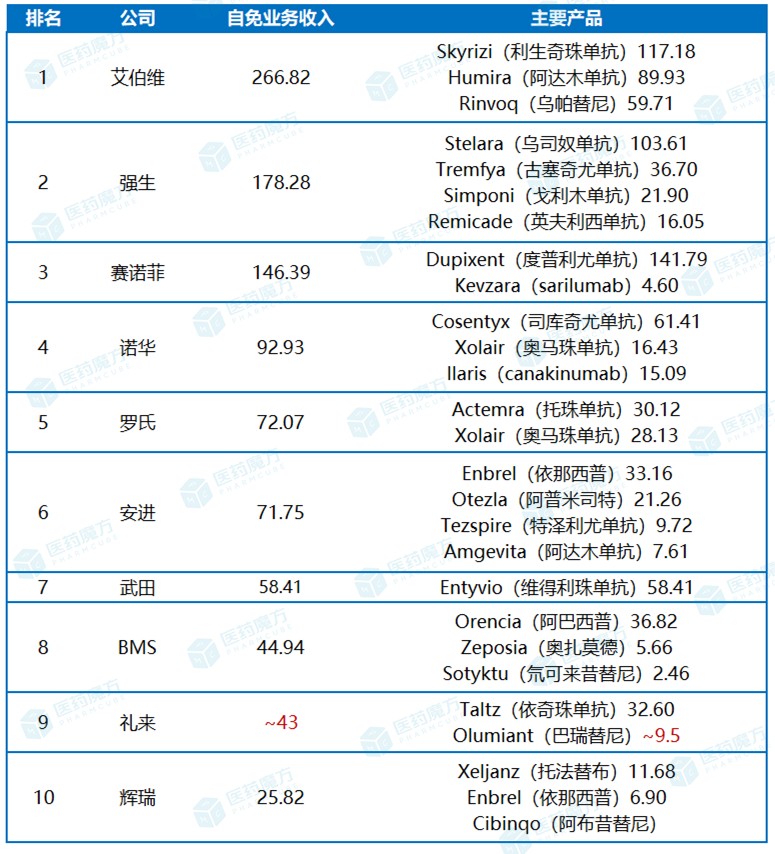
In 2024, the top ten global pharmaceutical giants in the autoimmune business ranking include Abbvie, Johnson & Johnson, Eli Lilly, and NOVARTIS AG, among others, which have enhanced their competitiveness through mergers and acquisitions. The number of M&A transactions in the autoimmune field increased by 150% year-on-year, boosting market vitality and driving the development of a new generation of drugs. Pfizer's performance in the TOP 10 has declined, with a decrease in sales of major products, but there are still new drugs under development
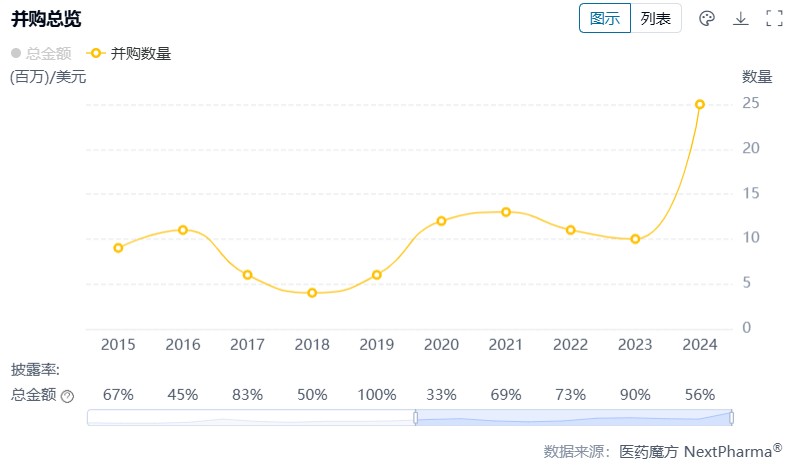
2024 is a year of explosive growth in the field of autoimmune diseases, with the scale of merger and acquisition transactions reaching a historical high, totaling 25 transactions throughout the year, a year-on-year increase of 150%. Pharmaceutical giants such as Abbvie, Johnson & Johnson, Eli Lilly, and Novartis continue to ramp up their investments, building competitive barriers in the autoimmune field through strategic mergers and acquisitions.
Number of M&A transactions in the autoimmune field over the years
Through continuous exploration and practice, the value of sub-sectors such as inflammatory bowel disease and IgA nephropathy in the autoimmune field has gradually gained attention from the industry. At the same time, cutting-edge technologies such as CAR-T and TCE have been innovatively introduced into the autoimmune field. Additionally, more drug developments targeting classic autoimmune targets have entered a new iteration cycle, while targets such as PD-1 and BTK, which originally shone in the oncology field, also show great potential in autoimmune diseases.
Today, the autoimmune field is radiating unprecedented vitality, and its market dynamism has been further activated. This fertile ground has not only nurtured a new generation of super blockbuster products but has also enabled major giants to achieve dominance in the autoimmune field. Next, let us unveil the TOP 10 autoimmune business revenues for 2024, analyze the product layouts and pipeline evolution logic of these autoimmune giants, and explore the future development trends in the autoimmune field.
TOP 10 global pharmaceutical giants in autoimmune business revenue for 2024
NO.10 Pfizer
Although Pfizer's autoimmune business remains in the TOP 10, it seems to be showing a trend of gradual decline year by year. The JAK inhibitor Xeljanz (tofacitinib) is unable to escape the impact of the patent cliff, with sales in 2024 amounting to $1.168 billion, a year-on-year decrease of 31%. Enbrel (etanercept), co-developed by Amgen and Pfizer, sees the bulk of its revenue going to Amgen, with Pfizer receiving $690 million in 2024, a year-on-year decrease of 17%.
The JAK1 inhibitor Cibinqo (abrocitinib) is an iterative product of tofacitinib, featuring higher target selectivity. Abrocitinib's growth momentum is also strong, with a year-on-year increase of 69% to $215 million in 2024; however, its overall scale has yet to grow, falling far behind the sales of the same-target product upadacitinib.
Fortunately, Pfizer still has trump cards. The IFNβ monoclonal antibody dazukibart has advanced to Phase III, while the IL-4/IL-13/TSLP tri-antibody PF-07275315 and the IL-4/IL-13/IL-33 tri-antibody PF-07264660 are in Phase II

NO.9 Eli Lilly
Eli Lilly's Taltz (ixekizumab) is the second IL-17A monoclonal antibody approved for market globally, and its market performance is also good, achieving sales revenue of USD 3.26 billion with a growth rate of 18% in 2024. In the development of iterative drugs, Eli Lilly is heavily betting on oral IL-17 small molecule inhibitors, having acquired DICE Therapeutics for USD 2.4 billion in 2023, bringing in two IL-17 small molecule inhibitors, DC-806 and DC-853, although DC-806 has failed.
The 2024 Q4 financial report did not disclose the specific sales figures for the JAK inhibitor Olumiant (baricitinib), but based on the data from the first three quarters (USD 696 million), it can be roughly estimated that its sales for 2024 will be around USD 950 million, basically flat compared to last year.
Omvoh (mirikizumab) entered the market in 2023, marking an important move for Eli Lilly in the inflammatory bowel disease (IBD) space. This drug is the first IL-23 antibody approved for the treatment of ulcerative colitis and has recently gained a new indication for Crohn's disease.
In 2024, a major move for Eli Lilly in the autoimmune field is the acquisition of Morphic Therapeutic for USD 3.2 billion. This acquisition strengthens Eli Lilly's layout in the IBD space, not only acquiring an oral small molecule α4β7 inhibitor MORF-057 that is in Phase II clinical trials but also solidifying its preclinical pipeline with new candidates such as next-generation α4β7 inhibitors, αvβ8 inhibitors, α5β1 inhibitors, and TL1A/IL-23 targeted drugs.
NO.8 BMS
BMS's best-selling autoimmune product is the CTLA4-Fc fusion protein Orencia (abatacept), which, after nearly 20 years of market penetration, is expected to achieve sales of USD 3.682 billion in 2024. The oral selective S1PR modulator Zeposia (ozanimod) was launched in 2020 and has now been approved for two indications: multiple sclerosis and ulcerative colitis, with revenue growing to USD 566 million.
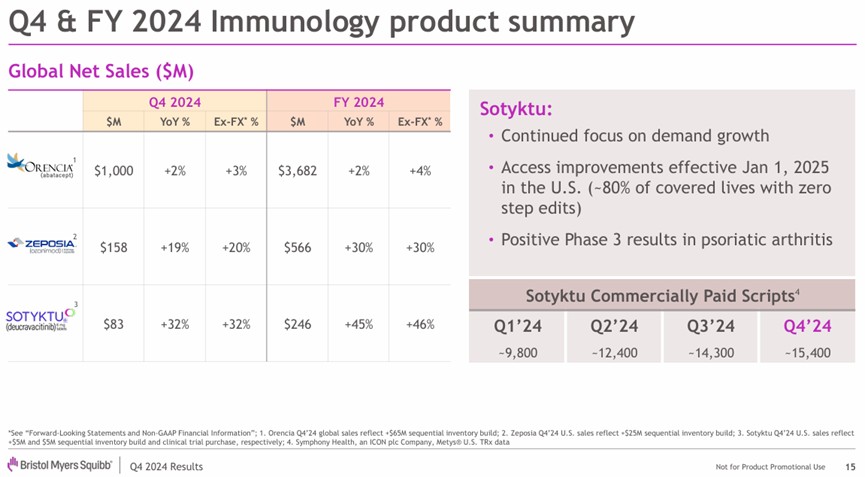
As the world's first TYK2 allosteric inhibitor, Sotyktu (deucravacitinib) has completed its second full year of sales, achieving revenue of USD 246 million, which is below market expectations. Currently, deucravacitinib has only secured one indication for plaque psoriasis, but its two Phase III studies for treating psoriatic arthritis have been successful, and it is expected to further expand its market in the future It is worth noting that in the update of the 2024 Q4 financial report, BMS removed the IL-13 monoclonal antibody cendakimab, which is already in Phase III. This move is based on existing data and aims to prioritize investments and opportunities with a more competitive advantage. Similarly, the development of the second-generation TYK2 inhibitor BMS-986322 has also been slowed down by BMS.
Currently, BMS's investment focus in the autoimmune field is mainly concentrated on three directions: controlling inflammation, resetting immune memory, and promoting balance. In line with these strategic focuses, the LPAR1 antagonist admilparant and the CD19 monoclonal antibody Obexelimab have progressed to Phase III clinical stages.
NO.7 Takeda
Takeda's successful strategy in the autoimmune field lies in finding differentiated breakthroughs. Unlike most autoimmune products that focus on dermatological diseases such as atopic dermatitis and plaque psoriasis, Takeda's α4β7 monoclonal antibody Entyvio (vedolizumab) early on bet on inflammatory bowel disease (IBD) indications. Now, after ten years on the market, vedolizumab has become the best-selling biologic in the IBD space, with projected revenue of 880.7 billion yen (approximately 5.841 billion USD) in 2024.
However, as more players enter the IBD space, many emerging competitors are poised to launch, and the competition from biosimilars is also a factor that cannot be ignored. In the future, under this dual pressure, it may be difficult for vedolizumab to maintain long-term growth.
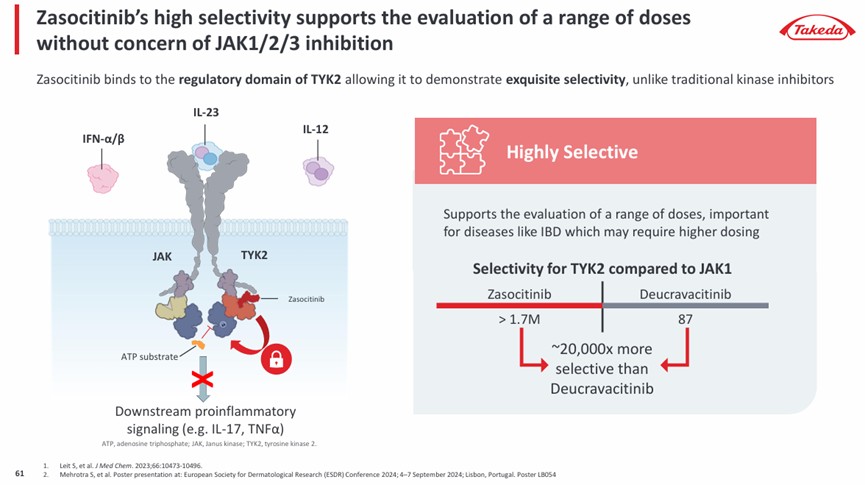
Next-generation autoimmune products are on the way. Takeda's acquisition of the TYK2 inhibitor zasocitinib (TAK-279) for 6 billion USD has advanced to Phase III clinical stages, and this drug has the potential to treat major autoimmune indications such as IBD and plaque psoriasis. Takeda has estimated the potential peak sales of zasocitinib to be between 3-6 billion USD and believes there is significant room for market entry.
The exploration of the CD38 monoclonal antibody mezagitamab in immune thrombocytopenia has also entered Phase III. Currently, the two approved CD38 monoclonal antibodies, daratumumab and isatuximab, are both approved for multiple myeloma indications, while Takeda hopes that mezagitamab can bring innovation and fundamentally address autoimmune diseases.
NO.6 Amgen
Amgen has a certain foundation in the autoimmune field, with four products: the TNFR2-Fc fusion protein Enbrel (etanercept), the PDE4 inhibitor Otezla (apremilast), the TSLP monoclonal antibody Tezspire (tezepelumab), and the adalimumab biosimilar Amgevita, which maintain Amgen's autoimmune performance at around 7 billion USD It is worth noting that risk signals have emerged. The sales of Infliximab and Apremilast have both declined, especially Infliximab, which saw a 10% year-on-year decrease in revenue for 2024, potentially widening the revenue gap in the self-immune business in the future.
The new increment comes from Tezepelumab, which is currently the only approved TSLP-targeted drug globally. With just the indication for severe asthma, Tezepelumab generated nearly one billion dollars (USD 972 million, +71%) in revenue in its third full year post-launch.
In November 2024, Tezepelumab achieved positive results in the Phase III WAYPOINT study for the treatment of chronic rhinosinusitis with nasal polyps. Next, Amgen plans to submit a new indication application for Tezepelumab in the first half of this year. Meanwhile, Amgen will initiate a Phase III study of the drug for the treatment of chronic obstructive pulmonary disease.
The OX40 monoclonal antibody Rocatinlimab is Amgen's next-generation heavyweight product in the self-immune field, with eight Phase III ROCKET study projects for atopic dermatitis underway, which may see multiple key milestone advancements this year.
NO.5 Roche
After two consecutive years of revenue decline, Roche's self-immune business revenue returned to growth in 2024, rising one position compared to 2023, mainly supported by the IL-6R monoclonal antibody Actemra (Tocilizumab) and the IgE monoclonal antibody Xolair (Omalizumab), both of which have been on the market for about 20 years and generated around USD 3 billion each.
Roche is also seeking new business increments, such as exploring the potential of products from other fields to treat self-immune diseases. According to the 2024 financial report, Roche submitted a new indication application to the FDA in December 2024 for Ocrelizumab to treat lupus nephritis.
Ocrelizumab was approved for marketing in the U.S. in 2013, and its previously approved three indications were all for hematological malignancies. This application makes Ocrelizumab likely to become the first FDA-approved CD20-targeted therapy for the treatment of lupus nephritis. Additionally, Roche is advancing multiple Phase III clinical studies of Ocrelizumab for systemic lupus erythematosus, membranous nephropathy, and idiopathic nephrotic syndrome.
These research plans also reflect Roche's future focus in the self-immune field—immune-mediated kidney diseases. The antisense therapy Sefaxersen aligns with this strategic direction, developed based on Roche's collaboration with Ionis Pharmaceuticals, primarily for IgA nephropathy.
NO.4 Novartis
Novartis's self-immune business is sprinting towards the USD 10 billion mark, achieving USD 9.293 billion in revenue with a growth rate of 21% in 2024. This high growth is largely attributed to the IL-17A monoclonal antibody Cosentyx (Secukinumab), which reached USD 6.141 billion in sales in 2024, a year-on-year increase of 25%. The growth driver for Secukinumab mainly comes from the approval of a new indication for hidradenitis suppurativa and the launch of intravenous formulations In core indications such as psoriatic arthritis, plaque psoriasis, and ankylosing spondylitis, secukinumab also has strong market competitiveness.
The expansion of secukinumab is ongoing, with its Phase III clinical studies targeting giant cell arteritis (GCA) and polymyalgia rheumatica (PMR) expected to announce results in 2025, and it is anticipated that a new indication application for giant cell arteritis (GCA) will be submitted in the second half of 2025, which will bring further growth opportunities.
The other two autoimmune products, Xolair (omalizumab) and Ilaris (canakinumab), are also growing steadily, with revenues of $1.643 billion (+15%) and $1.509 billion (+14%), respectively.
In the autoimmune field, Novartis is advancing a total of 15 Phase I/II clinical projects and 8 Phase III projects. Over the next five years, Novartis expects to read out results for 6 Phase III and more than 10 Phase II projects.
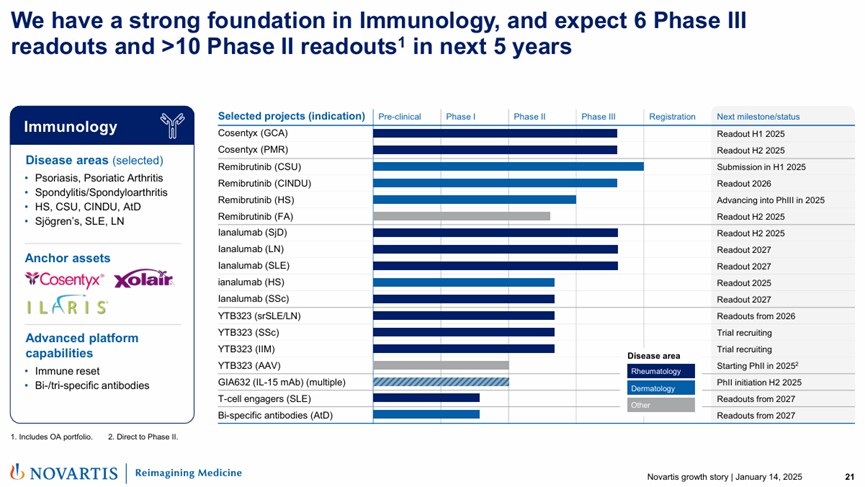
The BTK inhibitor remibrutinib has achieved differentiated success in the Phase III clinical trial for the treatment of chronic spontaneous urticaria (CSU) and is set to be submitted for market approval this year. The BAFF-R monoclonal antibody ianalumab for the treatment of Sjögren's syndrome is also expected to yield Phase III results this year, although the Phase II project for the CD40 antibody iscalimab in the treatment of Sjögren's syndrome has been terminated by Novartis.
NO.3 Sanofi
The blockbuster IL-4Rα monoclonal antibody Dupixent (dupilumab) has propelled Sanofi's autoimmune business to new heights, maintaining a top 3 ranking in the industry. In 2024, the sales of dupilumab reached €13.072 billion (approximately $14.179 billion, +23.1%), making it the best-selling autoimmune product currently. A key factor in the accelerated uptake of dupilumab is its approval for chronic obstructive pulmonary disease (COPD) in Europe and the U.S., becoming the first biologically targeted therapy in this field.
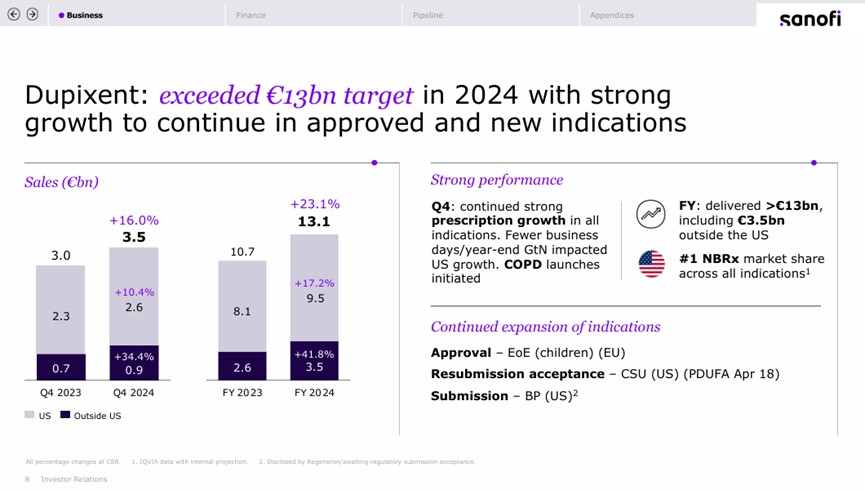
After achieving the COPD milestone, Sanofi submitted new indication applications to the FDA for dupilumab in the treatment of chronic spontaneous urticaria (CSU) and bullous pemphigoid (BP). Currently, the FDA has only approved one biologic, omalizumab (Xolair), for the treatment of CSU, and there are no targeted treatment options available for BP. If these two indications are successfully approved, it will further boost the sales of dupilumab to new heights Dupilumab is certainly still in its prime, but time is running out for Sanofi as the patent cliff of 2028 approaches, making the launch of successor products urgent. The IL-6R monoclonal antibody Kevzara (sarilumab), which was launched in the same year as dupilumab, has shown decent growth, but its sales volume is relatively small, with projected revenue of €424 million (approximately $460 million, +21.0%) in 2024.
More potential stocks are poised to take off. The BTK inhibitor rilzabrutinib has been submitted for approval in Europe, the United States, and China, targeting immune thrombocytopenia indications. Another BTK inhibitor, tolebrutinib, has conducted multiple Phase III studies focusing on multiple sclerosis, with the HERCULES study targeting non-relapsing secondary progressive multiple sclerosis (nrSPMS) achieving its primary endpoint. The Phase III study of the IL-33 monoclonal antibody itepekimab for treating COPD is expected to read out key results this year.
NO.2 Johnson & Johnson
In 2024, Johnson & Johnson's autoimmune performance showed a slight decline, mainly due to the flagship product Stelara (ustekinumab) facing competition from biosimilars, with revenue of $10.361 billion, a year-on-year decrease of 4.6%. According to the pharmaceutical database, nearly 10 biosimilars of ustekinumab have been approved globally.
The IL-23p19 monoclonal antibody Tremfya (guselkumab) maintained double-digit growth, with sales reaching $3.670 billion in 2024 (+16.6%). Over the past year, Johnson & Johnson has intensified its focus on guselkumab, including the approval of new indications for ulcerative colitis and the submission of new indications for Crohn's disease and pediatric psoriasis arthritis.
In the future, Johnson & Johnson still has significant opportunities to turn around the crisis in its autoimmune business. The FcRn monoclonal antibody nipocalimab, acquired for $6.5 billion, has entered the submission phase for approval to treat generalized myasthenia gravis. Previously, two FcRn monoclonal antibodies have been approved by the FDA, namely Argenx/Zai Lab's efgartigimod and UCB's rozanolixizumab, with efgartigimod achieving sales of $1.449 billion in the first three quarters of 2024. With Johnson & Johnson's deep expertise in the autoimmune field and the strong sales capabilities of MNCs, nipocalimab has the potential to capture a larger market.
Additionally, two Phase III studies of the oral IL-23R antagonist icotrokinra for treating plaque psoriasis also reported successful news in November 2024. Based on this, Johnson & Johnson plans to submit a marketing application for icotrokinra. This will also promote the transformation of psoriasis targeted therapies from injectable antibodies to oral medications.
NO.1 Abbvie
Abbvie's autoimmune business has been continuously growing due to Humira (adalimumab), which has generated over $230 billion in revenue over its 22 years on the market As the former "king of medicine," adalimumab still shines, contributing $8.993 billion in sales in 2024.
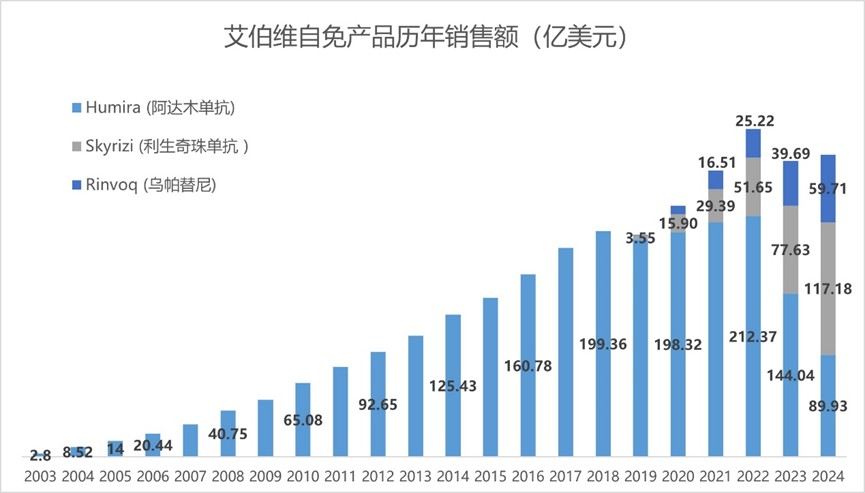
The transition between old and new is the norm in the market. As Humira's brilliance gradually fades, the autoimmune double stars IL-23 monoclonal antibody Skyrizi (risankizumab) and JAK1 inhibitor Rinvoq (upadacitinib) are rising rapidly, with projected growth to $11.718 billion (+50.9%) and $5.971 billion (+50.4%) respectively in 2024.
In June 2024, risankizumab received FDA approval for the treatment of adult patients with moderate to severe active ulcerative colitis, bringing the total number of indications for this product to seven, including plaque psoriasis, psoriatic arthritis, and Crohn's disease. With extensive applications in treating inflammatory bowel disease and dermatological conditions, Nature predicts that this product will enter the top 5 global bestsellers in 2025, reaching approximately $13.7 billion.
Although Abbvie has a strong leading advantage in the autoimmune field, it has not slowed down; instead, it is more actively embracing external innovations to expand its autoimmune portfolio. The PharmaCube database shows that Abbvie completed seven autoimmune-related mergers and acquisitions and business development transactions in 2024, such as acquiring Nimble to obtain its core asset, an oral peptide IL-23 inhibitor, introducing Mingji Bio's targeted TL1A monoclonal antibody, and acquiring Landos Biopharma to gain multiple innovative projects targeting the NLRX1 and PLXDC2 pathways
