


IDC: China's wearable device shipments account for 32% of the global market, making it the largest market, with growth potential still in 2025

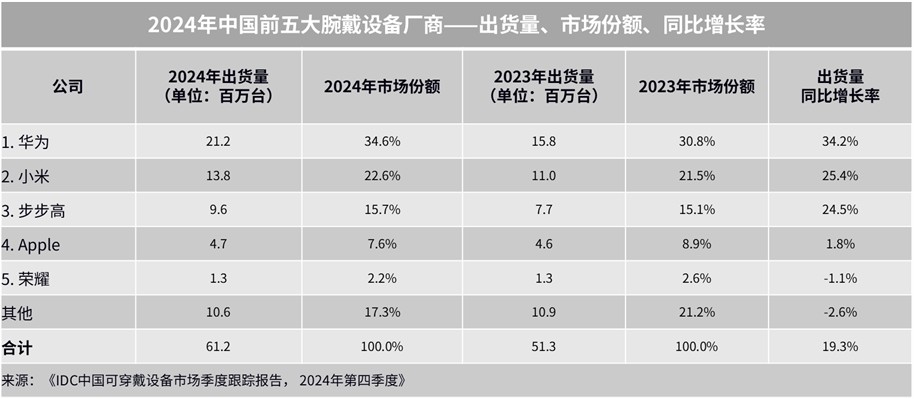
According to the latest report from IDC, the shipment volume of wearable devices in China will reach 61.16 million units in 2024, a year-on-year increase of 19.3%, accounting for 32% of the global shipment total. Despite a slight decline of 1.4% in global wearable device shipments, the Chinese market still shows growth potential, with expectations for continued growth in 2025. In the global wearable market, Apple remains in the lead, while Huawei ranks first in the market under $700
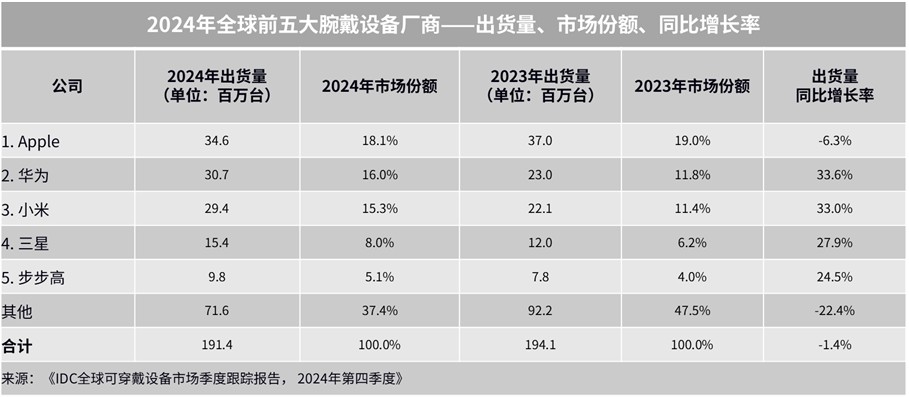
According to the latest "Global Wearable Device Market Quarterly Tracking Report" released by IDC, the global wrist-worn device market is expected to ship 190 million units in 2024, a year-on-year decline of 1.4%. The adult smartwatch market in the United States and India is affected by factors such as an unstable economic environment, a saturated market space, and limited product innovation, leading to a slight decline in global shipments. The shipment volume of wrist-worn devices in China is 61.16 million units, a year-on-year increase of 19.3%, making China the largest wrist-worn device market in the world in 2024, accounting for 32.0% of global shipments. As the largest wrist-worn device market globally, China's market still has growth potential in 2025.
The wrist-worn device market includes smartwatches and wristbands. Among them, the global shipment volume of the smartwatch market is expected to be 150 million units in 2024, a year-on-year decrease of 4.5%; while the shipment volume of smartwatches in China is 43.17 million units, a year-on-year increase of 18.8%. The global shipment volume of the wristband market is expected to be 37.29 million units in 2024, a year-on-year increase of 14.2%; the shipment volume of wristbands in China is 17.99 million units, a year-on-year increase of 20.2%.
2024 Global Wrist-Worn Market Performance:
Apple
Apple (AAPL.US) maintains strong market competitiveness in the global wrist-worn market solely with its smartwatch product line, ranking first in global wrist-worn market shipments in 2024. In addition to important value markets such as North America, Western Europe, and China, Apple has increased its market expansion efforts in developing regions such as Asia-Pacific (excluding China), the Middle East, and Africa, showing a growth trend.
Huawei
Huawei shows strong development momentum in the global wrist-worn market. In 2024, Huawei ranks first in the global wrist-worn market under $700 (pre-tax) in terms of shipment volume. Its product line has been enhanced through the Band, FIT, GT, WATCH, Ultimate, and WATCH D blood pressure monitor series, achieving comprehensive coverage from daily sports health, professional sports to smart wrist experiences and health care. At the same time, significant growth has been achieved in overseas markets in various regions such as Asia-Pacific, the Middle East, Africa, and Latin America. In the Chinese wrist-worn market, Huawei has ranked first in shipment volume for five consecutive years.
Xiaomi
In 2024, Xiaomi (01810) has made significant progress in its wrist-worn product line. The Xiaomi Band 9 achieved impressive performance in the second half of the year, establishing itself as the largest vendor in both the global and Chinese wristband markets, laying an important foundation for the growth of the entry-level wrist-worn market globally and in China. Additionally, Xiaomi's smartwatches have also seen significant growth alongside the group's brand premiumization strategy, especially with the S series receiving better market feedback compared to previous generations.
Samsung
In 2024, Samsung's growth mainly comes from the contribution of its wristband product line, particularly finding a more refined market positioning between entry-level wristbands and entry-level smartwatches in developing regions However, its smartwatch business still faces severe competitive pressure from other leading manufacturers globally.
BBK Electronics
BBK Electronics' children's watch products continue to hold the top position in the Chinese market and further expand their advantages through application software ecosystems, channel differentiation, and refined product line layouts. At the same time, BBK Electronics is gradually expanding its layout in overseas markets to make more localized adaptations for the local children's watch market.
2024 China Wearable Market Performance:
As the largest wearable device market in the world, the Chinese market still has growth potential in 2025, especially with the "National Subsidy" policy having the following main impacts on the Chinese wearable market:
1. The "National Subsidy" policy stimulates broader market demand
Driven by the "National Subsidy" policy, the sales of smartwatches and wristbands have significantly increased. IDC data shows that in January 2025, the sales volume of the Chinese wearable market grew by 41.0% year-on-year, with smartwatches and wristbands increasing by 33.7% and 68.0%, respectively. With the continuation of subsequent subsidy policies and the addition of platform and store discounts, the cost-performance ratio of wearable products will be further strengthened, thereby stimulating broader consumer demand, including users upgrading and purchasing new devices.
2. The market is concentrating on the ¥1000 and ¥1000-2000 price segments, while the ¥2000-3000 segment is significantly driven by the "National Subsidy"
The rapid penetration of the adult smartwatch market over the past year has largely benefited from the increased richness of products in the ¥1000 and ¥1000-2000 price segments, including refined price differentiation, diverse brand options, and varied appearances. This concentration trend will become even more pronounced under the influence of the National Subsidy policy. IDC data shows that in January 2025, the fastest-growing price segments for adult smartwatches in China are ¥500-1000, ¥1000-1500, and ¥1500-2000, with year-on-year growth rates of 83.1%, 112.3%, and 77.0%, respectively. Additionally, the ¥2000-3000 segment has also seen significant growth driven by the subsidy cap of ¥500.
3. Offline channels inject more growth momentum
E-commerce channels previously benefited from substantial growth in various platform subsidies, which significantly impacted offline channels, leading to noticeably weak sales performance over the past year. Although e-commerce channels remain active, the introduction of the "National Subsidy" policy in 2025 has enhanced the attractiveness of offline channel promotions, which will drive significant growth in offline channel sales. In January 2025, the sales of adult smartwatches through offline channels increased by 12.8% year-on-year.
IDC China Research Director Pan Xuefei believes that under the influence of the "National Subsidy" policy, 2025 presents a favorable opportunity for manufacturers to impact the mid-to-high-end smartwatch market. On one hand, it is essential to maintain the ¥1000 and ¥1000-2000 price segments by strengthening product cost-performance ratios and channel capabilities; on the other hand, product pricing needs to consider the impact of "National Subsidy" prices on price segments and the potential internal effects of having two generations running simultaneously In addition, appropriately developing products priced above ¥2000 will make subsidized prices more attractive for mid-to-high-end products. However, brand premiumization remains a long-term strategic goal that all manufacturers need to pursue
