


Morgan Stanley: China's generative AI has entered an explosive application phase, optimistic about Alibaba and KUAISHOU-W

JP Morgan released a research report on March 9, stating that generative artificial intelligence (Gen AI) in China has entered an application explosion phase, which is expected to impact the fundamentals and stock prices of related companies. The report mentioned that the development of Gen AI in China will go through four stages and is currently in the second stage, accompanied by rapid growth in computing power. Morgan Stanley recommends investing in Alibaba and KUAISHOU-W, believing that high-potential Gen AI application beneficiaries may outperform the market
According to the Zhitong Finance APP, JP Morgan released a research report on March 9, stating that generative artificial intelligence (Gen AI) in China has entered an application explosion phase. In this research report, Morgan Stanley established a four-stage framework for the development of Gen AI in China and provided investment strategies for each stage. The bank believes that the development of Gen AI in China will impact the fundamentals and stock prices of the companies it covers for many years; from a 12-month investment perspective, the IAAS (Infrastructure as a Service) value chain is expected to continue to outperform the market, as the development of Gen AI in China has just entered the second stage of its framework, which will be accompanied by rapid growth in computing power. Additionally, the bank believes that high-potential beneficiaries of Gen AI applications may also outperform the market, despite their higher uncertainty and risks. Among the companies it covers, it recommends investing in Alibaba (BABA.US) and KUAISHOU-W (01024).
1. Four Stages of Gen AI Development in China
Morgan Stanley expects that the development of Gen AI in China will go through four distinct stages, each accompanied by significant changes in market dynamics. The launch of DeepSeek's latest V3 and R1 models has pushed the industry into the second stage, and the bank believes that 2025 will be a critical turning point for Gen AI adoption.
Morgan Stanley points out that the four stages are:
First Stage: Development of Large Language Models (LLM). This stage focuses on creating and refining LLMs, laying the technological foundation for subsequent AI applications.
Second Stage: Adoption of Gen AI in existing applications and services. By 2025, the development of Gen AI in China will have entered the second stage, characterized by the rapid integration of Gen AI features and functionalities into existing internet applications and operations. This stage involves a trial-and-error process, as businesses are still unclear about how Gen AI will create value for their operations. Entering the second stage requires a combination of commercially viable model quality and cost-effectiveness. In the bank's view, DeepSeek's V3 and R1 models help advance this stage.
Third Stage: Growth in internet service consumption. In the third stage, consumer and enterprise spending on internet services is expected to increase significantly. With the popularity of Gen AI, internet operators may gain considerable economic benefits, driving further growth in the industry.
Fourth Stage: Emergence of local Gen AI killer applications. In the fourth stage, the rise of local Gen AI killer applications will reshape the competitive landscape of key market segments. These applications may drive new business models and revenue streams, creating opportunities for market leaders and challengers.
Morgan Stanley adds that the corresponding investment strategies for each stage are:
First Stage: Leading LLM developers.
Second Stage: IAAS value chain. The bank believes that the development of Gen AI in China has just entered the second stage, characterized by explosive growth in Gen AI consumption. Although the financial benefits of Gen AI applications have not yet materialized, it is expected that stocks in the IAAS value chain will outperform the market in this stage, thanks to upward revisions of their revenue expectations
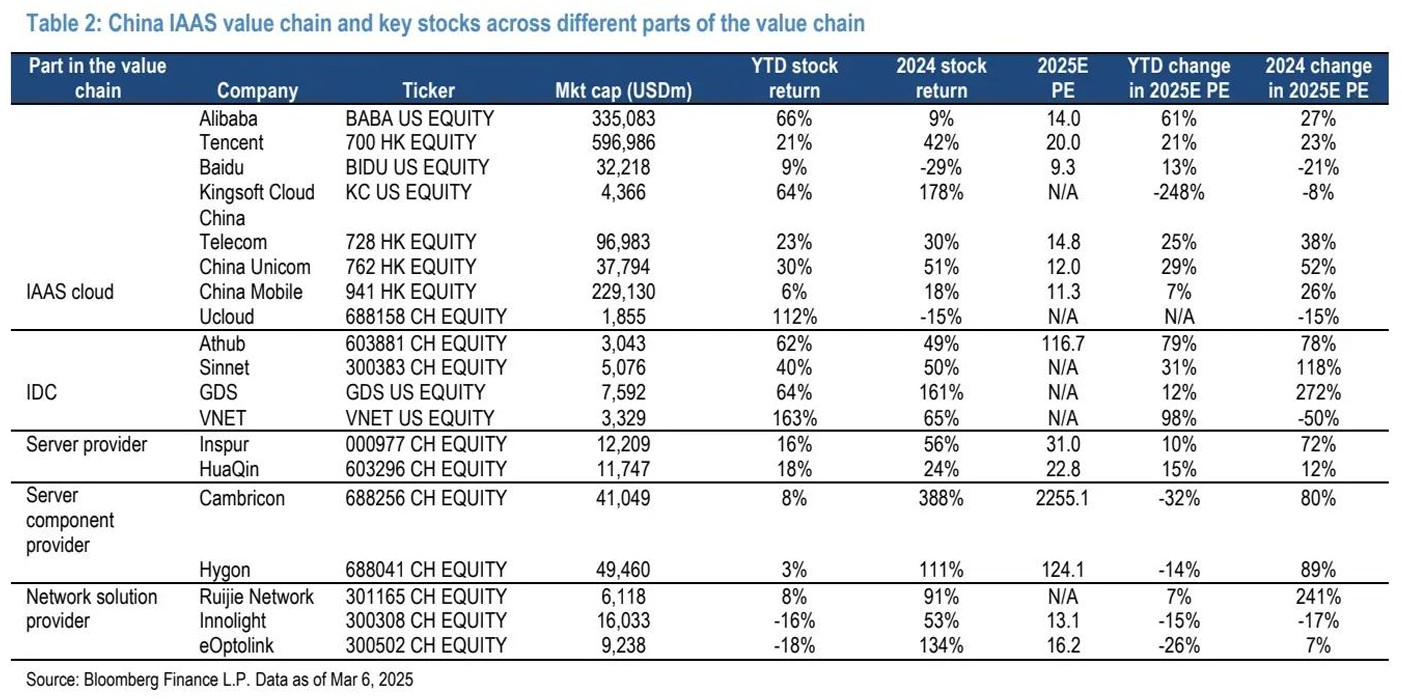
Phase 3: Application and service providers that gain tangible economic benefits from the popularization of Gen AI. The bank stated that when Phase 3 begins, it recommends investors shift funds from the IAAS value chain to application and service providers that can achieve tangible economic benefits through the adoption of Gen AI. The catalyst for this rotation will be positive surprises in revenue or profit margin expectations.
Phase 4: Local Gen AI killer application developers.
2. 2025 will be a turning point for Gen AI adoption in China
JP Morgan stated that the development of Gen AI in China in 2025 can be compared to the development of mobile internet in 2010, as there are several key similarities between the two. The bank believes that by 2025, all Chinese internet companies will recognize the importance of integrating Gen AI into their existing business operations and will invest significant resources to embrace Gen AI capabilities. This is similar to the strategy of transformation seen in the mobile internet in 2010. However, by 2025, the actual benefits of Gen AI for existing businesses have yet to be validated, and local Gen AI killer applications have not yet emerged, which is similar to the situation in 2010.
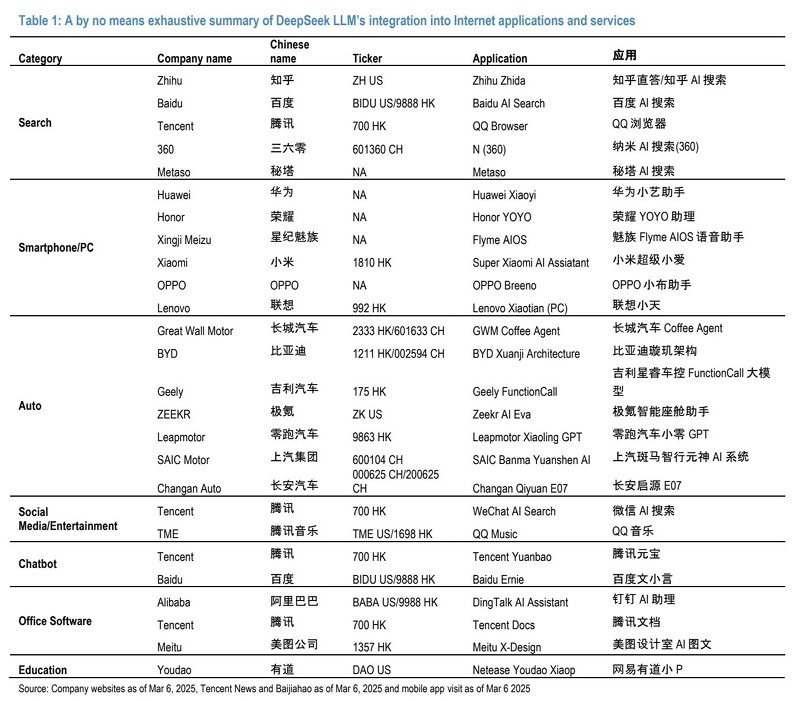
JP Morgan believes that 2025 will be a turning point for Gen AI adoption in China, driven by DeepSeek's V3 and R1 models. The bank stated that these high-performance, cost-effective models will accelerate the integration of Gen AI with existing internet applications and services in the coming quarters, significantly increasing the consumption of computing power. The bank indicated that the facts in the table below show that Gen AI in China has entered a phase of rapid adoption.
3. What will the Gen AI era look like?
JP Morgan expects the following trends in the coming years:
Improvement in financial performance: Gen AI will significantly enhance existing internet services through new revenue streams and improved cost efficiency, thereby improving the overall financial performance of internet operators.
Changes in competitive landscape: As Gen AI applications disrupt traditional business models, the market competition landscape will undergo significant changes. Companies that adapt to and leverage Gen AI will gain a competitive advantage.
Emergence of Gen AI killer applications: While predicting the exact timing and nature of Gen AI killer applications is challenging, their emergence is expected to redefine market dynamics and create growth opportunities Increased Demand for Computing Power: To meet the growing demand for computing power from Gen AI, large IAAS cloud operators will maintain high levels of capital expenditure in the coming years, benefiting downstream stakeholders such as data center and server providers.
4. Positioning of Several Internet Large-cap Stocks in AI Trading
Alibaba: Morgan Stanley believes that Alibaba is an IAAS value chain stock, and its performance in the second phase will outperform its internet peers, while it may also become a beneficiary of Gen AI applications in the third phase.
Tencent (00700): Although Tencent has significant exposure in the Chinese IAAS market, Morgan Stanley views the stock more as an application beneficiary in AI trading rather than an IAAS provider stock. The firm expects Tencent to actively integrate Gen AI into its existing product portfolio to enhance consumer engagement in terms of traffic, time spent, and product reliance, which may translate into incremental advertising inventory and revenue in 2026 and beyond.
KUAISHOU-W: Morgan Stanley stated that among the Chinese internet companies it covers, KUAISHOU-W is a less prominent beneficiary of Gen AI development. The firm believes that Gen AI will significantly drive user engagement and monetization of KUAISHOU-W's main application; KUAISHOU-W's leading AI video generation large model, KLING, has deep synergies with the KUAISHOU-W application in video generation, offering rich monetization potential across various commercial verticals (e-commerce, professional content production—such as gaming/movies).
Baidu (BIDU.US): Morgan Stanley believes that Baidu is both an IAAS value chain stock and a potential beneficiary of Gen AI applications, with its stock price outlook depending on changes in the narrative of Baidu's core advertising business and cloud business. Among these two factors, changes in the narrative of the core advertising business are more critical, as this business generates the vast majority of the company's profits
