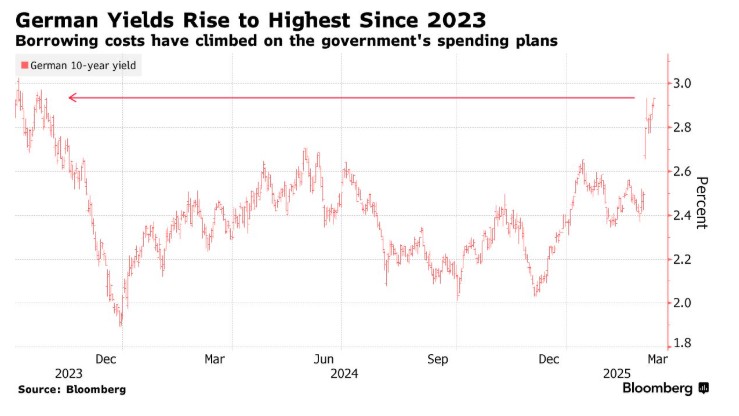
Germany's debt expansion disrupts the European bond market: After 18 months, the 10-year German bond yield is expected to break 3% again

The yield on Germany's 10-year government bonds rose by 4 basis points to 2.93%, approaching the psychological barrier of 3%. If it breaks through, it will be the first time in 18 months. The market expects Germany to undertake large-scale debt expansion to support the economy and defense, leading to pressure on government bond prices and a significant widening of the yield curve. Germany's fiscal policy may see a major shift towards stimulus, with investors demanding higher yields on long-term government bonds. This volatility affects other European countries, reflecting a general expectation of increased defense budgets
According to Zhitong Finance APP, the yield on German benchmark government bonds is approaching the key psychological level of 3%. If it surpasses the 3% mark, it will be the first time in the past 18 months. As market expectations rise for a historic large-scale expansion of government debt and issuance to support economic growth and national defense construction, the selling sentiment among European bond market investors has significantly intensified recently, putting substantial pressure on German government bond prices.
On Wednesday, the yield on Germany's 10-year government bonds rose by 4 basis points to 2.93%, significantly exceeding the peak level reached last week, marking the highest level since October 2023. Since the beginning of this month, the yield on Germany's 10-year government bonds has accumulated an increase of 53 basis points, making it the largest single-month increase in the past two years.

The sharp fluctuations in the German bond market are primarily due to the upcoming large-scale fiscal spending plan from Berlin to boost investment in Germany's defense and infrastructure construction. This plan is fully led by the incoming German Chancellor Friedrich Merz. Although the German Green Party previously vetoed the fiscal reform proposal put forward by the Merz government, it later indicated that a compromise could be reached as early as this week, leading to further declines in German government bond prices to a new temporary low, which means a significant rise in the yield curve.
Germany's fiscal policy may undergo a significant stimulus shift, prompting investors to demand higher yields on long-term government bonds to compensate for the risks associated with a surge in future debt levels. As a result, the difference in yields between German long-term and short-term bonds (i.e., the yield curve) has clearly widened recently, with the difference between the yields on two-year and ten-year government bonds now expanded to 70 basis points, the largest level since July 2022. Just a year ago, this yield curve was in an inverted state of around 50 basis points (i.e., short-term government bond yields were far higher than long-term government bond yields).
The soaring yields on German bonds have also spread to other European countries, reflecting the general expectation among investors in the European bond market that countries across Europe will significantly increase their defense budgets in response to the defense situation following the U.S. withdrawal from NATO. Over the past week, the yields on ten-year government bonds in Spain and Italy have rapidly climbed by about 40 basis points.
In light of this situation, some large institutional investors, including the world's largest asset management giant BlackRock, have begun to hold a pessimistic view on the price trends of Eurozone bonds. Earlier this week, the head of the BlackRock Investment Institute pointed out in a report that with the significant increase in defense spending by European countries and limited room for further interest rate cuts in the future, the yields on ten-year government bonds in major Eurozone economies may rise further The core logic of the euro bond market regarding the 10-year government bonds of major eurozone economies like Germany is that a surge in government spending will lead to a sharp increase in long-term bond issuance—this also means that the market will demand higher long-term bond investment returns, accelerated economic growth, and a rebound in inflation—these two factors are forcing investors to require higher returns to hold long-term debt.
In the face of geopolitical upheaval and economic growth challenges, the German government announced an unprecedented fiscal expansion plan last Tuesday evening local time, stating that it would amend the constitution and vow to strengthen national defense "at all costs." This historic fiscal stimulus measure will not only profoundly impact the German economy and its defense system but also herald a significant shift in the economic and defense landscape of Europe and even the world.
European banking giant Deutsche Bank recently stated in a research report that this plan could be "one of the most important fiscal paradigm shifts in post-war German history," with the extent of change potentially surpassing that of the "German reunification" 35 years ago, and it may allow for "unlimited" borrowing for defense spending at a faster pace.
According to media reports, more than 1% of Germany's defense spending may be exempt from the "debt brake" mechanism in the German constitution. Merz also stated that major central parties have agreed to initiate a €500 billion (approximately $528 billion) infrastructure fund to invest in priority areas such as transportation, energy grids, and housing.
For a long time, Germany has been known globally for its extremely strict fiscal discipline, which has also limited its domestic economic growth, especially since the pandemic and the Russia-Ukraine conflict have led to economic stagnation. Many investors have been calling for Germany to relax its fiscal constraints, and the ambitious fiscal plan led by Merz is undoubtedly a positive response to these calls, marking a break from Germany's long-standing "iron rule" on government borrowing. The new German government led by Merz intends to amend the constitution to remove debt limits on defense spending to enhance Germany's defensive capabilities.
Germany's "at all costs" slogan has not only triggered a steepening shift in the euro bond market but has also caused significant waves in the foreign exchange market. The risk reversal indicators in the foreign exchange options market show that traders' bullish sentiment towards the euro has reached its highest level in five years. Top investment institutions such as Goldman Sachs, Mitsubishi UFJ Financial Group, and TD Bank have all abandoned their previous pessimistic forecasts that the euro would fall to parity against the dollar