


Top 10 Global Pharmaceutical Companies in 2024

The 2024 global pharmaceutical companies TOP 10 list has been revealed, with Johnson & Johnson, Roche, and Merck taking the top three spots. Pfizer remains in fourth place, while AstraZeneca has risen to sixth due to its expansion in emerging markets. Eli Lilly enters the top ten with a 32% growth. In terms of pharmaceutical business revenue rankings, companies such as Pfizer, Merck, Johnson & Johnson, AbbVie, AstraZeneca, and Roche performed outstandingly. Merck's K drug sales reached USD 29.482 billion, making it the best-selling drug
The latest global pharmaceutical company TOP 10 list has been officially announced. Compared to 2023, the law of "the strong getting stronger" still dominates the industry landscape, with Johnson & Johnson, Roche, and Merck firmly occupying the top three positions in total revenue. Pfizer successfully reversed the decline caused by COVID-19 products, maintaining its fourth position. AstraZeneca, through expansion in emerging markets, has seen its total revenue ranking rise to sixth, with its pharmaceutical business surpassing Roche to rank fifth, demonstrating strong growth momentum. Meanwhile, Eli Lilly has shown remarkable explosive power with its "super blockbuster," achieving a rapid growth rate of 32% to enter the top ten.
Specifically, if ranked by pharmaceutical business revenue, the global pharmaceutical TOP 10 are Pfizer, Merck, Johnson & Johnson, AbbVie, AstraZeneca, Roche, Novartis, BMS, Eli Lilly, and Sanofi.
If ranked by total company revenue, the global pharmaceutical TOP 10 are Johnson & Johnson, Roche, Merck, Pfizer, AbbVie, AstraZeneca, Bayer, Novartis, BMS, and Eli Lilly.
Global TOP 10 pharmaceutical companies (ranked by pharmaceutical business revenue)
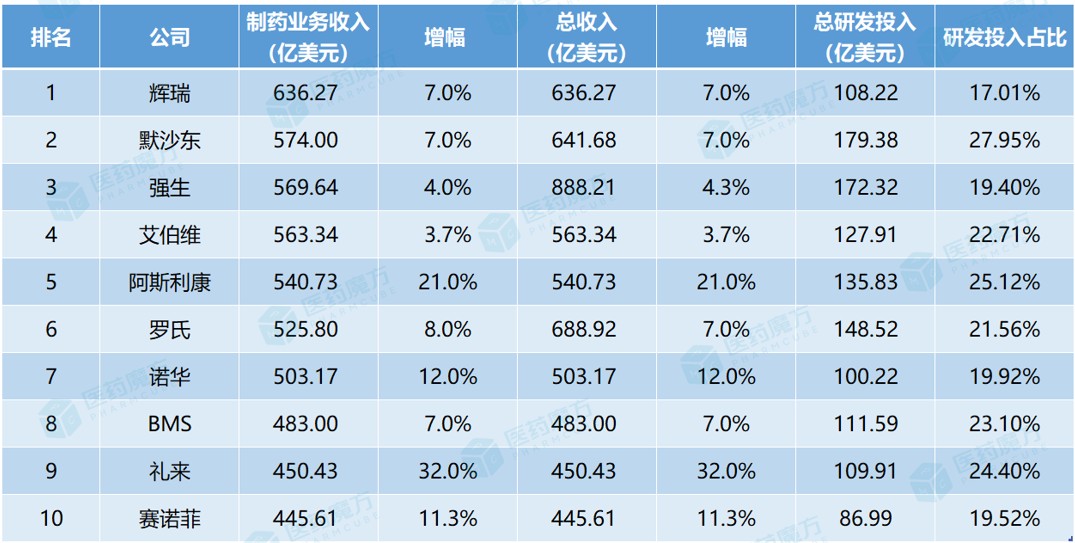
Note: Roche, AstraZeneca, Novartis, and Sanofi are calculated at fixed exchange rates; based on the average exchange rates for 2024: 1 Swiss Franc = 1.1388 USD, 1 Euro = 1.0847 USD, 1 Danish Krone = 0.14514 USD, 1 British Pound = 1.2813 USD.
It is worth noting that in the TOP 10 list by pharmaceutical business revenue, six companies have a core product revenue share exceeding 40%. These billion-dollar "cash cow" products not only serve as the strongest engine for the performance growth of major giants but also significantly shape the strategic layout of the companies.
Top-selling drugs of the global TOP 10 pharmaceutical companies
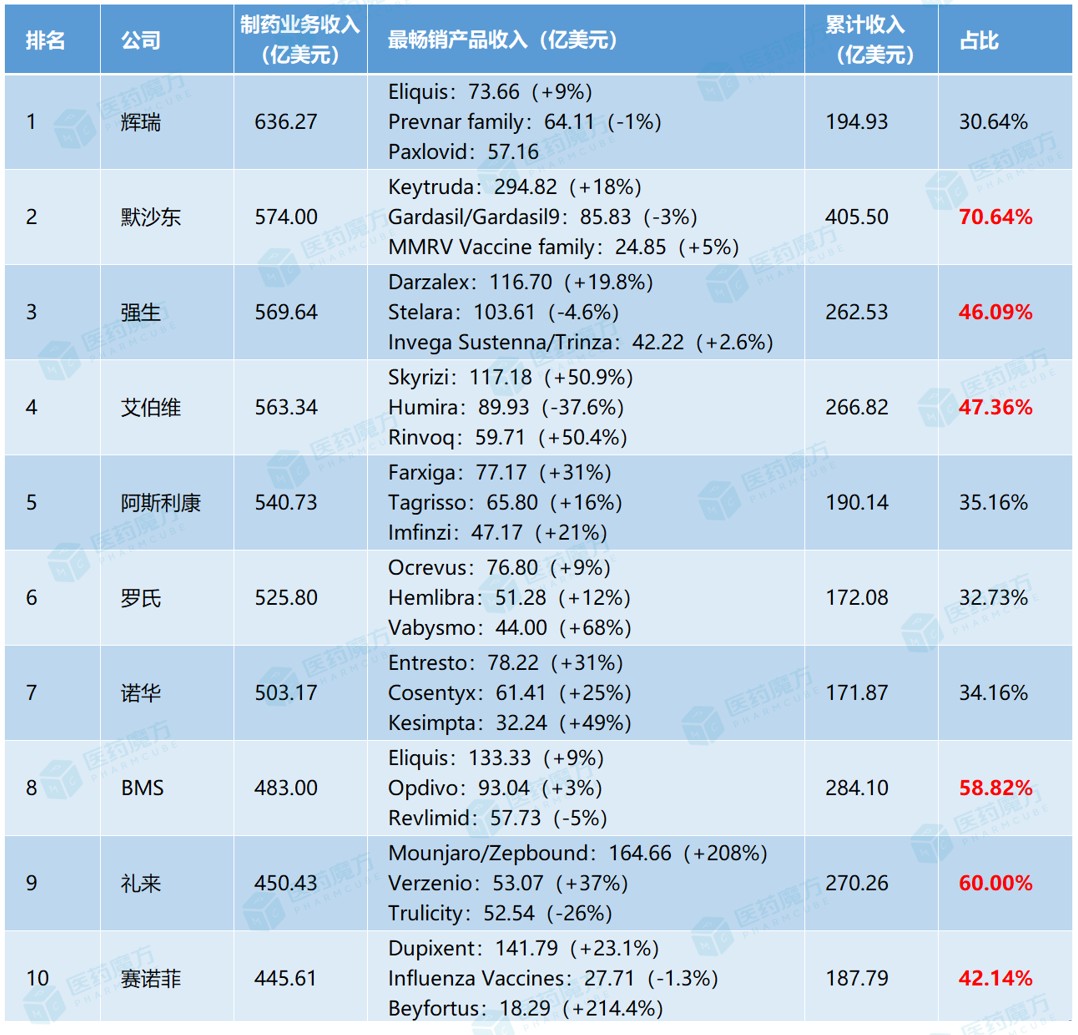
Note: Roche, AstraZeneca, Novartis, and Sanofi are calculated at fixed exchange rates; based on the average exchange rates for 2024: 1 Swiss Franc = 1.1388 USD, 1 Euro = 1.0847 USD.
Taking Merck as an example, its K drug has maintained its title as "King of Drugs" with sales of $29.482 billion, while also supporting half of Merck's revenue. Combined with the HPV and MMRV series vaccines, these three blockbuster products generated a total revenue of $40.55 billion, contributing 70% of the revenue. For sustainable development, Merck is also laying out next-generation products in the oncology field, including ADCs, multi-antibodies, oncolytic viruses, and cancer vaccines.
However, while relying on blockbuster products to create performance myths, there is also the risk of falling into a passive situation due to patent cliffs and competitive product iterations, with the former "King of Drugs," Humira, being the best example Due to competition from biosimilars, Humira's performance plummeted in 2023, leading to a 6.4% year-on-year decline in AbbVie's overall revenue. Fortunately, AbbVie successfully transitioned with its new flagship product Skyrizi, achieving a smooth handover. In 2024, Skyrizi's revenue surpassed the $10 billion mark for the first time, driving positive growth for AbbVie alongside Rinvoq.
Johnson & Johnson's Stelara also faces similar challenges after its peak period. However, with the support of Darzalex, Johnson & Johnson has successfully maintained its growth momentum. This further proves that lifecycle management of blockbuster products is crucial; companies need to timely launch new "heavyweights" to fill the gap as core products enter maturity.
BMS can also be regarded as a "blockbuster harvester," with cumulative revenues from Eliquis, O drug, and Revlimid reaching $28.41 billion, accounting for nearly 60% of total revenue. As mature products face greater challenges from the "patent cliff," BMS is accelerating the development of a more innovative and diversified pipeline to ensure sustained growth in the future.
In the currently hot GLP-1 sector, Novo Nordisk and Eli Lilly have reached new heights with two super "heavyweights"—semaglutide ($29.296 billion) and tirzepatide ($16.466 billion). With the GLP-1 market size surpassing $50 billion, this field has become the most valuable strategic territory after PD-(L) 1, attracting numerous pharmaceutical companies to accelerate their layouts.
Sanofi also has a super "heavyweight"—Dupixent, which is currently the best-selling autoimmune product. Although Sanofi temporarily dropped out of the top ten in total revenue rankings due to the spin-off of its consumer health business (Opella), this marks an important transformation period for the company.
By focusing on its core pharmaceutical business, Sanofi achieved an overall performance growth of 11.3% after becoming a pure pharmaceutical company. This strategy aligns with the actions of other pharmaceutical giants, as Merck, Pfizer, GSK, Johnson & Johnson, and Novartis have all completed the spin-off of their consumer health or generic drug businesses to "slim down" and better focus on and invest in pharmaceutical operations.
Significant investments in R&D are also key for major pharmaceutical giants to maintain their leading positions and product innovations. Except for Bayer, all other companies in the top 10 total revenue list have invested over $10 billion in R&D, ranked as follows: Merck ($17.938 billion), Johnson & Johnson ($17.232 billion), Roche ($14.852 billion), AstraZeneca ($13.583 billion), AbbVie ($12.791 billion), BMS ($11.159 billion), Eli Lilly ($10.991 billion), Pfizer ($10.822 billion), and Novartis ($10.022 billion).
Cultivating and strengthening advantageous products through external acquisitions is also a common strategy among major pharmaceutical giants. However, according to the Pharma Cube database, the total global M&A amount in 2024 decreased by 60.76% year-on-year, with major pharmaceutical companies preferring smaller-scale acquisitions The largest acquisition was Novo Nordisk's purchase of CDMO giant Catalent for $16.5 billion. The former has gained ample cash flow in recent years through GLP-1 drugs, and this acquisition will help it continue to expand the production capacity of GLP-1 drugs.
2024 MNC Merger and Acquisition TOP 10
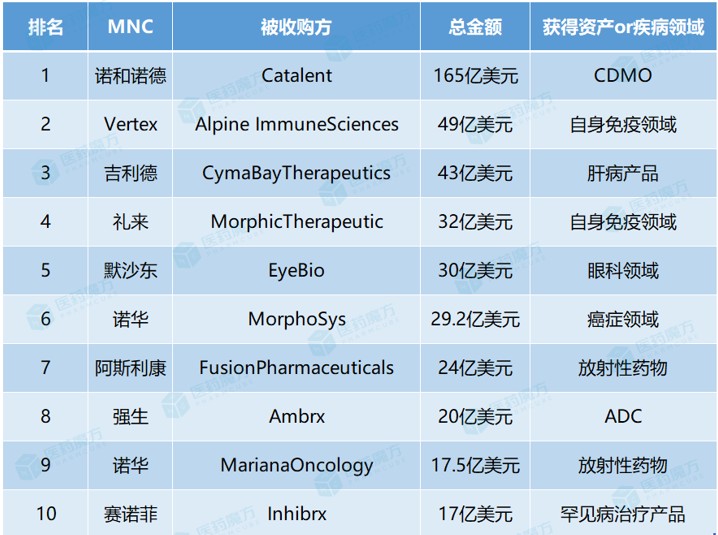
In terms of transaction cooperation, compared to 2023, major pharmaceutical giants have been relatively conservative, with no large deals like Merck's $22 billion ADC transaction with Daiichi Sankyo. Instead, they are focusing on small-scale strategic investments, such as Merck's cooperation agreements with LianBio and Hansoh regarding PD-1/VEGF bispecific antibodies and oral small molecule GLP-1 drugs, respectively. Novartis has been relatively active, occupying 6 positions in the TOP 20 transactions, the most notable being a $4.165 billion collaboration with Bausch Health aimed at jointly developing multiple cardiovascular siRNA drugs.

Source: NextPharma database
Conclusion
The competitive landscape of the top 10 global pharmaceutical companies in 2024 continues the traditional logic of "the strong get stronger" while also showcasing new variables in an evolving market. From the relay and layout of next-generation core products to collective increases in R&D investment, and to business restructuring under strategic focus, these actions reflect the pharmaceutical giants' firm determination to build sustainable competitiveness. Their prudent strategies in mergers and acquisitions also demonstrate careful consideration of the future market. In 2025, the pharmaceutical industry remains full of uncertainties, and how these industry leaders will continue to shape the future of the industry and write their own legendary narratives is something we can all look forward to
