The top ten A-share questions that global investors are most concerned about: Can it catch up with Hong Kong stocks? Can valuations be improved? Can profits improve? Is the policy given enough attention?

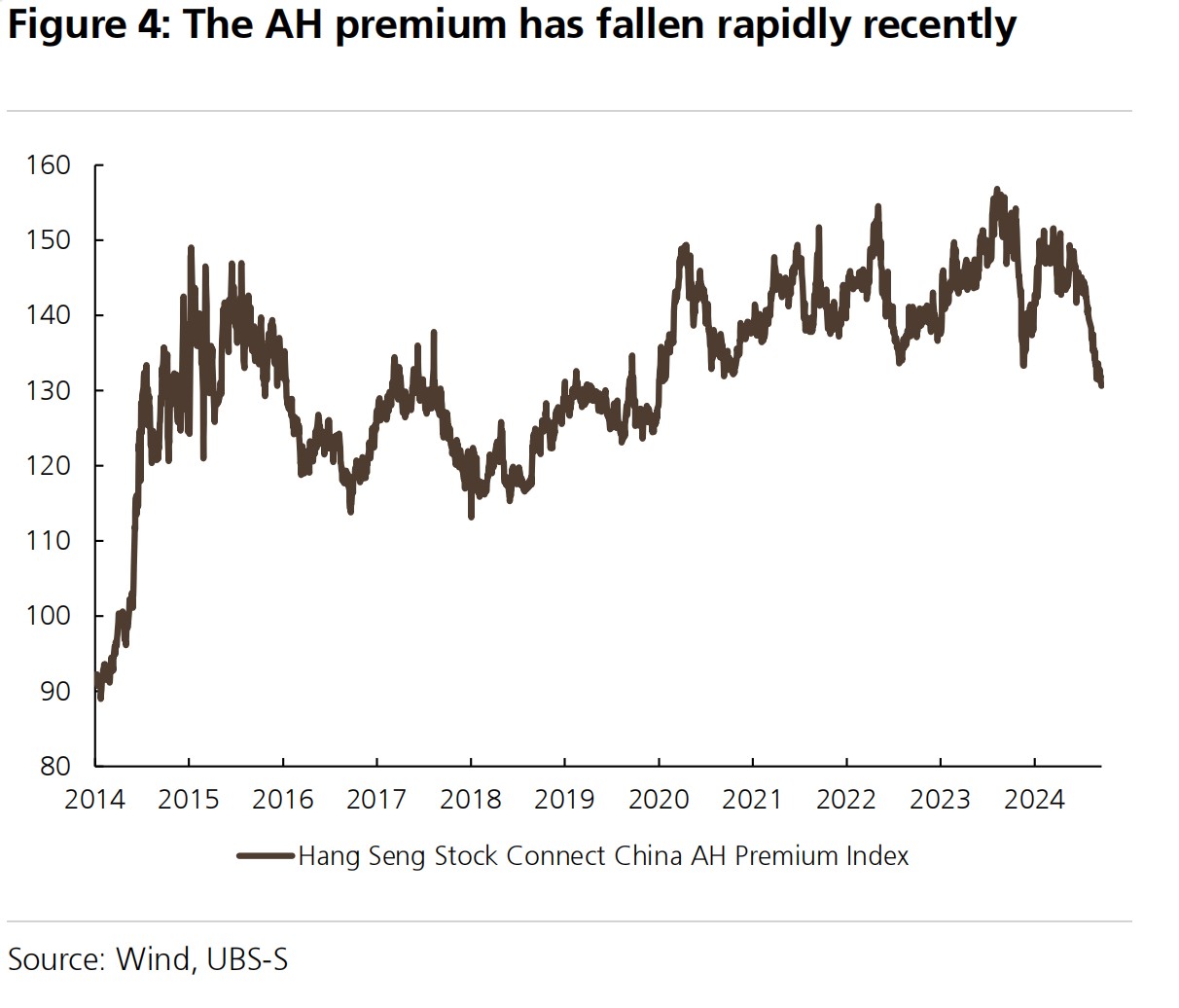
UBS believes that A-shares, as a better representative of China's macro economy, will benefit from signs of recovery in the consumption and industrial sectors, and are expected to catch up with Hong Kong stocks' performance over the annual cycle; the AH premium index has recently dropped rapidly below the historical average level, and from a mean reversion perspective, A-share returns are expected to gradually narrow the gap with Hong Kong stocks; from a global perspective, the CSI 300 is currently at a 4% discount to the MSCI Emerging Markets (excluding China) index, far below the historical average premium of 22%
Despite the significant underperformance of A-shares compared to Hong Kong stocks year-to-date, UBS believes that A-shares are expected to catch up with Hong Kong stocks over the full year cycle.
On March 21, UBS's China equity strategy team summarized the top ten A-share questions that global investors are currently most concerned about, including why A-shares have underperformed Hong Kong stocks this year, whether A-share returns can catch up with Hong Kong stocks for the year, and how much room there is for A-share valuations to rise.
UBS believes that A-shares, as a better representation of China's macro economy, will benefit from signs of recovery in the consumption and industrial sectors, including the popularity of high-quality domestic content, strong growth in automobile sales, and the gradual stabilization of the real estate market.
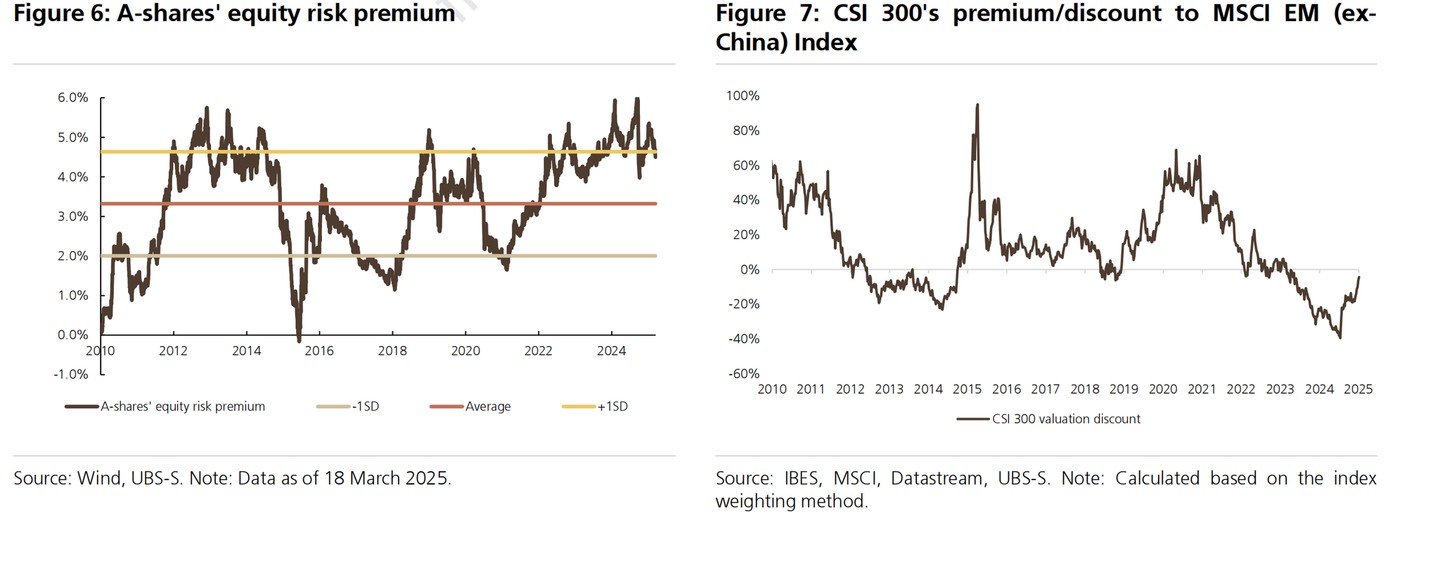
In terms of valuation, UBS pointed out that the equity risk premium of A-shares remains above the long-term average level, indicating that there is still room for improvement. From a global perspective, the CSI 300 is currently trading at a 4% discount to the MSCI Emerging Markets (excluding China) index, far below the historical average premium of 22%.
The following is a summary of the top ten Q&A:
1. Why have A-shares underperformed Hong Kong stocks this year?
A-shares have significantly underperformed the Hong Kong market this year. As of March 19, the CSI 300 and all A-shares have risen by 1.9% and 6.5%, respectively, significantly lower than the MSCI China Index (23.4%) and the Hang Seng Index (23.5%). UBS pointed out two main reasons:
Significant differences in index component weights: A-share indices are heavily weighted towards finance, consumption, and industry, while Hong Kong stocks are more inclined towards the internet and technology. The total weight of finance and industry in the CSI 300 exceeds 40%, while internet companies account for over 47% in the MSCI China. The internet sector better reflects the dynamics of China's macro economy, and the technology sector benefits from the important catalyst of domestic AI development.
Differences in capital flows: The issuance of actively managed mutual funds in A-shares has been sluggish, while Hong Kong stocks have enjoyed sustained net inflows from southbound and foreign capital. In the first ten weeks of 2025, new A-share stocks and mixed funds issued totaled only 91.8 billion yuan, a year-on-year increase of 118%, but only 11% of the scale in the same period of 2021. Passive funds accounted for 75% of the total new issuance, far higher than 14% in 2021. In contrast, as of March 18 this year, net inflows from southbound funds exceeded 361.1 billion yuan, a year-on-year increase of 345%.
2. Can A-share returns catch up with Hong Kong stocks for the year?
UBS believes that from a full-year perspective, A-shares are expected to catch up with the performance of the Hong Kong market. Over the past three years, the annual return gap between A-shares and the Hong Kong market has stabilized, averaging less than 3 percentage points. At the same time, the AH premium index has recently dropped rapidly below the historical average level, suggesting that A-share returns are expected to gradually narrow the gap with Hong Kong stocks from a mean reversion perspective.
The heavyweight stocks in the A-share index are mainly financial, consumption, and industrial stocks, which better represent China's macro economy. Recently, there have been clear signs of recovery in China's macro economy, especially in the consumption and industrial sectors:
In terms of consumption, high-quality products and content are favored by consumers. The domestic 3A game "Black Myth: Wukong," released in August 2024, sold over 20 million copies in its first month; the domestic animated film "Nezha 2," released during the 2025 Spring Festival, dominated the box office. During the Spring Festival, the number of domestic tourists and revenue increased by 6% and 7% year-on-year, respectively, and grew by 26% and 15% compared to 2019
Strong growth in automobile sales. In the first two months of 2025, wholesale sales of passenger cars reached 3.87 million units, a year-on-year increase of 13%.
Signs of recovery in the real estate market. The inventory of new homes in first-tier cities has fallen below historical averages, and the land auction market has recently been relatively active.
3. How much room for valuation increase is there in A-shares?
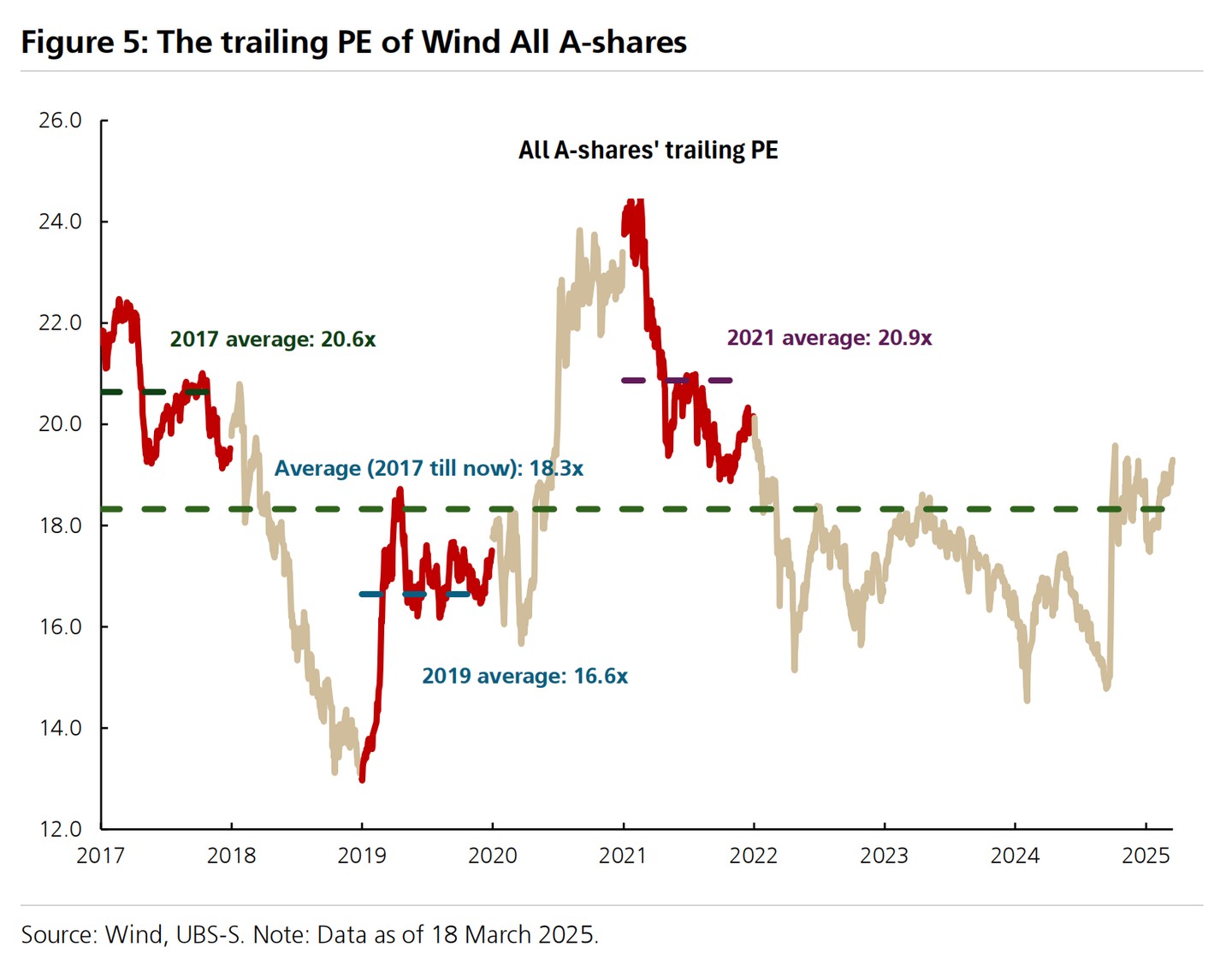
According to UBS, although the overall A-share price-to-earnings ratio has rebounded recently and exceeded 19 times, it is still 7-8% lower than the average levels of 2017 and 2021. In years of strong earnings (2017, 2019, and 2021), the price-to-earnings ratio of all A-shares was either significantly above the average level or showed clear improvement.
UBS expects the CSI 300's earnings growth to increase from 1% in 2024 to 6% in 2025, mainly benefiting from the recovery of profit margins in downstream industries and a lower earnings base. Therefore, historical averages may not necessarily be the upper limit for valuations, and A-shares have room for further valuation increases in 2025.
Currently, the equity risk premium in A-shares is still 0.9 standard deviations above the long-term average, indicating that the overall risk appetite in the market remains constrained. Lower risk-free interest rates and the influx of long-term funds help reduce the equity risk premium. From a global perspective, the CSI 300 is currently trading at a 4% discount to the MSCI Emerging Markets (excluding China) index, far below the historical average premium of 22%.
4. What is the trend of earnings revision in A-shares?
Recently, the earnings growth expectations for the CSI 300 have shown an upward trend, with the market consensus for earnings growth in 2025 being revised up by 1.3 percentage points over the past month. From an industry perspective, the rapid upward revision of earnings expectations in information technology has particularly driven the overall earnings revision in A-shares.
UBS stated that historical experience shows that the earnings revision trend for the CSI 300 typically changes direction around the end of April each year. In years with rising macro data and corporate earnings, earnings growth consensus expectations usually increase or remain relatively stable after April. If earnings expectations improve or remain relatively stable around April 2025, the momentum for annual earnings growth may improve, thereby meeting the benchmark forecast of 6%. Investors should pay attention to changes in the CSI 300 earnings growth expectations in the coming month.
5. Has the strategic importance of A-shares significantly increased?
Since 2024, a series of policy guidance documents issued by regulatory authorities have enhanced the strategic importance of A-shares. The "Nine Points Guideline" of 2024 referred to it as "the people's nature of the capital market." Capital appreciation contributes to common prosperity, and by the end of 2023, state-owned entities and ordinary citizens held over 63% of the total market value of A-shares.
In the recently concluded Two Sessions, the government work report for the first time included "considering the role of asset prices in macroeconomic regulation and stabilizing the real estate and stock markets" as part of the overall requirements. Subsequently, on March 17, the General Office of the Central Committee of the Communist Party of China and the General Office of the State Council issued the "Special Action Plan for Expanding Consumption," emphasizing the need to broaden channels for property income and take a series of measures to stabilize the stock market. This indicates that the central government has further elevated the strategic importance of the A-share market
6. What positive signals have appeared in the domestic real estate market?
After four years of a downturn in the real estate market, first-tier and core second-tier cities have shown signs of market stabilization. The UBS real estate team has noted a significant recovery in second-hand housing transactions, with inventory months in first-tier cities returning to the 15-year average level, an increase in land auction premium rates, and second-hand housing listing prices stabilizing in the first two months of 2025. The team pointed out that these signs are similar to those observed during the turning point of the 2014-15 cycle.
7. What key signals were conveyed in the private enterprise symposium?
The enhancement of corporate confidence may drive growth in capital expenditures, new hires, and wage increases. For A-shares, stable market expectations and stronger confidence help reduce equity risk premiums.
8. How is the capacity utilization rate across various industries in China?
According to UBS analysts' outlook on capacity utilization rates in the covered industries, there are significant differences across sectors:
The aluminum industry’s capacity utilization rate may increase year-on-year, benefiting from demand growth.
The capacity utilization rates in the steel and cement industries continue to decline due to weak demand.
In the passenger vehicle sector, the capacity utilization rate of Chinese brands has significantly improved compared to pre-pandemic levels, while foreign brands have declined.
The current capacity utilization rate in the engineering machinery industry is below pre-pandemic levels but is expected to improve in the next 2-3 years.
The air conditioning industry’s capacity utilization rate in 2024 is expected to be higher than pre-pandemic levels, supported by domestic replacement subsidies and increased export demand.
The capacity utilization rate of grid equipment is above pre-pandemic levels due to the global capital expenditure cycle in the grid sector and increasing market share of Chinese manufacturers in Europe, the Middle East, and other emerging markets.
The wind power industry’s capacity utilization rate has significantly improved in recent years, driven by a substantial increase in installed wind power capacity.
9. How to interpret the industry policy cycle?
UBS pointed out that industry policies in China are usually cyclical. On one hand, the government needs to regulate certain industries to ensure their healthy and sustainable development and maintain stability. However, in addition to regulatory measures, a series of policies have also been introduced in recent years to support the development of certain industries. For example, in the internet sector, e-commerce and internet companies rapidly rose with policy support during the 2014-2015 period. However, after 2017, the disorderly expansion of the platform economy led to the formation of industry bubbles. Subsequently, regulatory interventions helped to defuse the bubbles and bring the market back to rationality. Overall, UBS believes that the Chinese government will strive to seek balance in its policies. After the 2025 private enterprise symposium, UBS expects policies across industries to lean towards a more accommodative stance.
10. What is UBS's ranking of the global stock markets?
The UBS global equity strategy team is most optimistic about the European stock market, followed by the Chinese stock market, but holds a cautious attitude towards emerging markets (excluding China) and maintains a conservative stance on the US stock market.
The team recently upgraded the European stock market to "overweight" due to several reasons: 1) Increased equity risk appetite following changes in the European political environment; 2) Germany's fiscal stimulus and commitment to increase defense spending leading to upward revisions in expectations for European manufacturing, GDP growth, and corporate earnings growth; 3) Capital flowing back to Europe from the US market; 4) Decrease in energy prices In contrast, the team holds a cautious attitude towards emerging markets (excluding China) stock markets, maintaining an overweight only on the Chinese stock market. Although emerging market stocks have attractive valuations relative to developed markets, this mainly reflects the higher and continuously improving ROE in developed markets. Additionally, emerging markets are more vulnerable to the impact of tariffs. The team estimates that 13% of the total revenue of listed companies in emerging markets (excluding China) comes from the United States, while only 3% of the revenue of MSCI China constituents comes from the United States.
UBS believes that U.S. stocks may underperform European stocks and emerging market stocks in the next 1-3 months. They anticipate that the S&P 500 index may further adjust to 5,300 points in the next 1-3 months, so now is not the time to bottom fish