


Telephone and Data Systems, Inc.'s (NYSE:TDS) Price Is Out Of Tune With Revenues

Telephone and Data Systems, Inc. (NYSE:TDS) has a price-to-sales (P/S) ratio of 0.8x, which is concerning given its declining revenue of 3.8% over the past year and a projected decline of 4.1% next year. This contrasts with the industry average growth of 4.9%. The current P/S does not seem justified, as investors may be overvaluing the stock despite negative growth forecasts. Caution is advised for potential investors, as the stock may not align with the company's financial outlook.
There wouldn't be many who think Telephone and Data Systems, Inc.'s (NYSE:TDS) price-to-sales (or "P/S") ratio of 0.8x is worth a mention when the median P/S for the Wireless Telecom industry in the United States is very similar. Although, it's not wise to simply ignore the P/S without explanation as investors may be disregarding a distinct opportunity or a costly mistake.
We've found 21 US stocks that are forecast to pay a dividend yield of over 6% next year. See the full list for free.
See our latest analysis for Telephone and Data Systems
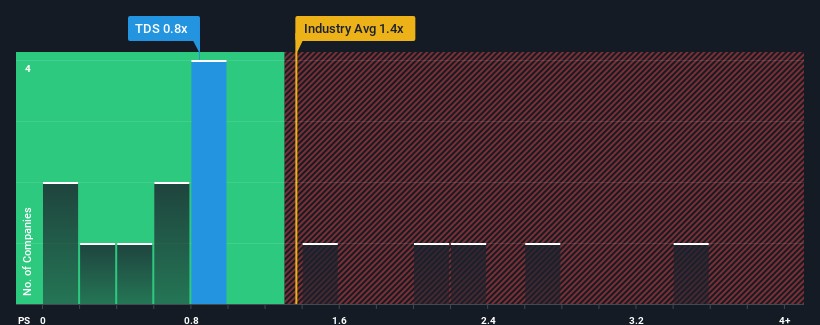
What Does Telephone and Data Systems' P/S Mean For Shareholders?
Telephone and Data Systems hasn't been tracking well recently as its declining revenue compares poorly to other companies, which have seen some growth in their revenues on average. Perhaps the market is expecting its poor revenue performance to improve, keeping the P/S from dropping. You'd really hope so, otherwise you're paying a relatively elevated price for a company with this sort of growth profile.
Keen to find out how analysts think Telephone and Data Systems' future stacks up against the industry? In that case, our free report is a great place to start.
Do Revenue Forecasts Match The P/S Ratio?
The only time you'd be comfortable seeing a P/S like Telephone and Data Systems' is when the company's growth is tracking the industry closely.
In reviewing the last year of financials, we were disheartened to see the company's revenues fell to the tune of 3.8%. As a result, revenue from three years ago have also fallen 6.8% overall. Accordingly, shareholders would have felt downbeat about the medium-term rates of revenue growth.
Shifting to the future, estimates from the two analysts covering the company suggest revenue growth is heading into negative territory, declining 4.1% over the next year. With the industry predicted to deliver 4.9% growth, that's a disappointing outcome.
With this in consideration, we think it doesn't make sense that Telephone and Data Systems' P/S is closely matching its industry peers. Apparently many investors in the company reject the analyst cohort's pessimism and aren't willing to let go of their stock right now. There's a good chance these shareholders are setting themselves up for future disappointment if the P/S falls to levels more in line with the negative growth outlook.
What We Can Learn From Telephone and Data Systems' P/S?
Generally, our preference is to limit the use of the price-to-sales ratio to establishing what the market thinks about the overall health of a company.
While Telephone and Data Systems' P/S isn't anything out of the ordinary for companies in the industry, we didn't expect it given forecasts of revenue decline. With this in mind, we don't feel the current P/S is justified as declining revenues are unlikely to support a more positive sentiment for long. If we consider the revenue outlook, the P/S seems to indicate that potential investors may be paying a premium for the stock.
Don't forget that there may be other risks. For instance, we've identified 1 warning sign for Telephone and Data Systems that you should be aware of.
It's important to make sure you look for a great company, not just the first idea you come across. So if growing profitability aligns with your idea of a great company, take a peek at this free list of interesting companies with strong recent earnings growth (and a low P/E).
If you're looking to trade Telephone and Data Systems, open an account with the lowest-cost platform trusted by professionals, Interactive Brokers.
With clients in over 200 countries and territories, and access to 160 markets, IBKR lets you trade stocks, options, futures, forex, bonds and funds from a single integrated account.
Enjoy no hidden fees, no account minimums, and FX conversion rates as low as 0.03%, far better than what most brokers offer.
Sponsored Content
