


The obedient BaWang Tea Princess takes action to reduce caffeine

BaWang ChaJi has launched a low-caffeine version of BoYa JueXuan based on consumer feedback, reducing the caffeine content by approximately 50%. This product is currently being tested in provincial capital cities nationwide and is expected to be promoted nationwide. At the same time, BaWang ChaJi has set up a "Low-Caffeine Zone" in stores and on its online ordering mini-program, using visual icons to indicate caffeine levels, helping consumers control their caffeine intake. This initiative addresses concerns from some consumers about the impact of tea beverages on sleep
Author: Meng Jiayi
Editor: Mu Yu
霸王茶姬 (Bawang Chaji) is taking advice, as a netizen's comment "I can't sleep" led to an immediate change in their formula.
Today, Bawang Chaji announced the launch of a new light caffeine version of the Boya Juexuan. Compared to the regular version, the caffeine content has decreased by about 50%. It is currently being tested in provincial capital cities nationwide and is expected to be launched nationwide soon. Additionally, Bawang Chaji's stores across the country and its online ordering mini-program have opened a "light caffeine zone," visually marking caffeine levels with icons, allowing consumers to accurately control their caffeine intake when ordering.
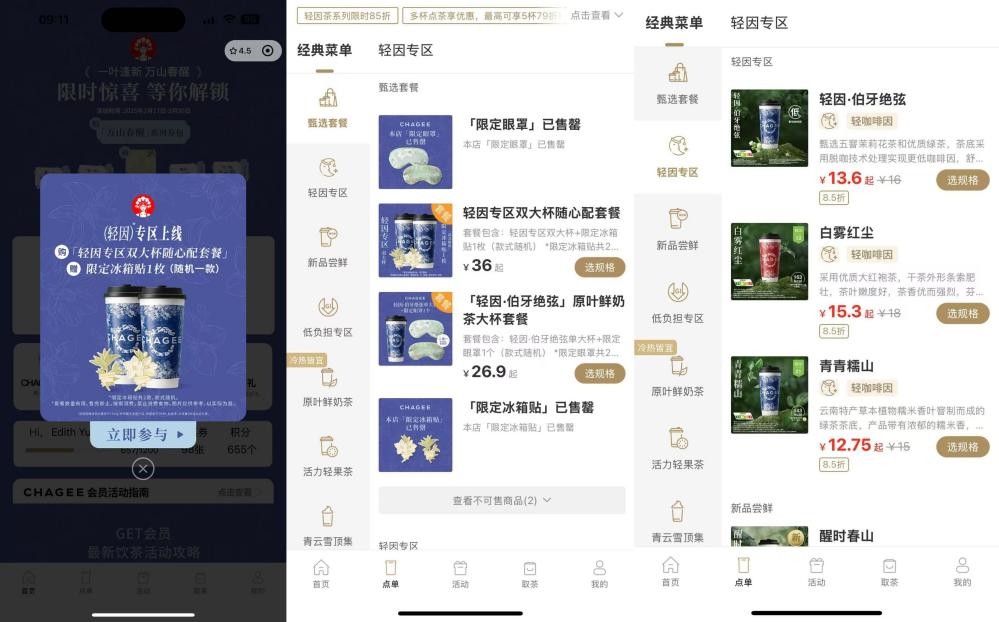 Image source: Bawang Chaji mini-program
This move is undoubtedly a positive response to consumer feedback. Last year, some consumers reported that they couldn't sleep after drinking tea, and there was even a meme about "drinking Wanli Mulan and enjoying a sleepless life." Although some people claimed it had no effect on them, Bawang Chaji clearly did not ignore the voices of those who "can't sleep." So the question arises: how can a cup of tea cause such restlessness? And how does the light caffeine version achieve this?
Hidden Caffeine
First, a fun fact: although caffeine has "coffee" in its name, it is not exclusive to coffee. As a natural compound, it is widely found in various plants, including tea leaves, cocoa beans, guarana leaves, and Paraguay tea.
Tea drinks made from tea naturally contain caffeine. In 2022, the Longyou County Inspection and Testing Research Institute tested 14 tea drinks on the market and found that their average caffeine content was 118mg/500ml, with one drink containing as much as 207mg of caffeine.
The caffeine content in tea drinks is mainly influenced by three factors. First is the tea tree variety; black tea typically has a higher caffeine content than oolong tea, which in turn has more than green tea. Recently popular tea bases like Fenghuang Dancong and Dahongpao are both oolong teas. Second is the concentration of the tea and the brewing time. Third is the form of the tea base.
It can be said that as long as a tea drink brand uses real tea, the presence of caffeine is unavoidable. The "insomnia controversy" surrounding Bawang Chaji is a reflection of this principle. Thus, some netizens jokingly remarked that if you can't sleep after drinking it, at least it shows that real tea is used.
So, in the trend of promoting public health, should we remove real tea and return to an era of only cream and tea essence? This would clearly go against the historical trend. Therefore, brands will naturally consider why some people can't sleep after drinking tea, which involves each person's caffeine tolerance.
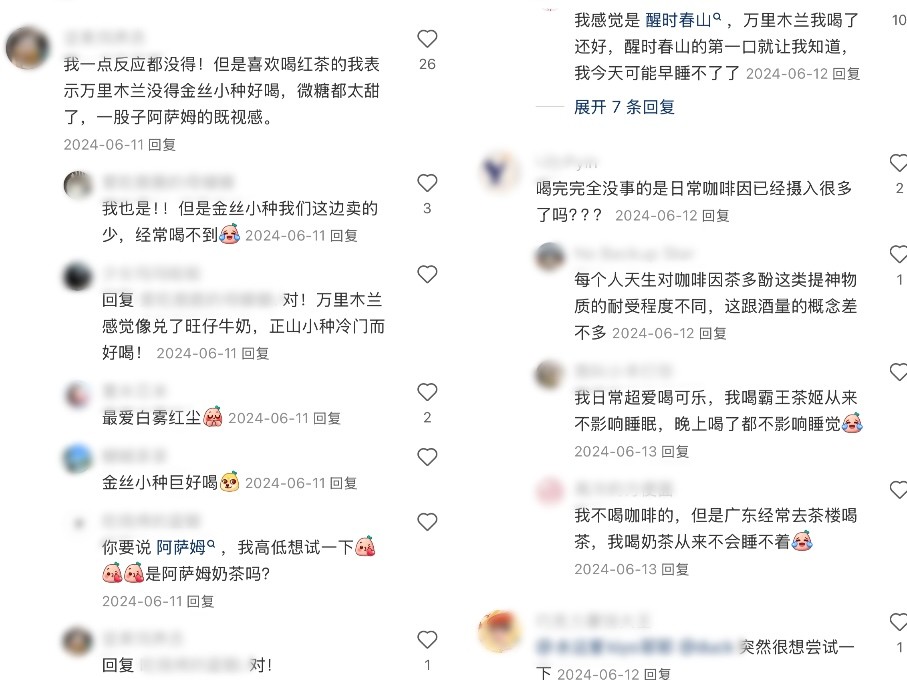 Image source: Xiaohongshu
According to the journal Cell Research, there are three genetic types regarding caffeine metabolism: AA type gene - fast caffeine metabolism; AC type gene - moderate caffeine metabolism; CC type gene - slow caffeine metabolism. This means that AA type individuals can sleep well whether they drink tea or coffee, while those with the CC type gene are the most likely to have trouble sleeping So, if you're afraid of not being able to sleep, why not just not drink it? But tea drink enthusiasts may not think so. As tea beverages become a popular drink, many consumers have developed the habit of drinking a cup every day, even becoming a "water substitute," which naturally gives rise to the demand for consumers to drink at all times (including at night). According to Meituan Takeout data, in the first half of 2023, new tea drink orders during dinner time accounted for the highest proportion at 21%, while late-night orders accounted for 12.4%, both of which are on the rise.
Therefore, the call for low-caffeine beverages among consumers is also increasing.
Listening to Advice: The Overlord
The ranks of tea drink enthusiasts are growing. According to iiMedia Consulting data, 26.0% of new tea drink consumers in 2024 indicated that their consumption frequency will increase in the future, and consumer demand will continue to rise. Against this backdrop, major tea brands are accelerating their expansion. iiMedia Consulting predicts that the market size of new tea drinks in China will reach 354.72 billion yuan by 2024 and is expected to exceed 400 billion yuan by 2028.
However, the prosperity of the market is also accompanied by intensified competition. According to Narrow Door Restaurant Eye data, as of February 2025, nearly 143,500 new tea shops opened in the past year, but the net decrease reached 8,000, which means over 150,000 tea shops are exiting the market, and the industry has entered a "buyer’s market." To survive, brands must pay attention to the segmented needs of consumers.
The group with weaker caffeine metabolism is not a small niche, so the trend towards low-caffeine beverages is inevitable. Many tea and coffee brands, such as Luckin, Tims, and CHABAIDAO, have begun to offer low-caffeine products. As a pioneer of modern tea, Overlord Tea Princess has naturally noticed consumer demand and made adjustments.
In terms of products, on March 21, Overlord Tea Princess officially launched the Light Caffeine · Boya Juexuan, with each cup containing about 53mg of caffeine under the conditions of a large cup, standard ice, and standard sugar, which is about a 50% reduction compared to the regular version, while the price remains unchanged. They also plan to launch a 0 caffeine version this year.
In terms of technology, Overlord Tea Princess uses a safer and more flavor-preserving supercritical carbon dioxide extraction method for decaffeination. Compared to traditional chemical solvent extraction methods, supercritical carbon dioxide extraction is non-toxic, inert, easy to separate, and does not leave residues in the material, maximizing the retention of tea aroma. Currently, the decaffeinated tea popular both domestically and internationally is made using this technology.
However, compared to chemical solvent extraction methods, the decaffeination method used by Overlord Tea Princess is very costly. According to "Everything" magazine, only factories with an annual output of 3,000 tons can afford it. In addition, Overlord Tea Princess has also added new ingredients such as agarwood and sour jujube seeds to low-caffeine tea drinks, enhancing the product's taste and nutritional value, but this also further increases costs.
Overlord Tea Princess is willing to bear high costs to continue launching low-caffeine products, and their actions have already spoken volumes. This time, listening to advice is indeed full of sincerity.
Looking back at the development history of Overlord Tea Princess's low-caffeine products, it can be seen that they have always adhered to the attitude of listening to consumer voices, responding sincerely, and taking practical measures. After the Wanli Mulan became popular due to its strong refreshing effect, Overlord Tea Princess quickly released a caffeine testing report within 72 hours and added relevant reminders to the product description At the same time, they are actively responding to consumer demands on social platforms, stating that they are intensively developing a low-caffeine version. Now, the Light Caffeine·Bo Ya Jue Xuan has officially launched, and a 0 caffeine product is also in intensive preparation.
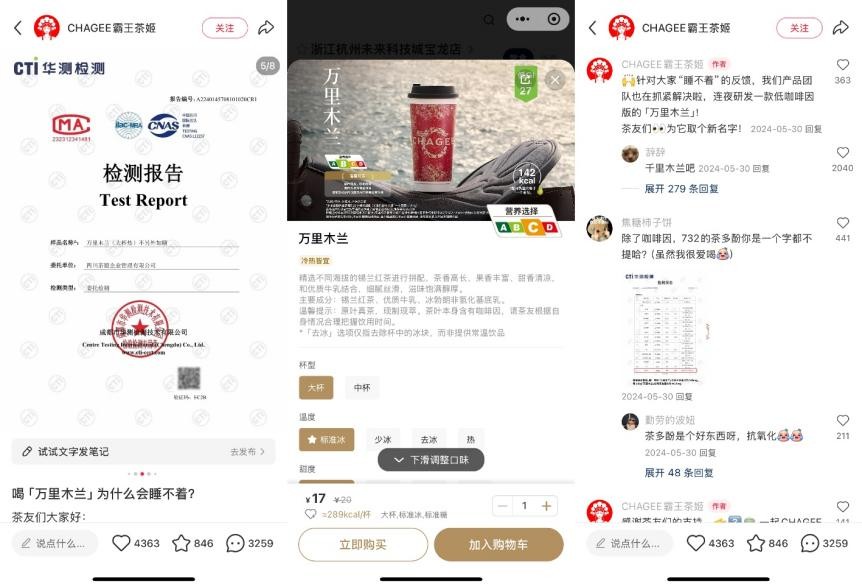 Image source: Xiaohongshu, Bawang Chaji Mini Program
This is exactly Bawang Chaji's consistent approach—listening to advice. If consumers want to know what ingredients and trace elements are in a cup of tea, Bawang Chaji sends the product for testing and launches a product ID; if consumers have sugar control needs, Bawang Chaji launches a calorie calculator; if consumers want to drink a certain limited beverage, Bawang Chaji announces its return...
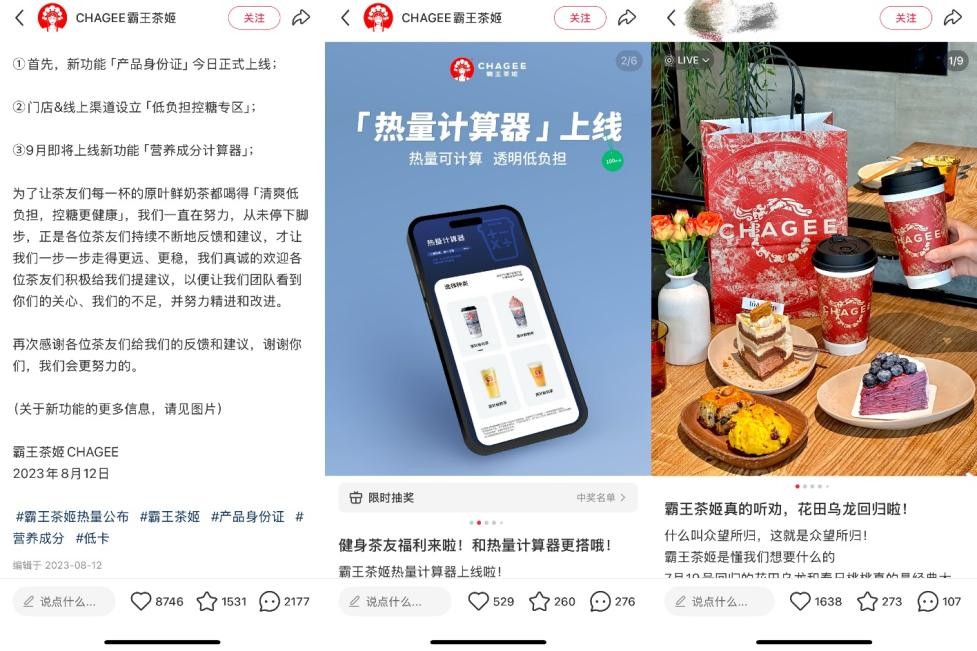 Image source: Xiaohongshu
It can be said that Bawang Chaji's value breakthrough lies not in conquering a certain technical parameter, but in constructing a closed-loop ecosystem of "user pain points - technical response - scene reconstruction," which is also its "killer feature" that allows it to stand out in the fiercely competitive tea beverage market.
Finally
In 1821, caffeine was first discovered in coffee, and it wasn't until 1903 that German coffee merchant Ludwig Roselius made the world's first cup of decaffeinated coffee, marking an 82-year journey towards decaffeination. Today, whether it is coffee or milk tea, low caffeine and health have become future trends. As the global decaffeinated coffee market approaches a scale of $28.8 billion with a compound annual growth rate of 4.45%, the new tea beverage sector in China is also undergoing more revolutionary changes.
Looking back from the watershed of industrial development, from the taste deception of the tea essence era, to the metabolic troubles brought by the true tea revolution, and now to the more possibilities endowed by technology, the new tea beverage industry has completed half a century of evolution in the coffee industry in just twenty years.
It is foreseeable that as Bawang Chaji promotes the low caffeine concept, more tea beverage brands will follow suit to launch low caffeine products, allowing consumers to enjoy the deliciousness of tea beverages without suffering from insomnia, and providing more people the opportunity to taste the true flavor of Eastern tea and experience the unique charm of modern Eastern tea.
This article is reproduced from Tea Coffee Observation (ID: newbp-) with authorization, and all copyrights belong to Tea Coffee Observation. Unauthorized translation or reproduction is prohibited.
"2024 China Consumer Brand Growth White Paper" is now on sale for 398 yuan with free shipping to your home!
In the past year, the global consumer market has shown unprecedented complexity after experiencing the challenges of economic fluctuations and the opportunities and changes brought by technological iterations. Under the overall slowdown in growth, a large number of structural opportunities remain to be explored. Currently, enterprises need to cope with short-term survival pressures while laying out long-term value, facing increasing challenges. Adapting to trends and reshaping core strengths will become the core strategy for consumer enterprises The "2024 China New Consumer Brand Growth White Paper" is based on in-depth analysis from over 8,000 consumer surveys, more than 100 expert think tanks, and over 3,000 companies, decoding the essence of the market from eight dimensions and anchoring future trends from six perspectives. This 200,000-word professional report will serve as a "barometer" for the iteration of the consumer industry and will also be a strategic guide for companies to break through the constraints of existing stock and reshape growth momentum.
Click here or the image below to purchase, with free shipping to your home!
