


Detailed Analysis of China Merchants Bank's 2024 Annual Report: Revenue Decline Continues to Narrow; Net Profit Growth Turns Positive; Dividend Payout Ratio Slightly Increases

China Merchants Bank's 2024 annual report shows that revenue decline continues to narrow, down 0.7% year-on-year, while net profit growth turns positive, up 1.2% year-on-year. Net interest income decreased by 1.6% year-on-year, while net non-interest income increased by 0.8% year-on-year. Quarterly net interest income grew by 2.1% quarter-on-quarter, and net interest margin decreased by 3 basis points to 1.94%. The performance growth is mainly supported by scale growth and other non-interest income. The dividend payout ratio has slightly increased
1. Revenue decline continues to narrow, net profit growth turns positive
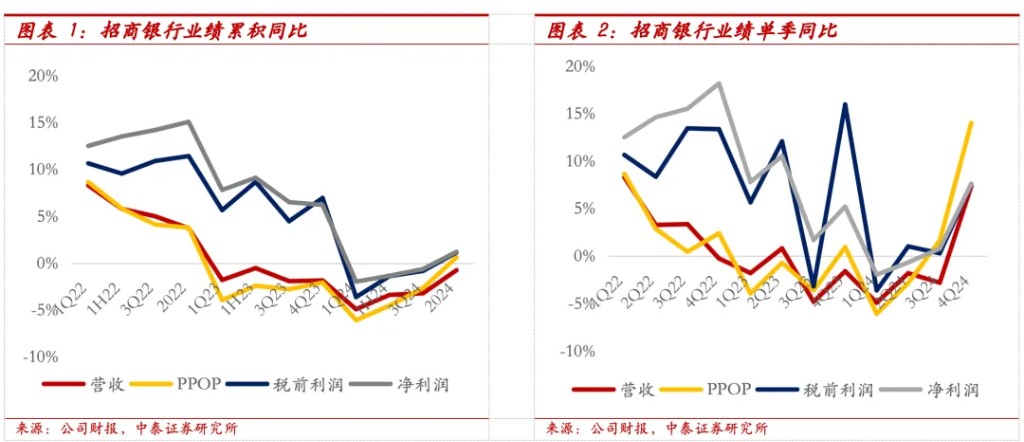
China Merchants Bank's cumulative revenue in 2024 decreased by 0.7% year-on-year (3Q24 down 3.2%), supported by a recovery in net interest and net non-interest income. Net profit increased by 1.2% year-on-year (3Q24 down 0.6%). Net interest income decreased by 1.6% year-on-year (3Q24 down 3.1%), with the decline narrowing. Net non-interest income increased by 0.8% year-on-year (3Q24 down 3.4%), turning positive. From 4Q23 to 4Q24, cumulative revenue, operating profit, and net profit attributable to shareholders grew by -1.8%/-4.9%/-3.4%/-3.2%/-0.7%, 7%/-3.6%/-1.3%-0.8%/1.2%, and 6.2%/-2%/-1.3%/-0.6%/1.2%, respectively.
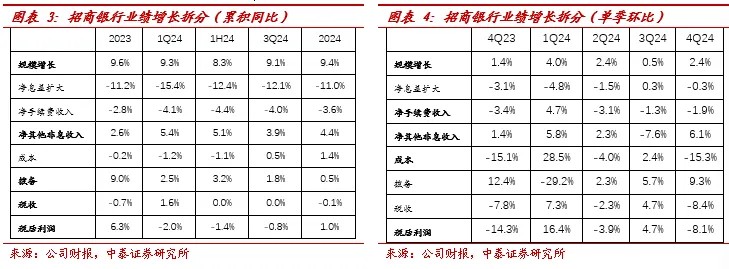
2024 performance cumulative year-on-year growth breakdown: scale growth is the main contributor, supporting performance by 9.4 points; followed by other non-interest income, costs, and provision accruals, contributing positively to performance by 4.4, 1.4, and 0.5 points, respectively. Net interest margin, fees, and taxes all contributed negatively. Looking closely at the marginal changes in contributions from various factors, the improvements in marginal contributions to performance are: 1. Scale growth's positive marginal contribution increased by 0.3 points. 2. The negative marginal contribution from net interest margin narrowed by 1.1 points. 3. The negative marginal contribution from fees narrowed by 0.5 points. 4. The positive marginal contribution from other non-interest income increased by 0.5 points. 5. The positive marginal contribution from costs is 0.8 points. The weakening marginal contributions are: 1. The positive marginal contribution from provisions narrowed by 1.3 points. 2. Tax contributions turned negative, decreasing by 0.1 points.
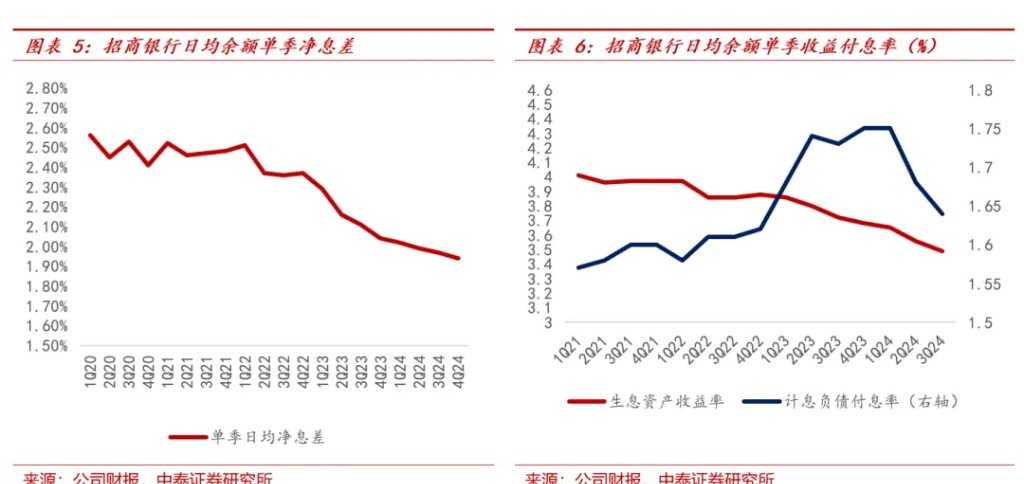
2. Quarterly net interest income increased by 2.1% quarter-on-quarter, net interest margin decreased by 3bp to 1.94%, with enhanced support from the liability side
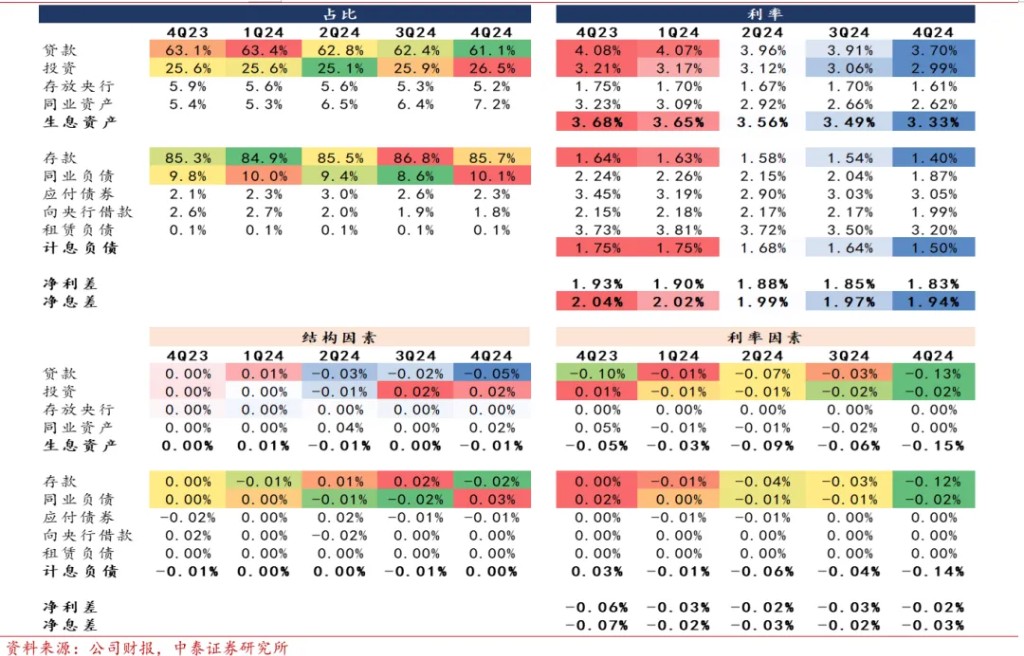
Quarterly net interest income increased by 2.1% quarter-on-quarter: the asset side dragged down the net interest margin, while the liability side provided some support. The average daily net interest margin for the quarter decreased by 3bp to 1.94%.
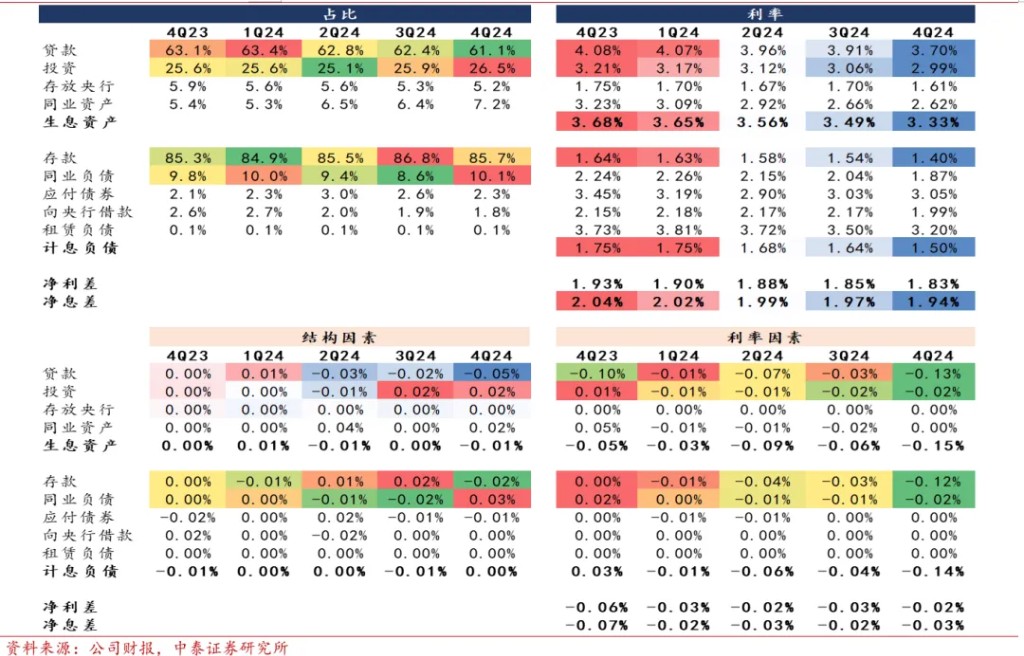
Asset side: The annualized yield on interest-earning assets for the quarter decreased by 16bp to 3.33%, with interest rates on various asset types declining. 1. Structural factors: dragged down by 1bp. The decrease in loan proportion dragged down by 5bp, while the marginal increase in the proportion of investments and interbank assets contributed 2bp each. 2. Interest rate factors: dragged down by 15bp. The interest rates on loans, investments, and interbank assets decreased by 21, 7, and 4bp, respectively, dragging down by 13, 2, and 0bp Liabilities: The annualized interest-bearing liability interest rate decreased by 14bp to 1.50% in the quarter, with declines in the cost rates of deposits and interbank liabilities. 1. Structural factors: The proportion of deposits slightly decreased, while the proportion of interbank liabilities slightly increased, remaining stable overall. 2. Interest rate factors: Contributed 14bp. The quarterly deposit interest rate decreased by 14bp to 1.4%, and the interbank liability interest rate decreased by 17bp to 1.87%, contributing 12bp and 2bp respectively.
3. Growth Rate and Structure of Assets and Liabilities: Stable credit growth; high growth in deposits
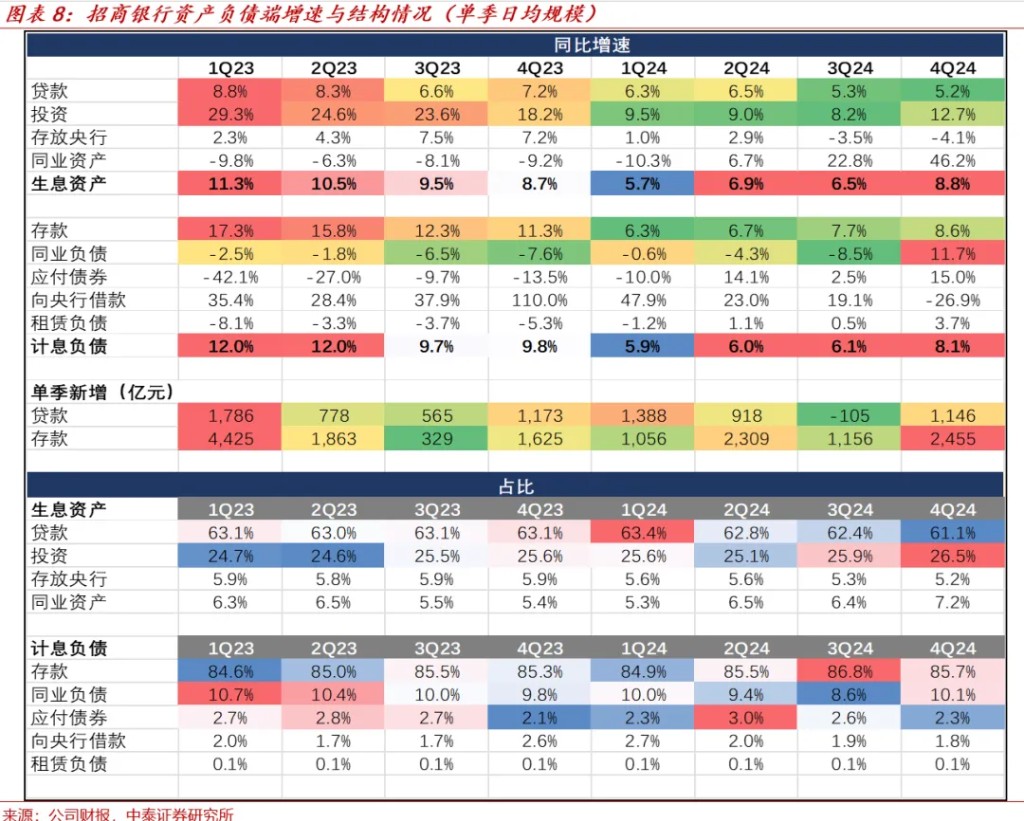
Asset side: Interest-earning assets in 2024 increased by 8.8% year-on-year (3Q24 increased by 6.5% year-on-year); total loans increased by 5.2% year-on-year (3Q24 increased by 5.3% year-on-year), with new loans in the quarter amounting to 114.6 billion, higher than in the second and third quarters, indicating active lending; bond investments increased by 12.7% year-on-year (3Q24 increased by 8.2% year-on-year). The growth rate of loans remains lower than that of assets, while bond investments maintain a relatively high growth rate.
Liability side: Interest-bearing liabilities increased by 8.1% year-on-year; total deposits increased by 8.6% year-on-year. The growth rate of deposits is higher than that of loans and interest-bearing liabilities.
4. Detailed Breakdown of Deposits and Loans: Year-round changes in the structure of outstanding credit—corporate up, retail stable, bills down
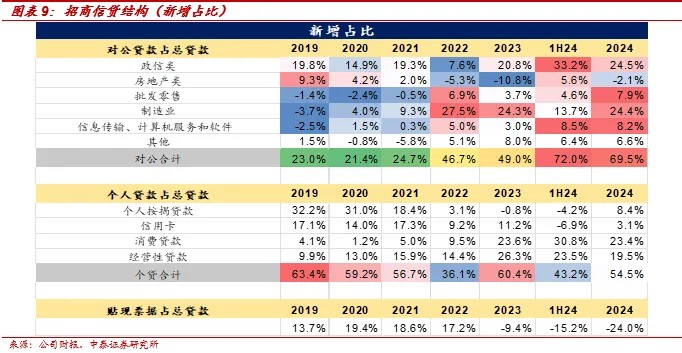
(1) New credit structure proportion: Corporate new loans significantly increased, mortgages showed a notable recovery year-on-year
The proportion of new corporate loans is 69.5%, an increase of 20.5 percentage points compared to 2023, showing a significant rise in new loan proportion.
In terms of absolute values for specific new credit proportions: The new proportions for government financing, manufacturing, and consumer loans are all above 20%, making them the top three contributing loan categories. The top six categories for new loan issuance throughout the year are government financing (24.5%), manufacturing (24.4%), consumer loans (23.4%), business loans (19.5%), mortgages (8.4%), and information technology (8.2%).
In comparison to 2023, the proportion of new loans in government financing, real estate, information technology, retail, and mortgages has increased significantly. The proportion of new loans in the broad government financing category (commercial leasing, transportation and storage, water conservancy and environment, electricity and gas, construction) continues to rise, increasing by 3.8 percentage points year-on-year to 24.5%. Real estate lending has warmed up, with a new proportion decrease of 2.1%, recovering by 8.6 percentage points compared to 2023. The new proportion for information technology has increased by 5.2 percentage points year-on-year, showing a significant rise In personal loans, mortgages have significantly rebounded, with the proportion of new additions increasing by 9.2 percentage points year-on-year, while the proportion of new non-mortgage products has declined.
(2) Credit stock structure proportion: Retail proportion remains stable year-on-year, corporate proportion increases, and bills decrease
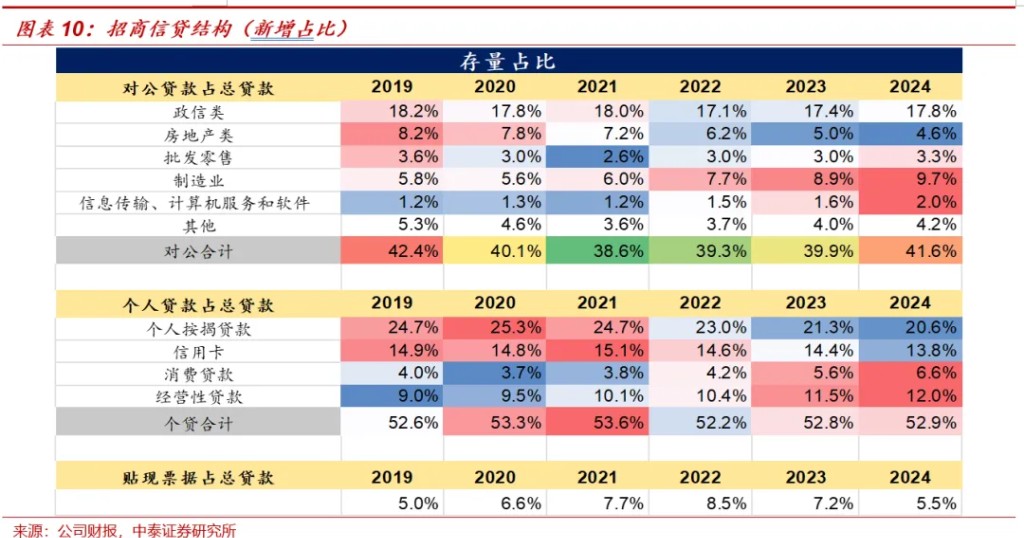
The corporate stock proportion is 41.6%, an increase of 1.6 percentage points year-on-year in 2023; the retail proportion is 52.9%, basically stable year-on-year; the bill proportion has decreased.
In terms of absolute values of credit stock proportions: Mortgages (20.6%), government financing (17.8%), credit cards (13.8%), business loans (12%), manufacturing (9.7%), and consumer loans (6.6%) are the top six.
In terms of changes year-on-year in 2023: Consumer loans and manufacturing have seen significant increases. The proportion of general government financing (commercial leasing, transportation and storage, water conservancy and environment, electricity and gas, construction) has increased by 0.4 percentage points year-on-year. Real estate investment has rebounded. Manufacturing has increased by 0.9 percentage points year-on-year to 9.7%. Consumer loans have increased by 1 percentage point year-on-year to 6.6%.
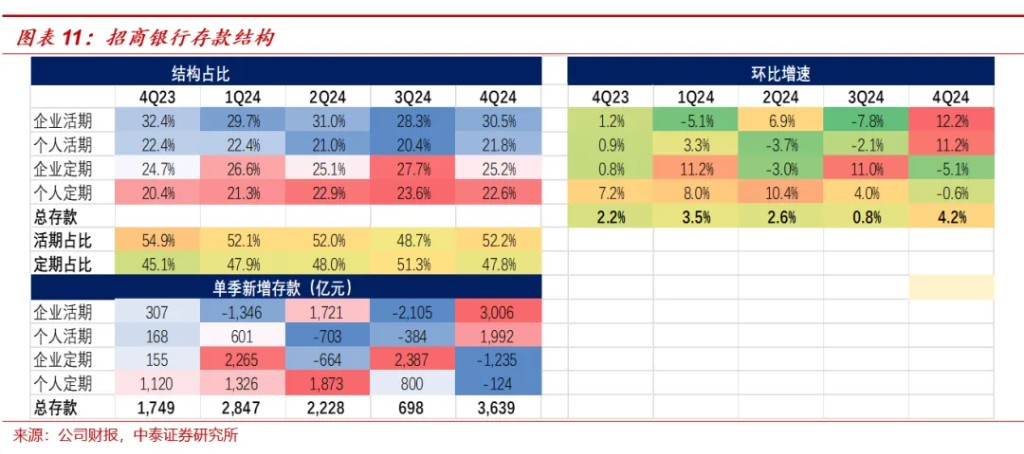
(3) Deposit structure: From an annual perspective, the proportion of demand deposits in 2024 has slightly decreased compared to 2023, but Q4 demand deposits have achieved high growth both year-on-year and quarter-on-quarter
Corporate demand deposits and personal demand deposits have increased significantly by 12.2% and 11.2% quarter-on-quarter, respectively, and have also achieved high growth year-on-year. By the end of 2024, the proportion of demand deposits is 52.2%, a significant increase of 3.5 percentage points quarter-on-quarter, but still a decrease of 0.7 percentage points year-on-year. From an annual perspective, the trend towards fixed-term deposits continues, although the proportion of demand deposits has remained stable throughout the year, with a slight increase in personal demand deposits compared to Q1 2024.
5. Year-on-year decline in net non-interest income narrows: Fee income decline has narrowed for three consecutive quarters, and agency wealth management income maintains high growth
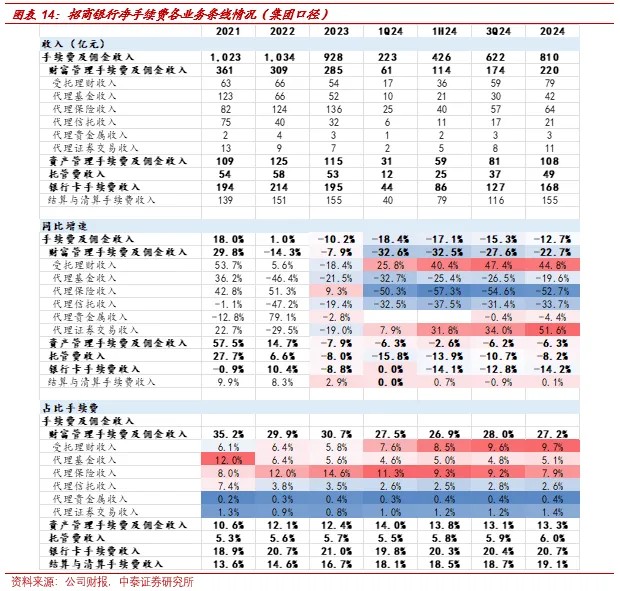
Net non-interest income increased by 0.8% year-on-year (3Q24 year-on-year -3.4%). Among them: Net fee income accumulated a year-on-year decline of 14.3% (vs 3Q24 year-on-year -16.9%), while net other non-interest income accumulated a year-on-year growth of 37.9% (vs 3Q24 year-on-year +30.9%). As of 2024, net non-interest income, net fee income, and net other non-interest income accounted for 36.1%, 21.8%, and 14.2% of revenue, respectively, with year-on-year changes of 0.5, -3.4, and 4 percentage points

Commission income accumulated year-on-year -12.7% (vs 3Q24 year-on-year -15.3%): 1. From a structural perspective, the company's commission structure remains stable, with wealth management business and bank card business contributing the most to commission income, followed by settlement business, asset management business, and custody business, accounting for 27.2%, 20.7%, 19.1%, 13.3%, and 6% respectively. 2. In terms of year-on-year growth rate, entrusted wealth management income and settlement clearing fees increased by 3.9 and 2.4 percentage points year-on-year, while agency insurance income decreased by 6.7 percentage points year-on-year.
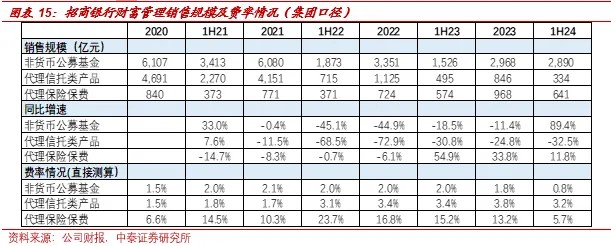
Detailed breakdown of wealth management commission from the group perspective: the decline in agency fund income has narrowed, and entrusted wealth management income maintains high growth. Looking at the situation of key projects from the perspective of the large wealth management value cycle chain. 1. In terms of structural proportion, the income from various wealth management businesses is relatively balanced. Entrusted wealth management, agency funds, insurance, and trusts contribute commission income of 9.7%, 5.1%, 7.9%, and 2.6% respectively, with agency wealth management income continuing to rise, firmly holding the first position in wealth management business income; agency insurance proportion decreased by 1.3 percentage points quarter-on-quarter, continuing to decline. 2. In terms of year-on-year growth rate, agency wealth management increased by 44.8% year-on-year, and agency securities increased by 51.6% year-on-year. Agency insurance, agency funds, and agency trusts decreased by 52.7%, 19.6%, and 33.7% year-on-year respectively. The decline in agency funds narrowed by 6.9 percentage points quarter-on-quarter.
6. Retail Tracking: Private banking clients maintain high growth, total AUM approaches 15 trillion
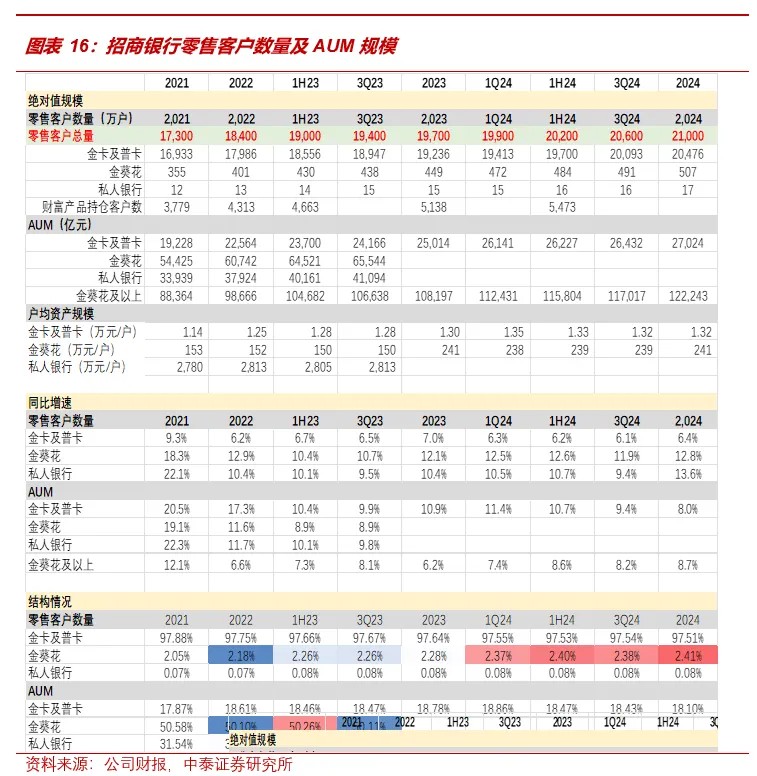
1. Number of clients. The number of retail clients reached 210 million. Among them, there are 5.07 million clients with Gold Sunflower and above, and 170,000 private banking clients. In terms of client growth, wealth clients maintain steady growth. Gold Sunflower and private banking clients increased by 12.8% and 13.6% year-on-year respectively, maintaining double-digit growth on a high base.
2. AUM: The total assets under management of retail clients approach 15 trillion, with Gold Sunflower and above accounting for 81.9% of AUM, an increase of 8.7% year-on-year.
7. Asset Quality: Overall Stable, Corporate Sector Continues to Improve, Real Estate Non-Performing Loan Ratio Improves for Four Consecutive Quarters, Retail Slightly Under Pressure
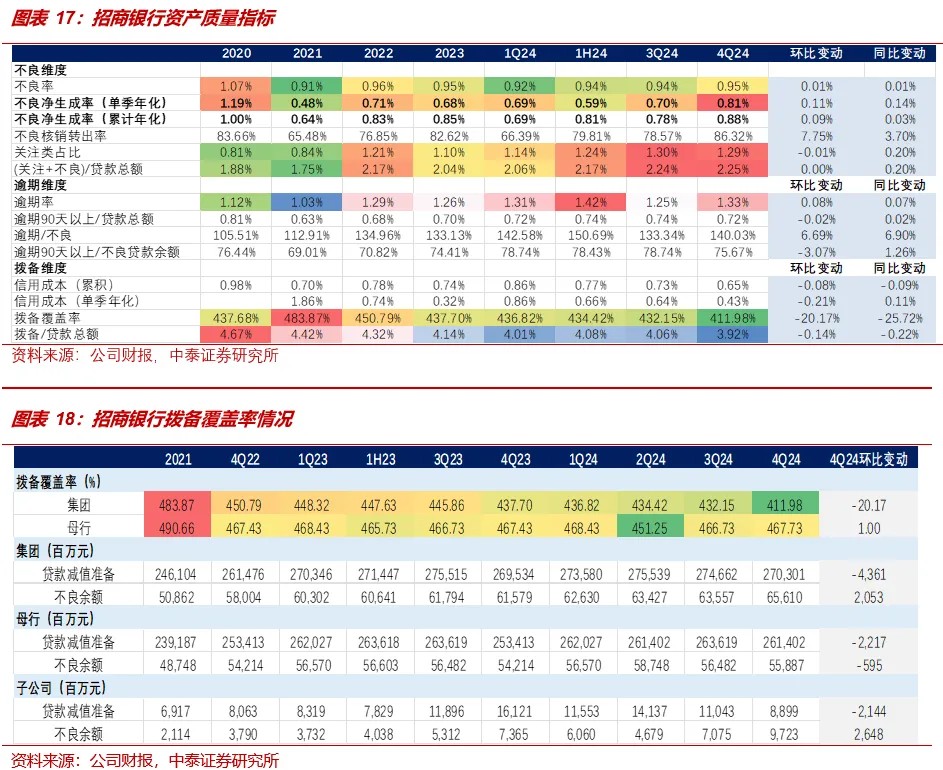
Non-Performing Dimension - Non-Performing Loans Remain Low. 1. The non-performing loan ratio at the end of 2024 is 0.95%, an increase of 1bp compared to the third quarter, basically stable, maintaining an excellent level. 2. The annualized net non-performing loan generation for the quarter is 0.81%, an increase of 11bp quarter-on-quarter.
Overdue Dimension - Overdue Rate is 1.33%, an Increase of 8bp Quarter-on-Quarter; among them, loans overdue for more than 3 months account for 0.72% of total loans, a decrease of 2bp quarter-on-quarter. The overdue ratio accounts for 140% of non-performing loans, an increase of 6.7 percentage points quarter-on-quarter.
Provision Dimension - Safety Cushion Maintained at a High Level. The provision coverage ratio is 411.98%, a decrease of 20.17 percentage points quarter-on-quarter, still maintaining a high level. The provision-to-loan ratio is 3.92%, a decrease of 14bp quarter-on-quarter.
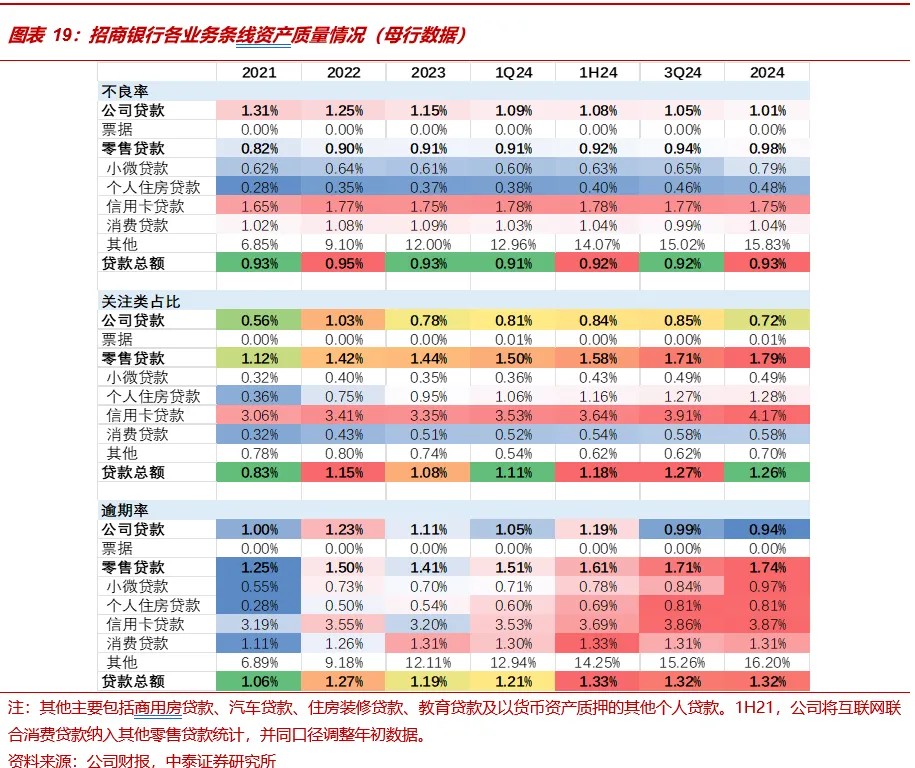
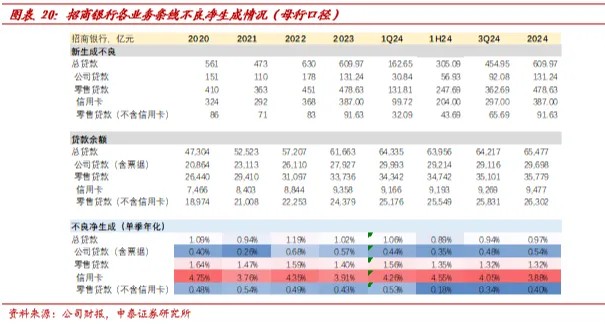
Asset Quality Situation of Each Business Line: Corporate Sector Shows Improvement in Attention, Overdue, and Non-Performing Loans; Retail Asset Quality Slightly Under Pressure, but Non-Performing Loan Generation Stabilizes, Credit Card Non-Performing Loan Ratio Declines for Two Consecutive Quarters.
(1) Corporate: The non-performing loan ratio decreased by 4bp quarter-on-quarter to 1.01%, continuing to decline from a low base; the proportion of attention loans decreased by 13bp quarter-on-quarter to 0.72%; the overdue rate decreased by 5bp quarter-on-quarter to 0.94%.
(2) Retail: The non-performing loan ratio increased by 4bp quarter-on-quarter to 0.98%, still relatively low overall; the estimated retail loan quarterly non-performing loan generation rate remained flat quarter-on-quarter, and the credit card non-performing loan generation rate declined for two consecutive quarters. The non-performing loan ratios for micro and small enterprises, mortgages, credit cards, and consumer loans changed by +15bp, +3bp, -3bp, and +4bp respectively. The credit card non-performing loan ratio has declined for two consecutive quarters.
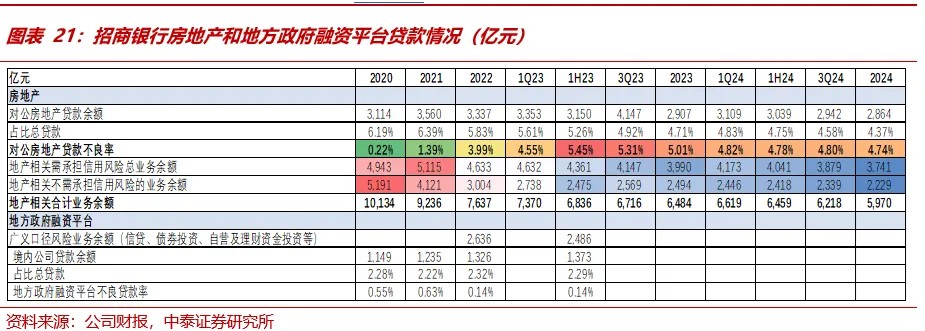
Real Estate Industry and Asset Quality Related Situation: 1. On-Balance and Off-Balance Scale: The scale has decreased quarter-on-quarter. The total balance of credit, self-issued bond investments, and self-issued non-standard investments related to real estate that bear credit risk amounts to 374.1 billion yuan, continuing to decrease quarter-on-quarter. Among them, the balance of corporate real estate loans is 286.4 billion yuan, accounting for 4.37% of the total loans and advances of the company, a decrease of 21bp quarter-on-quarter. 2. The corporate real estate non-performing loan ratio decreased by 6bp quarter-on-quarter to 4.74%, a decrease of 27bp year-on-year.
8. Others: Slight increase in dividend rate, estimated 25E dividend yield around 4.6%, further improvement in capital adequacy ratio
Dividend and dividend yield: The dividend rate reached 35.32%, a slight increase of 31 basis points compared to 2023. Assuming a 1.7% growth rate in net profit for 25E, the static estimated A/H dividend yields (tax-exempt) are 4.59% and 4.63%, respectively, with sufficient capital and no pressure for capital replenishment, making the dividend yield still attractive.
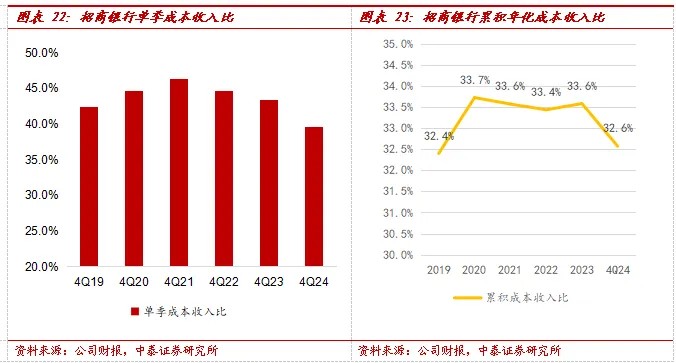
2024 management fees accumulated year-on-year decreased by 3.7%, and the cost-to-income ratio decreased by 3 percentage points year-on-year to 32.6%. The management fee for a single quarter decreased by 1.8% year-on-year, and the annualized cost-to-income ratio for a single quarter was 39.6%, down 8.5 percentage points compared to the same period last year.
Core Tier 1 capital adequacy ratio continued to rise quarter-on-quarter: Under the advanced approach, the core Tier 1 capital, Tier 1 capital, and capital adequacy ratio were 14.86%, 17.48%, and 19.06%, respectively, with quarter-on-quarter increases of +0.13%, +0.49%, and +0.38%.
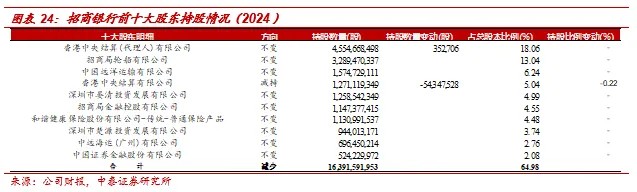
Changes in the top ten shareholders: Increase — Hong Kong Central Clearing Limited reduced its holdings by 0.22% to 5.04%.
9. Investment Recommendations
Based on external economic conditions, changes in industry policies, and the company's fundamentals, we slightly adjust our profit forecasts, expecting 25E-26E net profit attributable to the parent company to be 150.9 billion and 154.6 billion (previously 150.6 billion and 153.0 billion).
Investment recommendation: The company's 2025E, 2026E, and 2027E PB are 1.02X/0.94X/0.86X; PE are 7.62X/7.43X/7.36X. China Merchants Bank is gradually accumulating a "moat of business model" in the retail and wealth management sector; it is characterized by a long-term formed internal market-oriented and external customer-oriented "corporate culture" (which is rare in the banking industry); and a "team of personnel" formed by a large number of pragmatic, diligent, professional, and enterprising middle and senior management and business backbones. These underlying values have not changed, and it remains a rare and excellent bank in the industry, worthy of long-term holding. Maintain "Overweight" rating.
Authors of this article: Dai Zhifeng, Deng Meijun, Yang Chaolun from Zhongtai Bank, Source: Traditional Lending vs. New Financial Models, Original title: "Detailed Analysis of China Merchants Bank's 2024 Annual Report: Revenue Decline Continues to Narrow; Net Profit Growth Turns Positive; Slight Increase in Dividend Rate [Zhongtai Bank · Dai Zhifeng/Deng Meijun/Yang Chaolun]" Risk Warning and Disclaimer
The market has risks, and investment requires caution. This article does not constitute personal investment advice and does not take into account the specific investment goals, financial situation, or needs of individual users. Users should consider whether any opinions, views, or conclusions in this article are suitable for their specific circumstances. Investment based on this is at one's own risk
