Thomson Reuters Corporation's (TSE:TRI) Has Had A Decent Run On The Stock market: Are Fundamentals In The Driver's Seat?

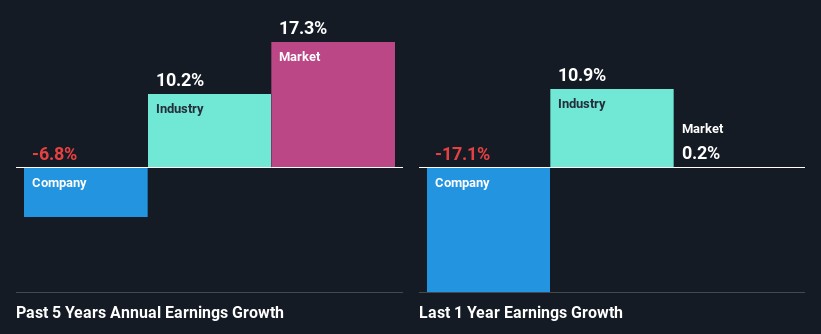
Thomson Reuters' stock (TSE:TRI) has risen 5.7% in three months, attributed to its decent financials, particularly an 18% Return on Equity (ROE). Despite this, the company reported a 6.8% decline in net income, contrasting with a 10% earnings growth in the industry. The firm retains 57% of its profits but faces challenges affecting growth. Analysts predict future earnings growth despite past declines, indicating potential for improvement in the company's financial performance.
Thomson Reuters' (TSE:TRI) stock up by 5.7% over the past three months. Given that stock prices are usually aligned with a company's financial performance in the long-term, we decided to investigate if the company's decent financials had a hand to play in the recent price move. Particularly, we will be paying attention to Thomson Reuters' ROE today.
Return on Equity or ROE is a test of how effectively a company is growing its value and managing investors’ money. Simply put, it is used to assess the profitability of a company in relation to its equity capital.
This technology could replace computers: discover the 20 stocks are working to make quantum computing a reality.
How To Calculate Return On Equity?
ROE can be calculated by using the formula:
Return on Equity = Net Profit (from continuing operations) ÷ Shareholders' Equity
So, based on the above formula, the ROE for Thomson Reuters is:
18% = US$2.2b ÷ US$12b (Based on the trailing twelve months to December 2024).
The 'return' is the amount earned after tax over the last twelve months. Another way to think of that is that for every CA$1 worth of equity, the company was able to earn CA$0.18 in profit.
Check out our latest analysis for Thomson Reuters
What Has ROE Got To Do With Earnings Growth?
We have already established that ROE serves as an efficient profit-generating gauge for a company's future earnings. We now need to evaluate how much profit the company reinvests or "retains" for future growth which then gives us an idea about the growth potential of the company. Assuming all else is equal, companies that have both a higher return on equity and higher profit retention are usually the ones that have a higher growth rate when compared to companies that don't have the same features.
Thomson Reuters' Earnings Growth And 18% ROE
To start with, Thomson Reuters' ROE looks acceptable. Even when compared to the industry average of 19% the company's ROE looks quite decent. As you might expect, the 6.8% net income decline reported by Thomson Reuters is a bit of a surprise. We reckon that there could be some other factors at play here that are preventing the company's growth. These include low earnings retention or poor allocation of capital.
That being said, we compared Thomson Reuters' performance with the industry and were concerned when we found that while the company has shrunk its earnings, the industry has grown its earnings at a rate of 10% in the same 5-year period.
The basis for attaching value to a company is, to a great extent, tied to its earnings growth. The investor should try to establish if the expected growth or decline in earnings, whichever the case may be, is priced in. Doing so will help them establish if the stock's future looks promising or ominous. If you're wondering about Thomson Reuters''s valuation, check out this gauge of its price-to-earnings ratio, as compared to its industry.
Is Thomson Reuters Using Its Retained Earnings Effectively?
Despite having a normal three-year median payout ratio of 43% (where it is retaining 57% of its profits), Thomson Reuters has seen a decline in earnings as we saw above. So there might be other factors at play here which could potentially be hampering growth. For example, the business has faced some headwinds.
Additionally, Thomson Reuters has paid dividends over a period of at least ten years, which means that the company's management is determined to pay dividends even if it means little to no earnings growth. Upon studying the latest analysts' consensus data, we found that the company's future payout ratio is expected to rise to 57% over the next three years. Despite the higher expected payout ratio, the company's ROE is not expected to change by much.
Conclusion
In total, it does look like Thomson Reuters has some positive aspects to its business. Although, we are disappointed to see a lack of growth in earnings even in spite of a high ROE and and a high reinvestment rate. We believe that there might be some outside factors that could be having a negative impact on the business. With that said, we studied the latest analyst forecasts and found that while the company has shrunk its earnings in the past, analysts expect its earnings to grow in the future. To know more about the latest analysts predictions for the company, check out this visualization of analyst forecasts for the company.