Shopee breaks through in Brazil, rising from an outsider to the second largest market

Shopee has performed excellently in the Brazilian market, with its market share increasing from 8.6% in January to 8.8%, becoming the second in the market, second only to Mercado Livre. In 2024, Shopee's sales in Brazil will reach 60 billion reais, double that of Amazon. Its success is attributed to continuous investment in logistics, localized operations, and live e-commerce, optimizing the delivery network and meeting local consumer demands
Author: Tu Ke Chuhai

Image source | pexels
While most e-commerce platforms struggle in the Brazilian market, Shopee from Southeast Asia has delivered an impressive performance.
According to the latest data from market research firm Conversion, the overall performance of Brazil's e-commerce market was sluggish in February, but Shopee experienced counter-cyclical growth, increasing its market share from 8.6% in January to 8.8%, firmly holding the second position in Brazil's e-commerce market, second only to local giant Mercado Livre (12.5%).
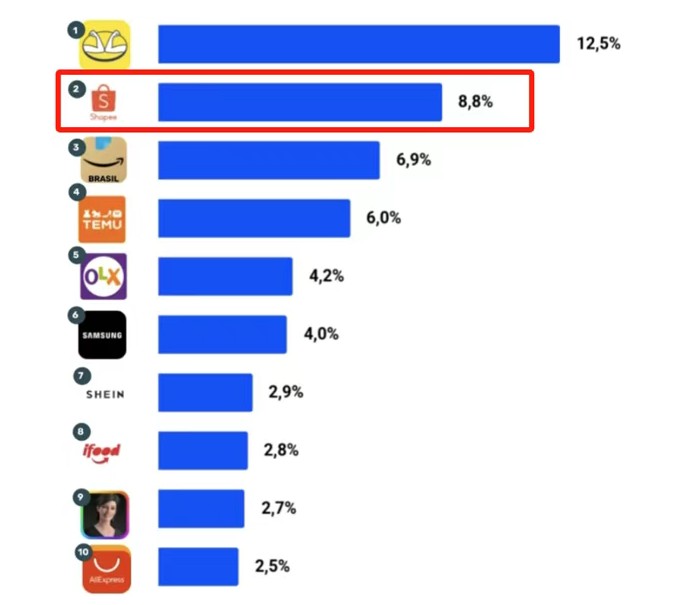
Shopee successfully crowned itself as the second in Brazil's e-commerce market, source: Conversion
Shopee's rise is not accidental. As early as May 2024, it surpassed Amazon for the first time, achieving 201 million visits in a single month, compared to Amazon's 195 million. Even more astonishing, Shopee's sales in Brazil reached 60 billion reais in 2024, equivalent to twice that of Amazon, while accounting for 40% of Mercado Livre's Brazilian business. This growth momentum has made Shopee the strongest challenger in Brazil's e-commerce market.
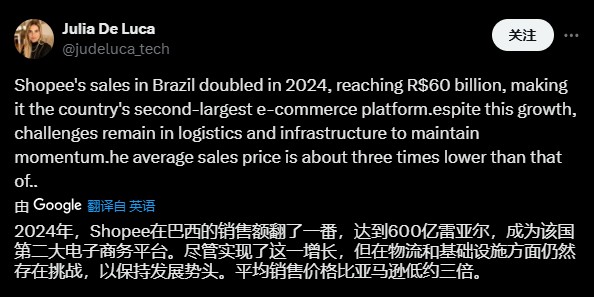
Shopee's annual sales reached 60 billion BRL, source: X
Three Growth Engines of Shopee
Shopee's rapid rise in the Brazilian market is attributed to its continuous investment in three key areas: logistics infrastructure, localized operations, and live-streaming e-commerce.
In terms of logistics, Shopee has been optimizing its logistics network in Brazil, reducing delivery times to major cities by 40% through Shopee Express in 2024. In February 2025, it further adjusted its policy, requiring third-party warehouse sellers to expedite shipping to enhance user experience.
At the same time, Shopee understands the importance of localized operations, not only introducing international products but also actively recruiting local Brazilian sellers to cover more local specialty products. This enables the platform to offer categories that better meet Brazilian consumers' needs while achieving faster delivery efficiency.
Most notably, Shopee has made breakthroughs in the live-streaming e-commerce sector. Brazilian consumers have a special preference for interactive shopping, and Shopee has keenly captured this trend, increasing its daily live-streaming sessions from 50 at the end of 2023 to over 1,000 in 2024 Data shows that user views have increased sixfold, and comments have increased fourfold, with live streaming becoming an important source of traffic and conversion for Shopee.
Next Battle: Challenging Mercado Libre's Dominance
Currently, Shopee's biggest competitor in Brazil remains Mercado Libre. This Latin American e-commerce giant has been deeply rooted in the market for many years, with a mature logistics and user base. However, Shopee's growth rate is faster, especially notable in its penetration among young users and in small to medium-sized cities.
In the future, the competition between the two platforms will revolve around logistics efficiency, price advantages, and localized operations. If Shopee can continue to maintain its current growth rate, it is likely to further narrow the gap with Mercado Libre in the coming years, potentially reshaping the landscape of Brazil's e-commerce market.
What Insights Does Shopee's Journey in Brazil Offer the Industry?
Shopee's success in Brazil proves that even foreign platforms can break through in fierce competition as long as they accurately grasp local demands, optimize logistics experiences, and leverage innovative models (such as live-streaming e-commerce).
For other overseas e-commerce companies, Shopee's case is worth in-depth study; true globalization is not about simply replicating models but deeply integrating into the local market.