


The detours taken by domestic smartphones, with foldable screens being just one of them

Huawei launched its first foldable phone, Pura X, at the Pura Pioneer Gala, but Apple's foldable phone release has been postponed to 2027. Other domestic manufacturers such as OPPO and Meizu are also stagnating in the foldable screen sector. IDC pointed out that foldable phones are struggling to break through in market appeal, and it is expected that more manufacturers will adopt a wait-and-see attitude by 2025. Foldable screens were once seen as the hope for domestic phones, but they have now become a "detour" for the industry
Author | Li Wenjie
Editor | Li Jinlin
At the recent Huawei Pura Pioneer Festival and HarmonyOS Smart Travel product launch event, Huawei launched its first large foldable screen phone, Huawei Pura X.
As Huawei once again expanded its foldable phone lineup, Apple's first foldable phone has yet to arrive. Previously, there were leaks suggesting it would be released in the second half of 2026, only to be followed by news that the release date has been pushed back to 2027. It has almost become a "wolf is coming" story.
On the other hand, the actions of other domestic phone manufacturers are also intriguing. OPPO has not released any foldable screen products throughout 2024. Recently, there have been reports that Meizu's large foldable development has been halted, and two other phone manufacturers have paused the development of their foldable products, with industry insiders speculating that one of them is Honor.
If we consider the launch of the world's first consumer-grade foldable screen phone, "Royole FlexPai," by Royole Technology, foldable phones have been around for 7 years. IDC believes that foldable phones have reached a point where there is little room for further breakthroughs or appeal in terms of usage scenarios and consumer demographics, predicting that more manufacturers will adopt a wait-and-see attitude in 2025 and become more conservative.
A path that once prompted domestic phone manufacturers to rush in and place their bets now seems to be proving that it is merely a "bumpy road" that is regrettable to abandon but must be continued.
This is just a microcosm; in the past few years of collective anxiety among domestic manufacturers, it feels like we have entered the "garbage time" of the competition, innovating for the sake of innovation, iterating without any real impact...
Collective Misplaced Bets?
Looking back at the years when domestic manufacturers flocked to the foldable screen market, especially against the backdrop of declining overall smartphone sales, the foldable screen, which was growing against the trend, was once seen as "the hope of the whole village."
At that time, global smartphone shipments declined by an average of 4% annually from 2019 to 2023, with a cumulative decrease of 16%. However, the niche market of foldable phones maintained growth against the trend.
Thus, when leading brands like Huawei and Samsung began to explore foldable screens, other manufacturers feared missing out or falling behind; at the same time, as the prices of foldable screens concentrated in the high-end market of 8,000 to 10,000 yuan, foldable screens clearly carried the hope of domestic phones moving upscale. It is worth noting that Xiaomi's 2019 concept phone, the MIX Alpha 5G, was officially priced at 19,999 yuan, and Huawei's Mate XT started at an official price of 19,999 yuan. Due to strong market demand, both were once speculated to be priced far above their official prices in the second-hand market.
So, was the collective choice of domestic phone manufacturers the right bet?
The answer may begin to emerge in 2024.
Counterpoint predicts that global shipments of foldable phones will reach 25 million units in 2024, representing a year-on-year growth of only 37%, which is a continuous decline compared to 52% in 2023 and 73% in 2022. Even for Samsung, the leader in the global foldable phone market, its market share in the third quarter of 2024 is expected to decline by 14% year-on-year, far less than the 70% in the third quarter of 2023 In addition, Samsung's foldable phone shipments also fell by 21% year-on-year.
 Source: Dingjiao One
Data source: IDC
In fact, as early as 2024, there were rampant rumors of manufacturers exiting the foldable screen market, sometimes OPPO, sometimes vivo. Although OPPO responded directly to the exit rumors by stating that its foldable series products are progressing as planned, and vivo launched a large foldable screen to express its intentions, the rumors hint at the many uncertainties in this market.
By the end of 2024, when Huawei's new foldable flagship Mate X6 opened for pre-order, Royole, which rushed to be the "world's first dual-foldable phone," had been officially declared bankrupt. As 2025 began, foreign media reported that Apple's vertical foldable iPhone project was still delayed, while blogger "Smart Pikachu" revealed that Meizu's large foldable phone R&D project had been halted.
This inevitably brings to mind that Meizu's former vice president Li Nan once stated that the component cost of an ordinary 5G phone is about 3,000 yuan, and upgrading to a foldable screen requires an additional 1,400 yuan for the screen, plus other components like the battery, making the estimated component cost of a foldable phone around 5,000 yuan. Additionally, the costs for screen molding, structural component molds, hinge design, and software development are allocated to each phone at about 15,000 yuan, resulting in minimal profit for a foldable screen.
But is it easy to let go? It has become very difficult. Honor CEO Zhao Ming stated last September: "We definitely haven't recouped our investment yet, we're far from it, it's not just 100 million, we invested 1 billion in Honor Magic V2."
Thus, although domestic smartphone manufacturers entered this market seeking "growth," they now cannot exit due to sunk costs. It can be said that the foldable screen market has nearly fallen into a "deadlock" that must be persisted in.
Innovating for the sake of innovation
Looking back over the past few years, the domestic smartphone industry has not seen any groundbreaking updates for a long time. Major brands continue to compete, but the so-called innovation points revolve more around cameras, batteries, 5G, and high frame rates.
As pointed out by "New Media Technology Review," the last collective innovation in smartphones dates back to 2018. At that time, in addition to the birth of the iPhone X, major manufacturers also launched their own full-screen phones, using slide covers, foldable screens, curved screens, and hole-punch designs to increase the screen-to-body ratio, which can be described as a flourishing of ideas.
However, in just a few years, revolutionary innovations have become a bubble, and most domestic smartphone manufacturers can only innovate for the sake of innovation. In search of new innovation points, phone manufacturers have iterated and updated nearly every component. But evidently, these innovation points do not seem to have been effective The main reason for this situation may be that the entire industry has entered a "garbage time"—neither able to turn the tide nor end the competition.
In this intense chaos, all manufacturers cannot afford to stop because if they cannot continuously launch new products, they face elimination. However, passively "getting involved" does not bring actual benefits. For leading manufacturers, there is often the confidence to "tough it out," but many manufacturers have fallen before the end of the competition.
As a result, not only foldable screens but also many niche markets, such as selfie phones and gaming phones, have attracted major manufacturers' investments. The reason is that for anxious domestic smartphone manufacturers, even the smallest outlet is still an outlet.
Recently, Realme launched a new gaming phone with the selling point of "durable gaming god, super battery life," starting at only 1,530 yuan. A relevant person from Realme stated that they aim to "continuously lead innovation, break bad competition... and achieve product differentiation through gaming phones."
 Image source: Realme official Weibo
Zinc Scale noted that the gaming phone launched by Realme still focuses on conventional gaming phone performance such as battery life and frame rate, which have already been discussed by Black Shark and Red Magic.
In fact, if the niche market of foldable screens is at least still allowing the game to continue, then the gaming phone market is actually getting closer to the end of the game.
Since officially entering the public eye in 2018, gaming phones indeed experienced a peak moment, even driving many mainstream smartphone manufacturers to join the fray. For example, Nubia, Lenovo, vivo, ASUS, and even Redmi have successively launched "gaming phones."
Among them, as a pioneer in the gaming phone market, Black Shark Gaming Phone topped the sales in this sub-category upon its initial release. In January 2022, there were media reports that Tencent would acquire Black Shark. However, in 2023, Black Shark Technology, which had been silent for a long time, was reported to be facing operational difficulties, layoffs, and unpaid wages. The gaming phone market has been questioned as a false proposition.
Previously, Lu Weibing, President of Xiaomi Group and General Manager of the Redmi brand, predicted on Weibo: "E-sports phones are destined to disappear." Even though the gaming phone launched by Redmi had already ranked first in the gaming phone market with a 45% market share at that time, Lu Weibing still stated that the Redmi series would no longer launch "e-sports versions" in the future.
By 2023, from January to September, the cumulative sales of gaming phones reached nearly 3.2 million units, a year-on-year decline of nearly 40%; the cumulative sales revenue was approximately 7.6 billion yuan, a year-on-year decline of 39%.
Even so, Realme still clings to this market, perhaps indicating that in "garbage time," so-called innovation is mostly "forced innovation."
2025, a time of uncertainty
In "garbage time," the mainstream market is saturated, and innovation is slowing down. Although major brands are looking for new ways to stimulate users to upgrade their devices, the results have not been significant. However, garbage time will eventually come to an end.
A good signal is that research firm IDC pointed out that since the second half of 2023, the global smartphone market has shown a steady recovery, with the growth rate of shipments for the entire last year approaching 7%. From a sales perspective, the global smartphone market has also ended the lowest point in a decade set in 2023, with a year-on-year growth of 4%.
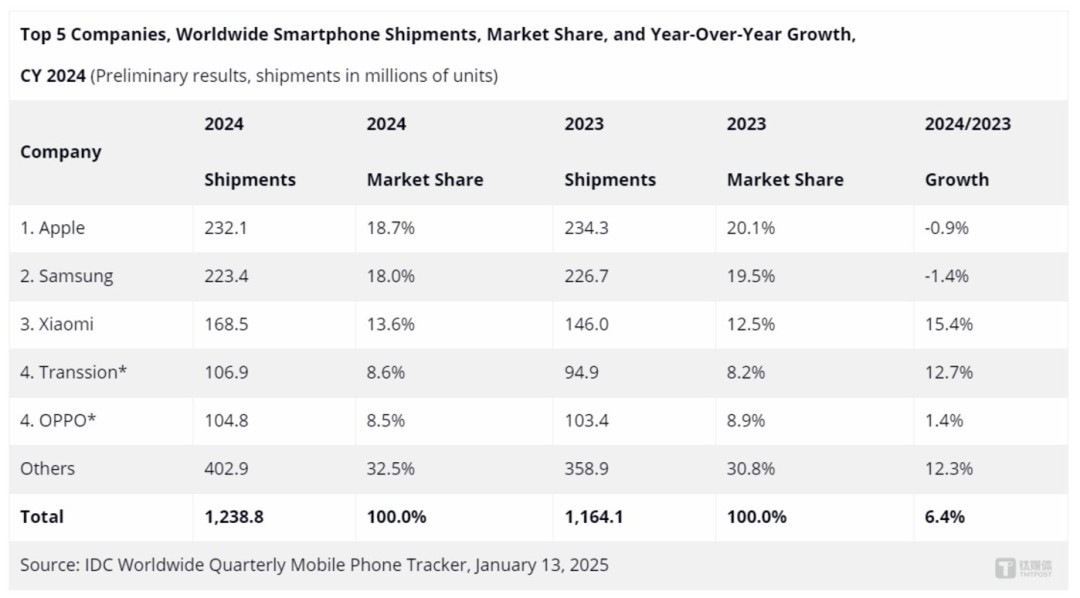 Image source: Titanium Media
Nabila Popal, Senior Research Director of Global Devices at IDC, stated that manufacturers have successfully adjusted their strategies to drive growth by focusing on promotions, launching new products across multiple price ranges, offering interest-free installment plans, and actively implementing trade-in strategies—continuing to maintain a high-end focus while increasing the share of low-end products, especially in China and some emerging markets.
However, in 2025, the mobile phone industry may face more new variables.
After all, as Canalys Senior Analyst Zhu Jiatao mentioned in an interview, it is unlikely that 2025 will replicate the high growth rate of 2024. This is because much of the growth in the past year stemmed from manufacturers and channels replenishing inventory levels and some macroeconomic recovery in certain markets. Demand fluctuations and macro uncertainties remain the primary challenges.
In short, 2025 may still be a year of uncertainty. Looking back over the past year, AI, price increases, overseas expansion, and Apple's fall from grace have all been focal points in the consumer market. Whether a new wave will truly emerge in 2025 remains to be seen.
This article is reproduced from Zinc Scale (ID: znkedu) with authorization. All rights reserved by Zinc Scale. Unauthorized translation or reproduction is prohibited.
The "2024 China Consumer Brand Growth White Paper" is now on sale for 398 yuan with free shipping!
Over the past year, the global consumer market has shown unprecedented complexity after experiencing challenges from economic fluctuations and opportunities and changes brought about by technological iterations. Beneath the surface of overall slowing growth, a large number of structural opportunities remain to be explored. Currently, companies need to cope with short-term survival pressures while also laying out long-term value, facing increasingly difficult challenges. Adapting to trends and reshaping mental strength will become the core strategy for consumer enterprises.
The "2024 China New Consumer Brand Growth White Paper" is based on research from over 8,000 consumers, insights from over 100 experts, and in-depth analysis of over 3,000 companies, decoding the essence of the market from eight dimensions and anchoring future trends from six perspectives. This 200,000-word professional report will serve as a "barometer" for the iteration of the consumer industry and will also be a strategic guide for companies to break through existing constraints and reshape growth momentum Click here or the image below to purchase, with free shipping to your home!
