


Wall Street identifies "tariff havens": Asian consumer staples stocks

Wall Street believes that the global trade war is beneficial for Asian consumer stocks and recommends companies that meet local demand. Goldman Sachs and Morgan Stanley strategists suggest that investors shift towards defensive positions, while Fidelity International quickly buys into Chinese consumer stocks. Since April 2, the MSCI Asia Pacific Consumer Staples Index has risen by 5%, outperforming the broader market. Analysts point out that investor sentiment is shifting, with a growing focus on the resilience of domestic demand, and expect fiscal stimulus measures to further support the recovery of the sector
According to the Zhitong Finance APP, Wall Street believes that the global trade war has brought benefits to Asian consumer stocks, favoring companies that meet the basic needs of local buyers. After the U.S. imposed reciprocal tariffs on April 2, strategists from Goldman Sachs and Morgan Stanley recommended Asian consumer staples stocks in their published reports, urging investors to shift towards defensive positions. Fidelity International also pointed out that it quickly bought Chinese consumer stocks, betting that these companies would benefit from government stimulus measures.
Since April 2, the MSCI Asia Pacific Consumer Staples Index has risen by 5%, making it the best-performing sector among the 11 sectors, surpassing the 2.5% decline of the broader market. China's chain supermarket Yonghui Superstores (601933.SH) and Japan's food production and distribution company Kobe Bussan have both risen by at least 19%, with other beverage and dairy producers also performing well.
This marks a sharp turnaround in the industry's fortunes, which has been sluggish in recent years as the AI frenzy drove tech stocks to soar. This highlights that as trade tensions threaten to slow down the global economy, investors are beginning to flee growth stocks. Signs that governments in Asian countries are preparing to launch fiscal stimulus measures to support spending have also boosted this group.
Charu Chanana, Chief Investment Strategist at Saxo Bank in Singapore, stated that China's outstanding performance signifies a "shift in investor sentiment from chasing global growth and exports to seeking refuge in domestic demand resilience." She said, "Investors are starting to price in a more decentralized and protectionist world, where local policy support and consumption are more important."
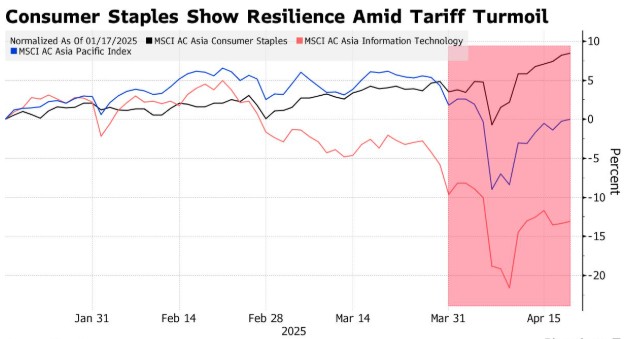
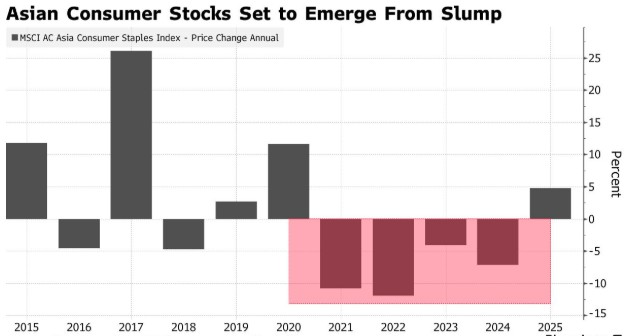
Although the protracted trade war will not spare any industry, consumer staples have shown resilience during economic pressures. This has also helped the sector benchmark index recover after four consecutive years of decline before 2024, while the MSCI Asia Information Technology Index has essentially risen for several consecutive years since 2019, indicating room for catch-up.
With the introduction of fiscal stimulus plans, this nascent rotation trend may extend. The Chinese government recently listed 48 measures to expand household spending in areas such as dining and healthcare, while South Korea has increased its supplementary budget plan to 12 trillion won (approximately $8.4 billion). In India, the monsoon is expected to be above normal levels, which will improve rural demand.
Terrence Kan, Portfolio Strategist at Fidelity International, stated that Fidelity International took advantage of the decline in mainland China and Hong Kong stock markets on April 7 to increase its holdings in consumer staples and some non-essential stocks related to tourism. He prefers stocks listed in mainland China, as they may benefit more from government support measures
During market turbulence, Asian consumer stocks have outperformed their US and European counterparts, thanks to the swift commitment of various countries to provide policy support. In a report on April 6, Goldman Sachs strategists upgraded their rating on Asian consumer staples from "in line with the market" to "overweight," stating that they prefer "local and defensive." Last Thursday, JP Morgan strategists made a similar rating upgrade for the Southeast Asian consumer staples sector.
Hiroori Akizawa, Chief Investment Officer of Tokio Marine Asset Management International Pte, stated, "Consumer staples is not a sector with highly volatile demand," and there are relatively few companies with significant exposure to US exports. "A positive scenario is that major central banks will take measures to cut interest rates to stimulate consumption."
In contrast, the discretionary goods sector has been affected by expectations that households will cut non-essential spending. Since April 2, the MSCI Asia Consumer Discretionary Index has fallen by more than 5%, making it the second-largest decline among all sectors. James Thom, Senior Investment Director for Asian Equities at Aberdeen Investments, noted that the risk facing discretionary goods is intensified inflation, which could dampen investor enthusiasm for the sector.
However, there is currently a growing consensus that the consumer staples sector is a safer choice. It is expected that the earnings growth of this sector's index over the next 12 months will be twice that of the MSCI Asia-Pacific Index.
Nick Twidale, Chief Market Analyst at AT Global Markets, stated, "In this scenario, the consumer staples sector will remain a focus for investors, and if risk appetite rebounds, we may see a return of discretionary stocks and service stocks. I believe this will only happen if the US changes its tariff policy."
