


New Generation Targets for Muscle Gain and Fat Loss: Eli Lilly Partners with LAEKNA-B, U.S. Phase I Clinical Trial Launching Soon

LAEKNA and Eli Lilly collaborate to plan the launch of the Phase I clinical trial for LAE102 targeting obesity in the United States by the end of April 2025. LAE102 is a monoclonal antibody targeting Activin Receptor Type II A, which has already undergone Phase I clinical trials in China. Eli Lilly will be responsible for the clinical trial in the United States and bear the costs, while LAEKNA retains global rights
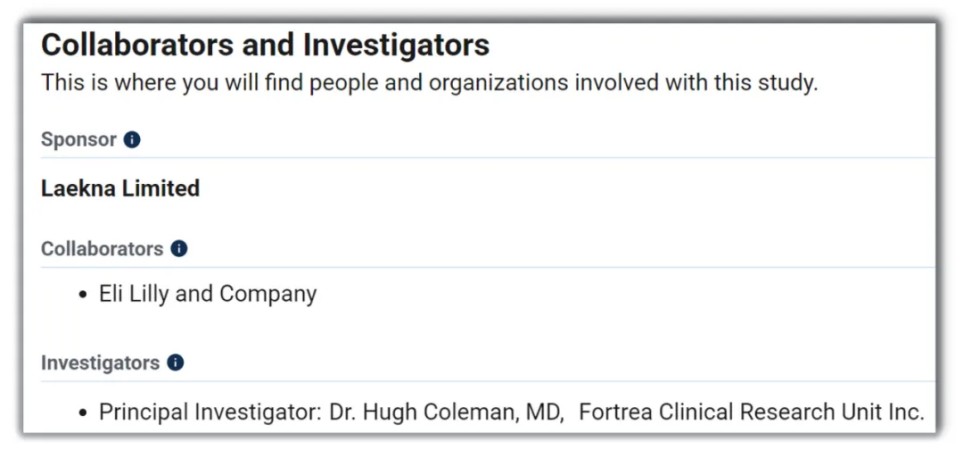
In April 2025, information from the global clinical trial registration platform ClinicalTrials indicated that the Hong Kong-listed biotech company LAEKNA updated relevant information regarding its self-developed pipeline LAE102 for obesity in a Phase I clinical trial (NCT06908707) in the United States.
A notable change is that the revised clinical protocol includes the name of the partner Eli Lilly.
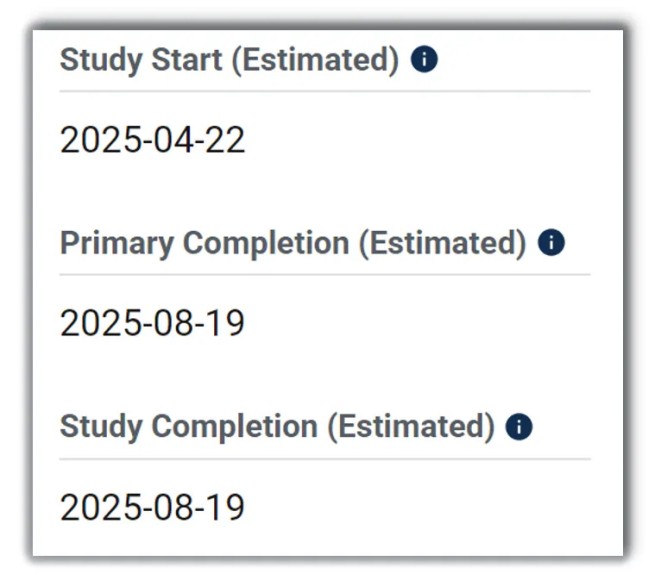
At the same time, information from the ClinicalTrials website also shows that the study is scheduled to start clinical enrollment at the end of April 2025, with an expected completion date in August 2025.
LAE102 is a monoclonal antibody independently developed by LAEKNA that targets Activin receptor type IIA (ActRIIA). It is one of the few targeted ActRII pipelines that have entered the clinical trial stage globally, aside from Eli Lilly's Bimagrumab.
Currently, LAEKNA's Phase I clinical trial for LAE102 in China is progressing at full speed: following the single ascending dose part (SAD study), the multiple ascending dose study (MAD study) completed its first subject visit in March 2025.
According to the database of the Pharmaceutical Investment Tribe, last November, LAEKNA signed a clinical collaboration agreement with Eli Lilly, where Eli Lilly will be responsible for conducting a Phase I clinical trial of LAE102 in the United States and bear the related costs, while LAEKNA retains global rights to LAE102.
The clinical protocol revision submitted by LAEKNA to the FDA corresponds to this clinical trial (NCT06908707) being advanced in collaboration with Eli Lilly in the United States.
Eli Lilly Continues to Increase Investment in ActRII Targets
As the leader in the global metabolic field, Eli Lilly is steadily increasing its investment in clinical trials for drugs targeting ActRII.
According to information from the ClinicalTrials website, in March and April 2025, Eli Lilly initiated two new clinical trials combining Bimagrumab with Tirzepatide, namely a bioavailability trial of Bimagrumab alone or in combination with Tirzepatide in healthy populations (NCT06890611), and a Phase II clinical trial of Bimagrumab alone or in combination with Tirzepatide in obese patients or overweight diabetic patients (NCT06901349) Including a Phase II clinical trial (NCT06643728) that started in October 2024, Eli Lilly has launched three new clinical trials for "Bimagrumab + Tirzepatide" in just six months.
After the great success of Tirzepatide, Eli Lilly clearly aims to make Bimagrumab the next top product in the metabolic field. This strategic choice is related to the shortcomings exposed by GLP-1 weight loss drugs.
Although the weight loss effects of GLP-1 drugs are already quite good, a large amount of research data indicates that about one-third of the weight loss achieved with Semaglutide or Tirzepatide comes from muscle loss rather than fat consumption.
How to avoid muscle loss or even increase muscle while losing weight is the next-generation weight management paradigm pursued by many pharmaceutical companies and is currently a clinical necessity for obese or overweight patients.
Bimagrumab is a pipeline that Eli Lilly acquired for over $2 billion, and this Activin receptor type II (ActRII) antagonist carries Eli Lilly's strategic intent to gain a first-mover advantage in the "fat loss and muscle gain" track.
Recent studies have shown that combining ActRII inhibitors with GLP-1 drugs can address the muscle loss caused by the latter, achieving the ideal effect of "fat loss and muscle gain," and is regarded as the "golden partner" of GLP-1 drugs. Therefore, the ActRII target is also seen as the next heavyweight target in the metabolic field, following the GLP-1 target, which is highly anticipated by the global pharmaceutical industry.
Previously, Eli Lilly completed a clinical trial involving about 500 participants using Bimagrumab in combination with Semaglutide.
As of now, Eli Lilly has not disclosed specific clinical research results for the combination of Bimagrumab and Semaglutide.
However, according to a case data from the February 2025 Nature magazine news feature "Dozens of new obesity drugs are coming: these are the ones to watch," a New Zealand patient weighing 114 kg successfully lost 18 kg of fat and gained 1 kg of muscle after nearly a year in the clinical trial. (Refer to "Eli Lilly's Heavy Bet on New Weight Loss Drug Reveals Case Data for the First Time")
This may also be the confidence behind Eli Lilly's recent launch of three new clinical trials related to Bimagrumab, indicating that the previous clinical research results of "Bimagrumab + Semaglutide" have given Eli Lilly great confidence in the ActRII target, further validating its druggability.
This is good news for all pharmaceutical companies engaged in the development of the ActRII target.
LAEKNA's Comprehensive Layout
In terms of the ActRII target, Eli Lilly is currently the pharmaceutical company conducting the most clinical trials, while LAEKNA is the company with the most extensive layout on the ActRII target.
Even with Bimagrumab already in hand, Eli Lilly still chooses to invest resources to advance the development of LAE102, likely due to the differentiated advantages already shown by LAE102 Bimagrumab targets Activin receptor type II A and B, and is a dual-target inhibitor, with a higher antagonistic activity against ActRIIB than ActRIIA. LAE102 targets Activin receptor type II A and is a single-target inhibitor.
Currently, ActRIIB is considered the main receptor for myostatin during the body's balance period, while ActRIIA is more closely related to muscle regeneration and lipid metabolism.
Based on the relatively limited research data available, it is still not possible to determine which targeting approach is the better choice, but LAE102 has indeed demonstrated better safety potential.
Clinical research data disclosed for Bimagrumab shows that while this drug exhibits muscle gain and fat loss effects, it also leads to side effects such as diarrhea and muscle cramps.
In contrast, in the Phase I single ascending dose study (SAD study) for obesity treatment of LAE102, encouraging safety and tolerability characteristics were observed: no serious adverse events occurred, and no treatments were discontinued due to adverse events.
So far, all reported treatment-related adverse events have been well tolerated, with most reported as mild (Grade 1), and no clinical symptoms or signs were observed, with no cases of diarrhea reported.
In fact, whether targeting Activin receptor type II A and B simultaneously, or targeting Activin receptor type II A or B alone, LAEKNA currently has corresponding research pipelines, achieving comprehensive coverage of the ActRII target.
Conclusion
As the world's largest pharmaceutical company by market capitalization, Eli Lilly's entry into the field has generated great expectations for the ActRII target.
As a Chinese biotech company, being at the forefront of research progress on such a cutting-edge target and achieving strategic cooperation with Eli Lilly, from this perspective, LAEKNA has made world-class depth in a niche field.
The metabolic track is long and challenging; any pharmaceutical company that successfully builds a substantial competitive advantage in this field has the hope of creating its own capital market myth.
With the industry continuously advancing research on the ActRII target, and with LAEKNA's clinical progress of the ActRII pipeline represented by LAE102, this Chinese biotech company currently valued at HKD 5 billion undoubtedly possesses immense imaginative potential.
(Source: Pharmaceutical Investment Tribe)
