


Omdia: In February 2025, global OLED TV shipments increased by 19.2% year-on-year

According to the latest data from Omdia, global OLED TV shipments in February 2025 increased by 19.2% year-on-year, continuing the strong performance from the end of 2024. Despite the continuous growth of OLED, the rapid rise of Mini LED poses a challenge, with Mini LED shipments surpassing OLED for the first time in the fourth quarter of 2024. The demand for Mini LED in the Chinese market, driven by energy-saving policies, is changing the global television technology consumption landscape
According to the latest monthly data released by Omdia, global OLED TV shipments are expected to grow by 19.2% year-on-year in February 2025. This growth continues the strong performance seen at the end of 2024, with OLED shipments in the fourth quarter of 2024 surpassing 2 million units for the first time since 2022. In the European market, OLED remains the preferred technology for high-end TVs, contributing up to 23% of total TV revenue in 2024, despite accounting for only 8% of overall sales. However, the rapid rise of Mini LED is gradually posing a challenge to OLED.
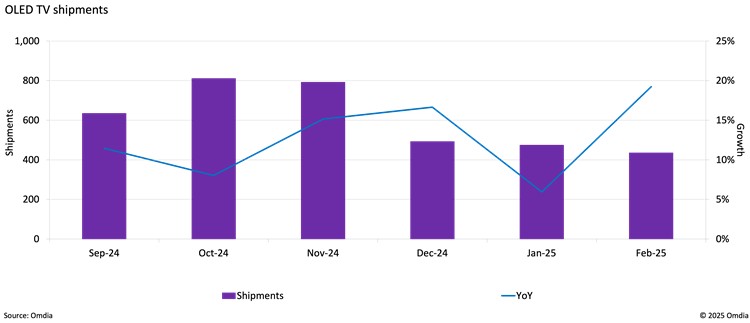
According to Omdia's "February 2025 TV Market Tracking Report," LCD TV shipments fell by 2.4% year-on-year in February, contrasting sharply with the growth of OLED. While OLED continues to grow, Mini LED is developing even more rapidly, with shipments reaching 3 million units in the fourth quarter of 2024, surpassing OLED's 2 million units for the first time.
The global television technology consumption landscape is changing, with the growing demand for Mini LED in the Chinese market becoming a key driving force. This trend is primarily driven by local energy-saving incentive policies aimed at promoting energy-efficient display technologies. This not only propels the rapid rise of Mini LED but also poses significant challenges to the European TV market, where OLED is the high-end benchmark.
Matthew Rubin, Chief Analyst of Omdia's TV research, stated: "In Western Europe, TVs priced over $1,000 account for more than 14% of shipments, while globally, it is less than 9%. This indicates that European consumers are more inclined to choose high-end technology products. Due to limited living space, the growth of screen sizes in the European TV market is relatively slow, which is a key factor driving the development of the U.S. market. In recent years, OLED technology has solidified its position in the European market, capturing a considerable and steadily growing revenue share. However, Chinese brands, such as Hisense and TCL, which have rarely ventured into the OLED field, are accelerating their layout in the Mini LED market, especially with the newly launched RGB Mini LED products, which are rapidly rising in the high-end market and becoming strong competitors to OLED.
The appeal of Mini LED to consumers lies in its excellent brightness performance, enhanced contrast, and vibrant colors, particularly with lower manufacturing costs for larger screen sizes. Moreover, for high-end brands that heavily rely on OLED, such as LG, Panasonic, and Samsung, which balances both OLED and Mini LED, there are considerable opportunities for Mini LED adoption. However, Mini LED still faces some adoption barriers, such as consumer confusion over terms like LED LCD, Mini LED, and RGB Mini LED, as well as the established cognitive advantage of OLED as a high-end synonym in consumers' minds Rubin concluded, "It will take time to overcome these challenges, and brands must make strategic decisions regarding product layout and technology positioning as soon as possible. Not all brands have the resources to launch high-end products with both OLED and Mini LED simultaneously, and doing so may weaken their marketing efforts. In the fiercely competitive European market, missteps in decision-making or delayed actions could have serious consequences."
