


For the second time in two weeks, the market successfully forced Trump to "back down"? After a big drop comes a big rise, traders are "numb"

On April 9th, when Trump announced the postponement of the tariff policy, the market also surged, experiencing a "roller coaster" trend. This week, Trump made headlines again. Now, traders are constantly "on alert for news headlines," saying, "It's so frustrating, every day is filled with uncertainty, uncertainty, uncertainty. We anticipate one thing to happen, and then another thing happens."
Trump's tariff policy is erratic, leaving investors feeling tormented in the "roller coaster" market.
On Tuesday, Trump stated he had no intention of firing Powell, and according to China News Service, Trump said on Wednesday that he would "significantly reduce" the high tariffs on China. During Wednesday's trading session, market sentiment surged, with U.S. stocks and the dollar both rising, while U.S. Treasury yields and gold retreated.
Additionally, U.S. Treasury Secretary Mnuchin mentioned on Wednesday the opportunity for a "significant" trade agreement between the two major economies, but a comprehensive trade agreement may take two to three years, and Trump will not unilaterally lower tariffs, causing U.S. stocks to give back more than half of their gains.
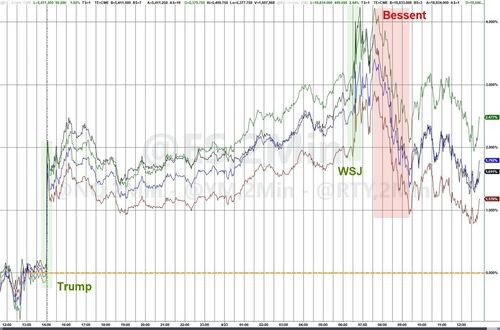
A seasoned trader humorously recounted the chaotic situation that began that day:
"As soon as Trump speaks, the stock market soars;
The Wall Street Journal repeats Trump's remarks, and the stock market soars further;
Reuters downplays the Wall Street Journal's report, and the stock market dips before rebounding;
Finally, Trump returns to square one, and the market no longer cares."
Market Volatility May Continue
The ongoing tariff news continues to stir market nerves, and such "roller coaster"行情 is not a first occurrence.
Just two weeks ago, according to Shanghai Securities Journal, Trump announced a 90-day tariff suspension for certain countries, during which tariffs would be significantly reduced to 10%, causing the market to surge, with the S&P reaching its largest increase since 2008.
In the face of many uncertainties, the only certainty is that volatility will persist.
According to compiled media data, the S&P 500 index has had price fluctuations exceeding 1% on 7 out of the past 10 trading days, and April is set to become the most volatile month since the pandemic began in 2020.
According to a report released by Citigroup on Monday, options traders are generally betting that the S&P 500 index will experience 1% or greater volatility on every trading day at least until May 23.
"News Headlines" Driving Market Direction?
Every pulse of the market seems to closely follow the snippets coming out of Washington.
Some media analyses point out that whether soaring or plummeting, all price movements are now driven by White House policies, which are often "unpredictable." This has caused the market to react strongly to any subtle news regarding tariff progress. As Chris Hentemann, Chief Investment Officer of 400 Capital Management, stated:
"People are always on alert for the next news headline."
"Whether the outcome is a big rise or a big drop, it will limit people's ability to put out funds."
Marko Papic, Chief Strategist at BCA Research, also bluntly remarked:
"The market is trading entirely based on policy, in other words, it's following the tweets."
Traders Feel Frustrated
Faced with such an unpredictable market environment, traders generally feel exhausted.
Jay Woods, Chief Global Strategist at Freedom Capital Markets, said:
"It's incredibly frustrating. Every day is filled with uncertainty, uncertainty, uncertainty. We expect one thing to happen, and then another thing happens."
This profound sense of powerlessness stems from the fact that market movements have lost their fundamental logic, and the uncertainty of policies has disrupted traditional market signals, making it nearly impossible to predict the next moves of stocks, bonds, or the dollar.
Keith Lerner, Co-Chief Investment Officer at Truist Advisory Services, believes that despite experiencing two consecutive days of rebounds, market sentiment has not truly improved, and the stock market has merely returned to the position it was in before last week's news of "Powell possibly being fired," with the high uncertainty lingering in the market not dissipating.
