


Japan's March wage growth unexpectedly slows down, and the Bank of Japan may adopt a more cautious approach to interest rate hikes

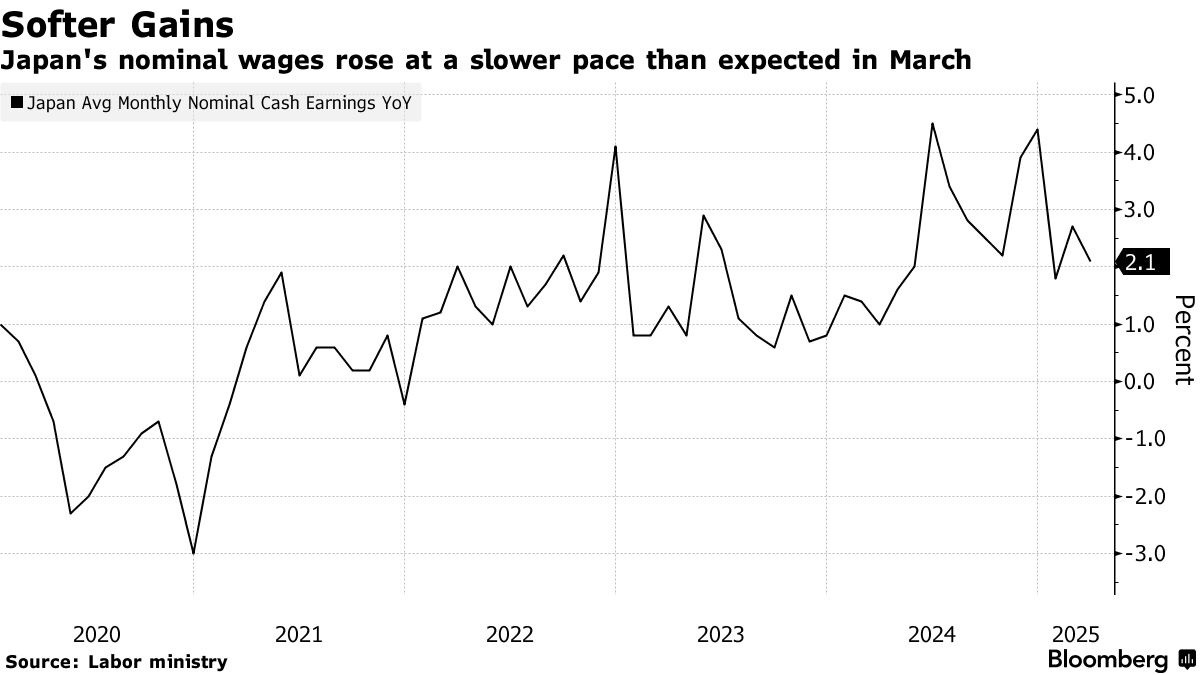
Japan's nominal wage growth rate slowed to 2.1% in March, below expectations, while real wage income fell by 2.1% year-on-year. This data has made the Bank of Japan more cautious about interest rate hikes, although the central bank governor stated that they will continue to raise rates, provided that economic development meets expectations. Japan's household spending in March increased by 2.1% year-on-year, exceeding market expectations and indicating potential growth in consumer spending
According to the Zhitong Finance APP, Japan's nominal wage growth in March slowed more than expected, which supports the Bank of Japan's cautious approach to interest rate hikes amid ongoing domestic and international economic risks. Data released by the Japanese Ministry of Health, Labour and Welfare on Friday showed that nominal cash income in March increased by 2.1% year-on-year, lower than the revised 2.7% in February and below the median forecast of 2.5% by economists; real wage income in March decreased by 2.1% year-on-year, further widening from a decline of 1.2% in February, indicating a continued decline in consumer purchasing power.
Although this latest wage data is unlikely to be weak enough to cause the Bank of Japan to deviate from its tightening policy plans, these figures, along with tariffs and other factors, may lead the Bank of Japan to remain cautious in the short term. The Governor of the Bank of Japan reiterated on Thursday that if economic developments meet expectations, the Bank of Japan will continue to raise interest rates. He also stated that uncertainty is "extremely high" and emphasized his cautious stance.
As widely expected by the market, the Bank of Japan maintained its interest rate level at 0.5% for the second consecutive week. The Bank of Japan also postponed the timeline for achieving its inflation target, but Governor Ueda emphasized that this adjustment does not necessarily mean a delay in future interest rate hikes.
It is worth mentioning that the slowdown in Japan's nominal wage growth in March was partly due to temporary factors. The total working hours in March this year decreased by 2.9% compared to the same period last year. Additionally, bonus payments increased by about 14% year-on-year, a significant slowdown compared to the 74% increase in February.
The new wage data is generally consistent with the Bank of Japan's forecast that nominal income will remain high, supported by solid results from this year's wage negotiations among Japanese companies. A recent report from Japan's largest labor union organization indicated that employees received the largest wage increase in over 30 years, which is expected to gradually reflect in employment numbers by this summer.
Although the continued decline in real wages puts pressure on consumer spending, Japan's household spending in March exceeded expectations, increasing by 2.1% year-on-year after excluding inflation factors, far surpassing the market expectation of 0.2%. Further expansion of consumer spending in the coming months will be viewed as a positive factor by the Bank of Japan. Nevertheless, the Bank of Japan had previously warned in its outlook report that wage growth may slow due to weak corporate profits
