


RPT-COLUMN-What was the point of April's market chaos?: McGeever

RPT-COLUMN-What was the point of April's market chaos?: McGeever
Repeats column published on Tuesday
By Jamie McGeever
ORLANDO, Florida, May 13 (Reuters) - The fog of uncertainty created by U.S. President Donald Trump's trade war is suddenly lifting, although doubts over its longer-term economic impact will linger. As will another question: what was the point of all that 'Liberation Day' chaos and confusion?
Trump, a consistent advocate of tariffs since the 1980s, made it very clear during his election campaign that he intended to significantly raise import levies. As the self-styled 'Tariff Man,' he vehemently argued that tariffs will help raise federal revenues, revitalize U.S. manufacturing, and reduce the country's yawning trade deficit.
One can argue the economic merits of his agenda, but no one, in good faith, can express surprise that he did exactly what he said he would do. But even some of Trump's ardent backers are questioning the strategy and implementation.
Was the aim to whip up economic and market chaos to gain maximum leverage over America's trading partners and thereby secure the most favorable terms for Washington in subsequent trade talks?
Maybe. Short-term havoc was certainly wreaked, with some $6 trillion wiped off the value of U.S. stocks in the three days after 'Liberation Day.' But now deals are getting done and all those losses have been erased – except, of course, for investors who got spooked and sold.
But after all that, it's unclear whether the tariffs that will result from these deals – which will likely be much lower than the extreme figures put forward a few weeks ago – will be significant enough to move the dial meaningfully on the U.S. trade deficit.
And on the fiscal side, all tariffs announced so far this year are forecast to raise $2.7 trillion in federal revenue over the 2026-35 decade, up from an estimated $2.4 trillion before the U.S.-China 'truce' in Geneva, according to Yale Budget Lab, which pointed out that sky-high tariffs were far from 'revenue optimal.' Was the turbulence of the last several weeks worth an extra $30 billion a year, or 0.1% of GDP?
Of course, $2.7 trillion is not to be sniffed at, but it comes at a cost. Yale Budget Lab also estimates tariffs will knock 0.7 percentage points off real U.S. GDP growth this year, and in the long run the U.S. economy will permanently be 0.4 percentage points smaller. The price level of goods across the country will be permanently higher too, economists reckon.
Estimates vary, but the general view is that the global average effective tariff rate will be somewhere in the 13-18% range, down 10 percentage points from before the weekend truce but still the highest since before the Second World War, and significantly higher than 2.3% at the end of last year.
Meanwhile, U.S. consumer and business confidence has slumped to some of the lowest levels on record, and consumer inflation expectations are the highest in decades. These indicators may improve in the months ahead, but much spending and investment has been put on hold due to the uncertainty and likely won't be switched back on so quickly.
LASTING DAMAGE
Perhaps most importantly, the damage done to U.S. credibility hasn't vanished simply because asset prices have rebounded.
Remember the methodology behind the Liberation Day figures, which saw some of the highest duties slapped on the world's poorest countries and tariffs imposed on frozen islands largely inhabited by penguins? This was widely ridiculed and called into question the seriousness of Trump's team, as have many of the other unorthodox policies the administration has been pursuing.
Faith in America as a reliable partner has clearly been diminished. As HSBC currency analysts reminded readers on Tuesday, "Trust takes years to build, seconds to break and forever to remake."
The administration appears to be trying to repair some of that reputational damage. It's notable that Treasury Secretary Scott Bessent and Trade Representative Jamieson Greer led the delegation in Geneva this weekend rather than tariff hardliners like Commerce Secretary Howard Lutnick and Office of Trade and Manufacturing Policy director Peter Navarro.
But fully restoring U.S. credibility won't be a quick fix. And the long-term consequences for U.S. rates, the dollar and U.S. assets overall could be meaningful.
So if we consider where we are relative to a no-tariff scenario, U.S. growth will likely be slower, prices will likely be higher, and uncertainty will run much deeper. But would these costs be so burdensome had the administration taken a more pragmatic, less confrontational approach from the start?
The wounds will heal, but the scars may last a long time.
(The opinions expressed here are those of the author, a columnist for Reuters)
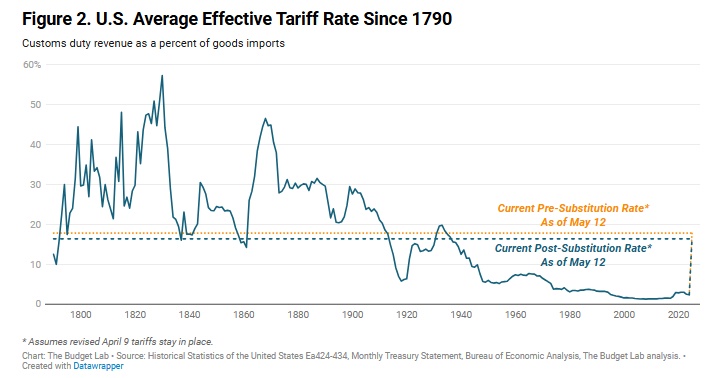
U.S. tariffs still projected to be highest since 1934 - Yale Budget Lab
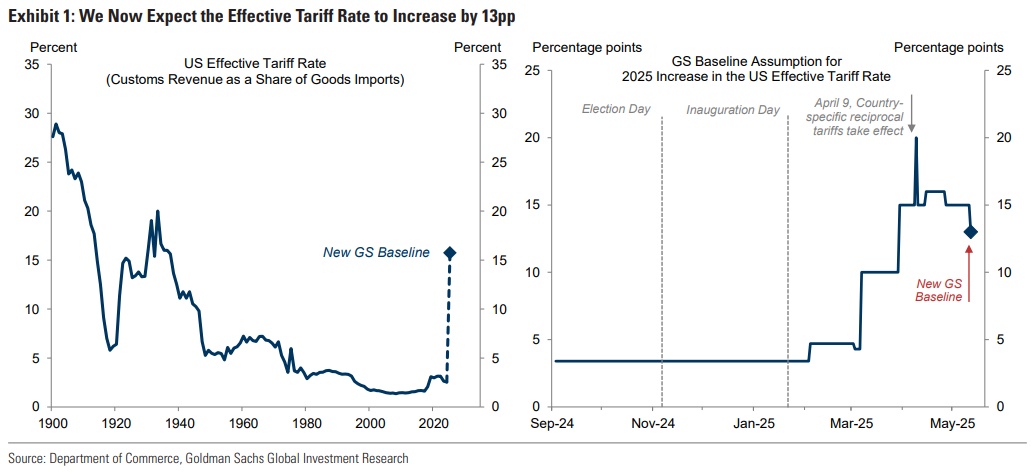
Goldman Sachs estimates of new U.S. tariffs
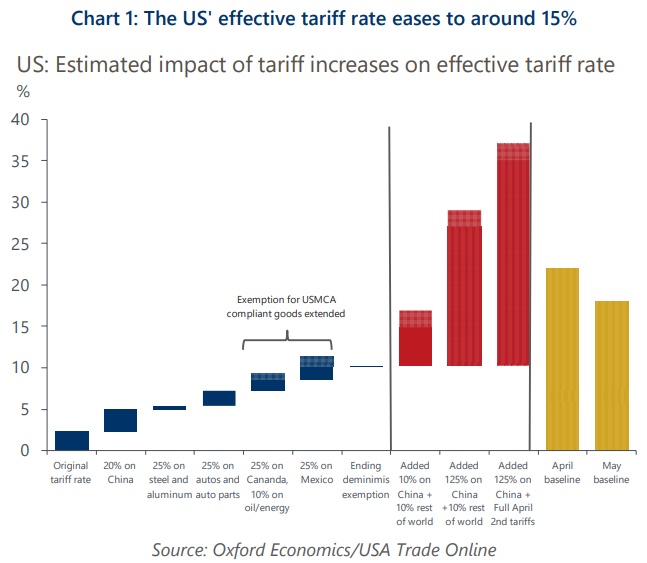
Oxford Economics breaks down the new U.S. tariffs
(By Jamie McGeever; Editing by Andrea Ricci)
((jamie.mcgeever@thomsonreuters.com; Reuters Messaging: jamie.mcgeever.reuters.com@reuters.net/))
