


Google aims to revolutionize its search engine! The Google homepage is testing new features: AI mode replaces "I'm Feeling Lucky"

Google is testing a new feature for its search engine called "AI Mode Search," which replaces the original "I'm Feeling Lucky" button. Although it is not yet widely available, some users can already find this new feature below the Google search bar. This move aims to respond to the competition from generative AI, as Google hopes to attract more users through the AI search functionality. A Google spokesperson confirmed that the feature began rolling out to some users last week and emphasized that test products may not necessarily be fully launched
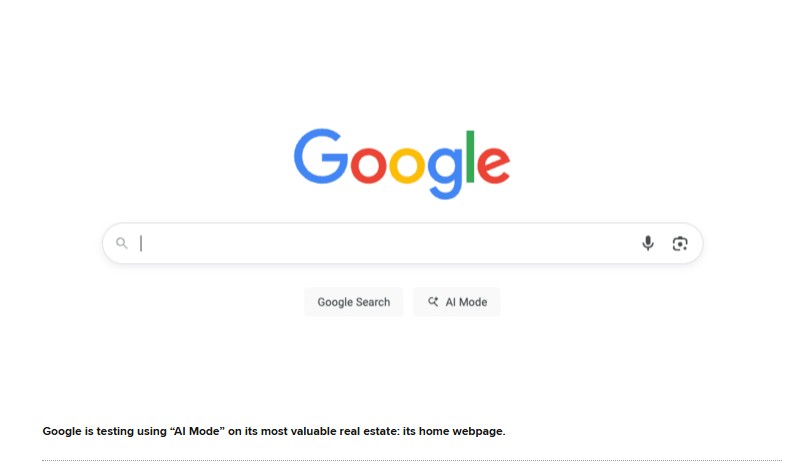
According to Zhitong Finance APP, the technology giant Google (GOOGL.US) has introduced a new partner to its traditionally stable and long-standing browser search engine button: AI Mode search. Google is actively testing this latest artificial intelligence feature in the search engine field, which is not yet widely available globally. Some users can find it just below the Google search bar on the Google homepage, next to the "Google Search" button, replacing the original "I'm Feeling Lucky" widget.
Although this new AI feature is not yet widely available, it is undergoing extensive testing in the search engine field, which is one of Google's core revenue areas, highlighting Google's efforts to retain users attracted by generative AI leaders like ChatGPT and Perplexity AI, which focus on "AI search." Google aims to use its own AI search functionality to keep these users and attract a larger user base in the era of generative AI.
According to reports, a Google spokesperson confirmed that the feature began rolling out to some users last week. The spokesperson stated that the company is testing many new features for selected users through its experimental testing platform, Labs, and added that the products being tested may not necessarily be fully launched.
Next to the classic "Google Search" button, AI Mode search replaces the "I'm Feeling Lucky" feature that has been in use for over 20 years, providing Google search engine users with a new way to obtain answers through dialogue. AI Mode search is an early experiment within Labs, and Google emphasizes that this testing feature will utilize more powerful reasoning and multimodal capabilities to answer "the toughest questions" and allow users to continue asking follow-up questions. Some AI researchers believe that Gemini will be integrated into Google's traditional search framework, leveraging its exclusive vast database and advertising system to enhance result depth.
Google is testing "AI Mode" search on its most valuable page - the Google homepage
This latest AI feature test indicates that under the competitive pressure of generative AI-driven search functionalities, Google is considering using its most commercially valuable "prime real estate" on the Google homepage to showcase its breakthrough generative AI technology based on the Gemini large model to long-time search engine users, core advertising clients, and new users interested in AI search.
Since the rise of the generative AI application ChatGPT in November 2022, investors in Google's parent company Alphabet have been concerned that OpenAI could capture Google's search engine market share through new information search methods In October last year, OpenAI took a further step by launching "ChatGPT search," which received widespread acclaim from users, enhancing its ability to compete fiercely with rivals focused on search functions such as Google Search, Microsoft Bing, and Perplexity AI. More importantly, investors in Google's parent company, Alphabet, are increasingly concerned that the maturing "AI + search" ecosystem of ChatGPT and Perplexity AI will continue to erode Google Search's market share, leading long-time advertisers on Google Search to shift towards generative AI leaders like ChatGPT and Perplexity AI.
It is reported that American software giant Microsoft (MSFT.US) has invested nearly $14 billion in ChatGPT developer OpenAI, but some software products under OpenAI directly compete with Microsoft's tools focused on "AI + search" (such as Copilot and Bing AI).
Although Google's flagship AI model and generative AI application software—Gemini—performs comparably or even better than top generative AI competitors, it has been striving to expand its user base to maintain long-term competition with ChatGPT.
According to the latest analytical data disclosed by Google during an antitrust court meeting in April, the Gemini AI platform has approximately 35 million daily active users; in contrast, reports estimate that ChatGPT has as many as 160 million daily active users.
Perplexity AI—The strongest competitor Google faces in the search field
Since 2023, Google, under Alphabet, has been internally testing homepage designs, during which a potential design showcased five suggested questions of possible interest below the Google homepage search bar, replacing the current "I'm Feeling Lucky" section. The company also tested placing a small AI chatbot icon at the far right of the search bar.
In March of this year, Google announced that it would test the "AI Mode" search function for a portion of users, but at that time, it described testing the widget on the Google search results page rather than the commercially valuable Google homepage. The company stated in its March announcement that this was an early experimental feature from Labs, aimed at fully integrating Google Search with generative AI capabilities for "more advanced reasoning, thinking, and multimodal abilities to help you solve the most challenging problems."
For Google, the current real threat to its search engine market share and search ecosystem does not come from ChatGPT developer OpenAI, but rather from another AI startup, Perplexity AI. Founded in 2022, Perplexity AI has gained popularity among global developers and researchers for its real-time, efficient, and accurate AI outputs and reasoning results, along with a search engine-like user interface. The "AI search" application provided by the company—Perplexity—can conduct in-depth research and can call upon AI large models other than its own, including those from OpenAI and Anthropic PBC Perplexity is committed to providing users with a reliable search experience, reducing the "hallucination" phenomenon (i.e., erroneous absurd outputs) of large language models (LLMs). It ensures the accuracy and safety of information through built-in content filtering and human annotation. Perplexity offers a chat-like interaction mode, allowing users to engage in multi-turn conversations, review past search records in detail, refine AI query results, and optimize the AI chatbot through a progressive chat box to obtain increasingly accurate inferential answers, while aiming to provide real-time updated information to ensure the timeliness and accuracy of answers.
Dubbed the "Google killer," the Perplexity app unexpectedly became the favorite AI tool of NVIDIA CEO Jensen Huang. In an interview, Huang was asked, "Do you frequently use ChatGPT or Google AI chatbots yourself? Or do you use other products?" Huang replied, "I generally use Perplexity; I really use it almost every day. For example, when I recently wanted to understand how AI assists in drug development, I used Perplexity for related searches."
The core difference between Perplexity and other AI chatbots' "AI search functions" as well as Google search engine lies in its ability to provide more real-time information and an ad-free AI search interface deeply integrated with AI technology, with the precision of AI search results ranking at the top of the "AI search" field. Although its primary service is AI search, this startup refers to itself as an "answer engine" because it provides refined search results in a textual format that integrates AI large model outputs, detailing the links on which the search results are based, rather than merely displaying the searched links like Google search engine.
Compared to Google search, Perplexity not only generates detailed refined answers but also includes footnotes citing sources, making it easier for users to verify the accuracy of information. In contrast, Google search engine primarily provides a list of links, requiring users to click on links to obtain detailed information, necessitating users to explore the final results themselves, while Perplexity directly provides users with the answers they want to know or detailed introductions to specific topics based on cited links and AI large model technology
