


Unignorable Major Trend: Stablecoins – The Exploding "Digital Dollar Hegemony"

Stablecoins are entering mainstream payment systems at an astonishing rate, with transaction volumes exceeding $28 trillion, surpassing Visa and Mastercard. Stablecoins are not just financial instruments; they are rapidly becoming strategic assets, with 83% pegged to the US dollar. Tether is one of the largest holders of US Treasury bonds. This series of trends not only represents the rise of a new asset class but also suggests the consolidation and expansion of dollar hegemony through digital means
In the context of rampant discussions about de-dollarization globally, stablecoins may unexpectedly become a savior for the dollar's hegemony.
Dollar-pegged stablecoins are expanding their influence in cross-border payments, international trade, and personal finance at an astonishing rate, to the extent that a professor from the London School of Economics recently warned in a speech: Dollar-denominated stablecoins are spreading in Europe, which could pose a serious threat to the economic sovereignty of the Eurozone.
According to news from the Wind Trading Desk, Deutsche Bank's latest research report shows that stablecoins are entering mainstream payment systems at an astonishing speed, with transaction volumes exceeding $28 trillion, surpassing Visa and Mastercard. Traditional payment giants are also beginning to embrace this trend—Visa recently announced a partnership with stablecoin company Bridge to enable cross-border payments and connections with Latin America, and invested in the startup BVNK to further develop its stablecoin payment capabilities.
Stablecoins are not just financial instruments; they are rapidly becoming strategic assets, with 83% pegged to the dollar. Tether ranks as one of the largest holders of U.S. Treasury bonds. This series of trends not only represents the rise of a new asset class but also suggests the consolidation and expansion of dollar hegemony through digital means.
Concerns in Europe: The Invasion of Dollar Stablecoins into the Eurozone
Stablecoins are cryptocurrencies that maintain stable value by pegging to existing currencies like the dollar or euro. Currently, the total value of stablecoins in circulation globally exceeds $200 billion, with monthly transaction volumes reaching hundreds of billions of dollars, providing a digital alternative to traditional currencies.
Recently, Luis Garicano, a professor of public policy at the London School of Economics, warned in a speech that the widespread adoption of dollar stablecoins across Europe would constitute a form of "digital dollarization," with serious macroeconomic impacts. This would weaken the European Central Bank's ability to manage the Eurozone economy, as a significant portion of transactions would bypass the euro system, thereby reducing the effectiveness of interest rate adjustments and other monetary policy tools.
This outcome also brings financial stability risks. Garicano pointed out that if the euro depreciates, European businesses and households earning income in euros but paid in dollar stablecoins would face dangerous currency mismatches. Furthermore, the European Central Bank cannot act as a lender of last resort for dollar-denominated instruments, limiting its ability to manage crises involving these stablecoins.
Ultimately, the surge of foreign digital currencies will erode Europe's monetary sovereignty, weaken the European Central Bank's control over its payment systems, and increase dependence on U.S. financial infrastructure.
These concerns are not unfounded. According to recent research, while using dollar-denominated stablecoins may seem illogical for Europeans, given the exchange rate risks, these digital assets offer three significant advantages that cannot be ignored.
First is the overwhelming market advantage. Euro-denominated stablecoins account for a negligible share of the global market— the total market capitalization of the top ten euro stablecoins is about €600 million, representing only 0.24% of the entire stablecoin market. This limited liquidity results in higher transaction costs for euro stablecoins in practical applications
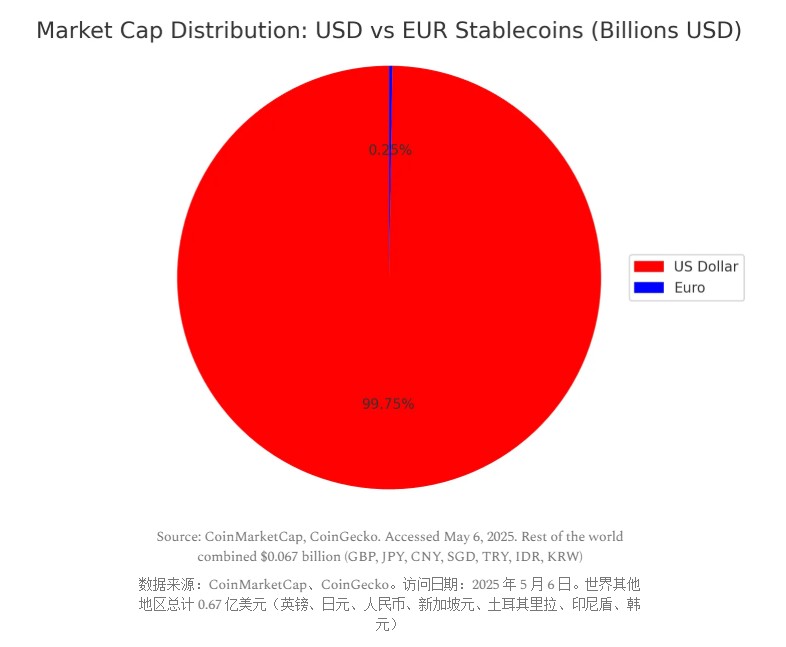
Secondly, there are significant differences in the regulatory environment. The European Union's Markets in Crypto-Assets (MiCA) regulation attempts to impose strict controls on stablecoins, requiring all issuers wishing to sell stablecoins in the EU to register locally and comply with stringent regulations. In contrast, the United States has yet to enact similar comprehensive legislation, which may pose higher systemic and consumer risks but also creates greater space for innovation and expansion.
Thirdly, USD stablecoins have already dominated early application scenarios and benefit from strong network effects. The cryptocurrency trading ecosystem and decentralized finance (DeFi) platforms primarily use USD stablecoins, further strengthening their market position.
Surge in Trading Volume: Stablecoins Have Surpassed Traditional Payment Giants
Deutsche Bank's latest research report shows that stablecoins have evolved from niche tools in crypto to mainstream financial payment infrastructure globally.
The research, co-authored by Marion Laboure and Camilla Siazon, points out that the total market size of stablecoins has surged from $20 billion in 2020 to $246 billion by May 2025, with Tether (USDT) alone growing from $67 billion in June 2022 to over $149 billion by May 2025.
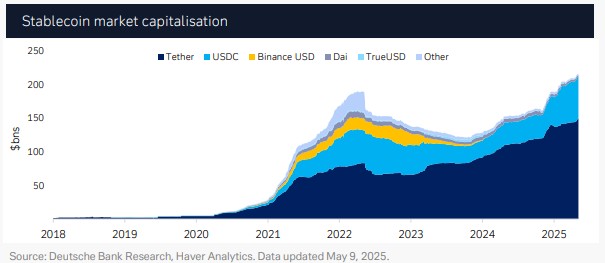
As the momentum of stablecoins as a medium of exchange and a store of value continues to increase, trading volume has grown by 598% since 2020.
Even more remarkably, stablecoins processed $27.6 trillion in transaction volume in 2024, surpassing Visa and Mastercard. The number of active stablecoin wallet addresses increased from 22.8 million in February 2024 to over 35 million in February 2025, a growth of 53%.
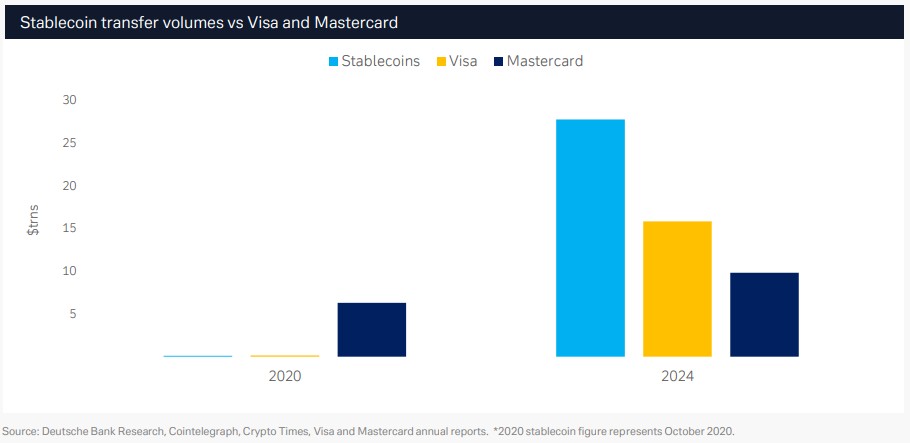
Visa itself is also actively embracing this trend, recently announcing a partnership with stablecoin company Bridge to launch cross-border payment services in Latin America and investing in startup BVNK to further develop its stablecoin payment capabilities.
According to Deutsche Bank, some well-known companies have also begun adopting stablecoins, such as Shopify customers being able to pay with USDC via Solana Pay; Gucci accepting cryptocurrencies, including stablecoins, in select stores since 2022; and PayPal announcing in April that customers can earn 3.7% on its PYUSD stablecoin
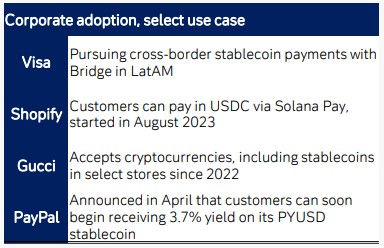
According to a survey by Visa, the reasons users prefer stablecoins over banks include higher yields (45%), greater efficiency (41%), and lower intervention risks (39%).
Stablecoins offer programmability and global accessibility, making them attractive during periods of geopolitical uncertainty. A survey conducted by Visa showed that in Nigeria, Indonesia, Turkey, Brazil, and India, 38% of users use stablecoins instead of US dollars to hedge against inflation. Stablecoins are also seen as tools to hedge against geopolitical turmoil. The Russian government has begun to consider using cryptocurrencies as an alternative international payment tool to bypass sanctions.
Deutsche Bank points out that stablecoins are not just financial instruments; they are rapidly becoming strategic assets. 83% are pegged to the US dollar, with Tether being one of the largest holders of US Treasury bonds, reinforcing the dollar's dominance in a divided world.
As the GENIUS Act progresses, regulatory clarity in the United States is improving, which will enable mainstream applications and deeper financial integration. Although the bill currently faces political resistance, Deutsche Bank expects it to be passed by August 2025.
Stablecoins: The Unexpected Savior of Dollar Hegemony
As the Trump administration's crackdown on external confidence in US sovereignty and the global de-dollarization rhetoric intensifies, stablecoins are becoming an unexpected force supporting dollar hegemony.
US Treasury Secretary Scott Basset clearly stated at the White House's first digital asset summit: "At the direction of President Trump, we will maintain the dollar's status as the world's dominant reserve currency, and we will leverage stablecoins to achieve this goal."
Why can stablecoins reinforce dollar hegemony? There are several key factors:
Demand for Reserve Assets: According to Deutsche Bank research, Tether's (USDT) reserve holdings grew from nearly $0 in 2020 to about $98 billion in US Treasury bonds by 2025 (accounting for 81% of its reserves). Circle (USDC) currently holds about $24 billion in US Treasury bonds, an increase from about $12 billion in December 2022. Ripple held approximately $70 million in US Treasury bonds as of March 31.
Reinforcing Dollar Demand: 83% of fiat currencies pegged to stablecoins are linked to the US dollar, with stablecoins holding over $120 billion in dollar reserves.
Accelerating Informal Dollarization: USDT is widely used in emerging markets as a tool to hedge against inflation and capital controls, accelerating the process of informal dollarization.
Political Support: Trump and Republican lawmakers openly support stablecoins over Central Bank Digital Currencies (CBDCs), positioning them as private sector solutions for digital currency.
Standard Chartered's latest research report predicts that once the US Congress passes the GENIUS Act, the supply of stablecoins will grow nearly tenfold over the next four years, expanding from the current $230 billion to about $2 trillion by the end of 2028 Every year, $400 billion in government bonds will be absorbed. At that time, stablecoin trading will account for 10% of the foreign exchange spot market trading volume, far higher than the current approximately 1%.
Federal Reserve's Waller pointed out: "Most transactions in decentralized finance (DeFi) involve the use of stablecoins, which peg their value to the dollar on a one-to-one basis. About 99% of the market value of stablecoins is pegged to the dollar, which means that crypto assets are effectively traded in dollars. Therefore, any expansion of trading in the DeFi world may only reinforce the dominance of the dollar."
