While institutions invested in Quantum-Si incorporated (NASDAQ:QSI) benefited from last week's 17% gain, retail investors stood to gain the most

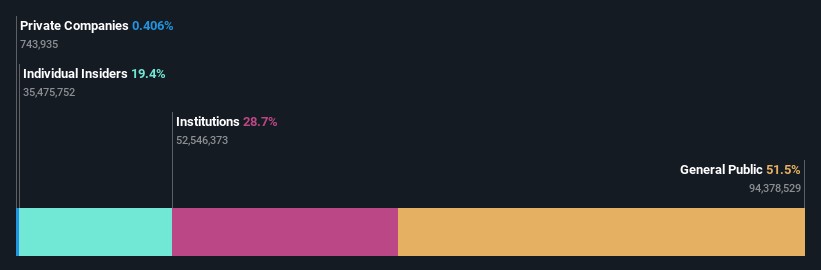
Retail investors hold a significant 51% stake in Quantum-Si (NASDAQ:QSI), allowing them to influence management decisions. Following a 17% price gain, retail investors benefited the most, while institutions saw a 29% increase. The top 25 shareholders own 46% of the company, with insiders, including CEO Jonathan Rothberg, holding a substantial portion. Despite institutional interest, hedge funds have minimal investment. Caution is advised as insiders have recently sold shares, and five warning signs have been identified for potential investors.
Key Insights
- Significant control over Quantum-Si by retail investors implies that the general public has more power to influence management and governance-related decisions
- The top 25 shareholders own 46% of the company
- Insiders have sold recently
Our free stock report includes 5 warning signs investors should be aware of before investing in Quantum-Si. Read for free now.
A look at the shareholders of Quantum-Si incorporated (NASDAQ:QSI) can tell us which group is most powerful. With 51% stake, retail investors possess the maximum shares in the company. Put another way, the group faces the maximum upside potential (or downside risk).
While retail investors were the group that reaped the most benefits after last week’s 17% price gain, institutions also received a 29% cut.
Let's take a closer look to see what the different types of shareholders can tell us about Quantum-Si.
See our latest analysis for Quantum-Si
What Does The Institutional Ownership Tell Us About Quantum-Si?
Institutions typically measure themselves against a benchmark when reporting to their own investors, so they often become more enthusiastic about a stock once it's included in a major index. We would expect most companies to have some institutions on the register, especially if they are growing.
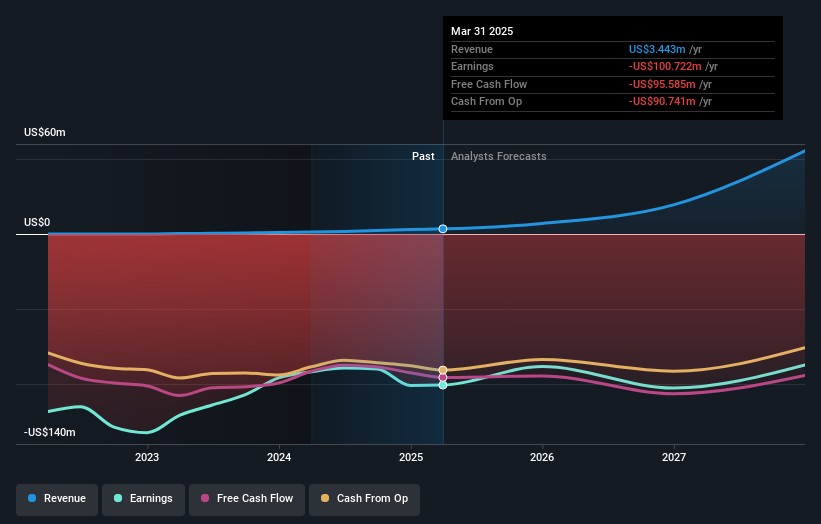
We can see that Quantum-Si does have institutional investors; and they hold a good portion of the company's stock. This implies the analysts working for those institutions have looked at the stock and they like it. But just like anyone else, they could be wrong. It is not uncommon to see a big share price drop if two large institutional investors try to sell out of a stock at the same time. So it is worth checking the past earnings trajectory of Quantum-Si, (below). Of course, keep in mind that there are other factors to consider, too.
We note that hedge funds don't have a meaningful investment in Quantum-Si. Because actions speak louder than words, we consider it a good sign when insiders own a significant stake in a company. In Quantum-Si's case, its Top Key Executive, Jonathan Rothberg, is the largest shareholder, holding 18% of shares outstanding. For context, the second largest shareholder holds about 5.2% of the shares outstanding, followed by an ownership of 4.8% by the third-largest shareholder.
Our studies suggest that the top 25 shareholders collectively control less than half of the company's shares, meaning that the company's shares are widely disseminated and there is no dominant shareholder.
Researching institutional ownership is a good way to gauge and filter a stock's expected performance. The same can be achieved by studying analyst sentiments. There are plenty of analysts covering the stock, so it might be worth seeing what they are forecasting, too.
Insider Ownership Of Quantum-Si
While the precise definition of an insider can be subjective, almost everyone considers board members to be insiders. Company management run the business, but the CEO will answer to the board, even if he or she is a member of it.
Most consider insider ownership a positive because it can indicate the board is well aligned with other shareholders. However, on some occasions too much power is concentrated within this group.
Our information suggests that insiders maintain a significant holding in Quantum-Si incorporated. Insiders own US$53m worth of shares in the US$272m company. This may suggest that the founders still own a lot of shares. You can click here to see if they have been buying or selling.
General Public Ownership
The general public -- including retail investors -- own 51% of Quantum-Si. This level of ownership gives investors from the wider public some power to sway key policy decisions such as board composition, executive compensation, and the dividend payout ratio.
Next Steps:
It's always worth thinking about the different groups who own shares in a company. But to understand Quantum-Si better, we need to consider many other factors. Consider for instance, the ever-present spectre of investment risk. We've identified 5 warning signs with Quantum-Si , and understanding them should be part of your investment process.
If you are like me, you may want to think about whether this company will grow or shrink. Luckily, you can check this free report showing analyst forecasts for its future.
NB: Figures in this article are calculated using data from the last twelve months, which refer to the 12-month period ending on the last date of the month the financial statement is dated. This may not be consistent with full year annual report figures.
If you're looking to trade Quantum-Si, open an account with the lowest-cost platform trusted by professionals, Interactive Brokers.
With clients in over 200 countries and territories, and access to 160 markets, IBKR lets you trade stocks, options, futures, forex, bonds and funds from a single integrated account.
Enjoy no hidden fees, no account minimums, and FX conversion rates as low as 0.03%, far better than what most brokers offer.
Sponsored Content