Gold plummets nearly $50! The 10-year U.S. Treasury yield falls below 4.5%, how to deploy in the future?

Gold prices fell sharply by nearly $50, dropping to $3,302, as the yield on the 10-year U.S. Treasury bond fell below 4.5% to 4.45%. Market concerns over bond sell-offs have eased, reflecting fluctuations in the actual risk premium. Japan has lost its status as the world's largest creditor nation, with Germany taking its place. The future trend of gold will be influenced by real interest rates and may still be in an adjustment phase
Investment Insights -
10-Year U.S. Treasury Yield Falls Below 4.5%, 10-Year Japanese Bond Yield Falls Below 1.5%
On Tuesday (May 27), after the U.S.-Europe tariff dispute eased, the market further recovered from last week's concerns over bond sell-offs, with the 10-year U.S. Treasury yield dropping to 4.45% and the 10-year Japanese bond yield falling to 1.45%. Meanwhile, gold fell to a session low of $3,302, plunging nearly $50 from the day's high.
It is noteworthy that the 10-year U.S. Treasury yield is referred to as the risk-free rate, widely used by the market as a primary reference for interest rate derivatives and mortgage rates, and is a major benchmark interest rate in the global financial market. Given that the Federal Reserve currently chooses to "hold steady," and inflation has not seen a significant rise due to early procurement by businesses, the current fluctuations in the 10-year U.S. Treasury yield more reflect the actual risk premium, specifically indicating risks related to the U.S. fiscal deficit and trade deficit.
In fact, the yields on U.S. and Japanese bonds are clearly linked at this stage. If the sell-off of Japanese bonds continues, the Japanese government may have to increase support for government bonds through state-owned institutions such as Japan Post and the Government Pension Investment Fund (GPIF) without restarting negative interest rate policies. The source of their funds may likely come from selling over a trillion dollars in U.S. Treasury bonds, thereby pushing U.S. bond yields higher.
Therefore, the decline in the 10-year U.S. Treasury yield indicates a rebound in market risk sentiment, which is beneficial for Bitcoin, U.S. stocks, and may even provide some short-term support for the U.S. dollar.
On Tuesday (May 27), the Japanese Ministry of Finance announced that Japan has lost its position as the world's largest creditor nation for the first time in 34 years, replaced by Germany, despite Japan's total external asset balance reaching a record high, partly due to the weakening yen.
The future of gold depends on real interest rates, which may still be in an adjustment phase in the medium term.
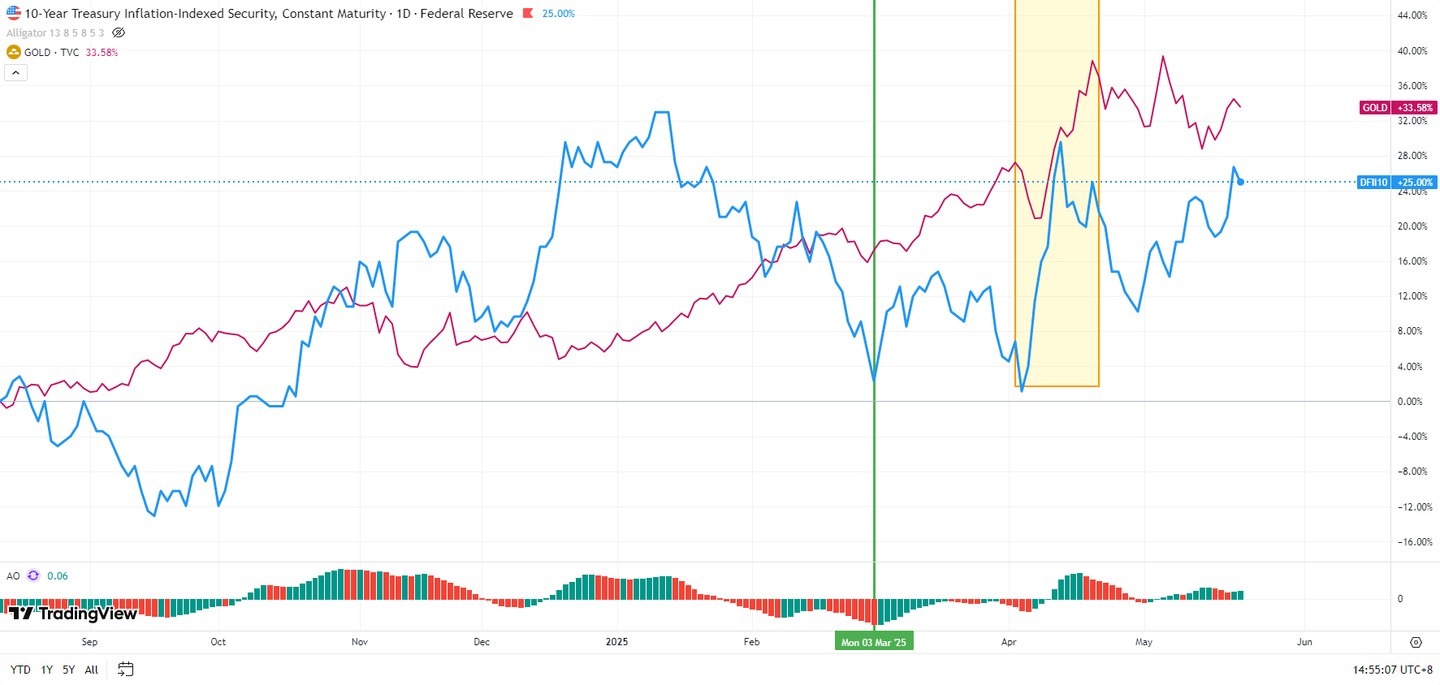
U.S. Real Interest Rates vs. Gold

Image source: tradingview
As shown in the chart above, U.S. real interest rates and gold have exhibited inverse fluctuations over the long term, as the asset nature of gold essentially makes it equivalent to a zero-yield asset, while real interest rates determine the investment returns of other interest-bearing assets, meaning that TIPS yields represent the opportunity cost of holding gold.
However, since the implementation of equivalent tariffs around early April 2025, gold and U.S. real interest rates have shown a correlated movement, highlighting the market's sell-off of U.S. assets and emphasizing the financial attributes of gold Looking ahead, gold investors may focus on U.S. Treasury supply and inflation prospects. Regarding U.S. Treasury supply, the market is concerned about the U.S. Treasury borrowing for spending under the "beautiful big plan." Issuing more bonds amid weak market demand further lowers bond prices, leading to an increase in borrowing rates for all Americans. This, in turn, raises the interest costs on the $36 trillion debt.
However, last Friday (May 23), U.S. Treasury Secretary Becerra stated that the Trump administration has suspended plans to create a sovereign wealth fund, prioritizing the repayment of national debt. Additionally, Becerra mentioned that U.S. regulators may relax a restriction on banks trading in the $29 trillion U.S. Treasury market this summer. Becerra indicated that the so-called supplementary leverage ratio will soon be implemented, and the three major banking regulators, including the Federal Reserve, the Office of the Comptroller of the Currency, and the Federal Deposit Insurance Corporation, are addressing this issue, with progress expected by summer. In fact, this move by the Treasury requires local buyers to take over U.S. Treasuries, which is likely to alleviate market concerns in the short term.
Regarding inflation, OPEC+ may continue to significantly increase production by 411,000 barrels per day in July, keeping oil prices low. At the same time, due to a 90-day tariff suspension, many U.S. companies are quickly initiating rush shipping to complete inventory replenishment within the window period. This may mean that recent data may not truly reflect the real situation of inflation.
In summary, U.S. real interest rates may remain relatively high for some time, which puts pressure on non-yielding assets like gold.
Gold Technical Analysis: The $3,300 level may struggle to hold
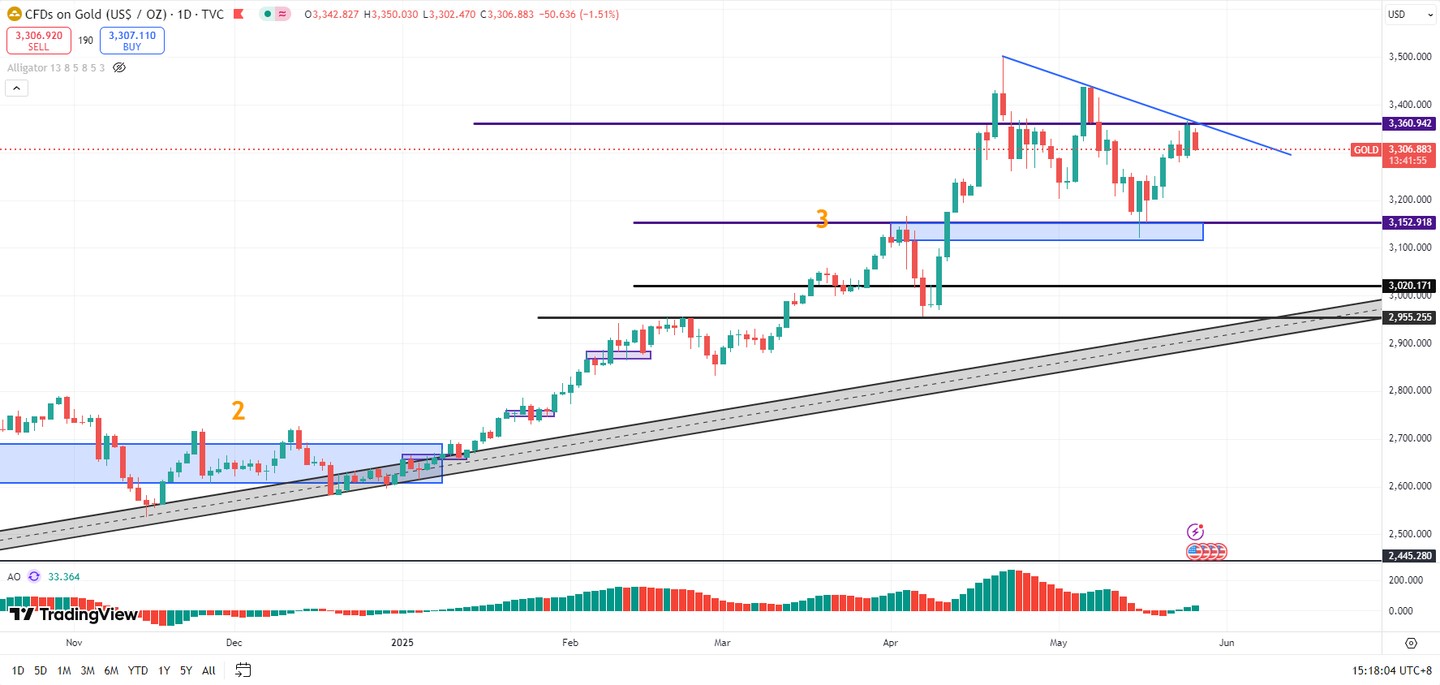
Gold Daily Chart:

Image source: tradingview
The daily chart shows that gold has retreated to around $3,300 after being blocked by the key resistance at $3,360, and the overall pattern has not escaped the high-level fluctuation. This may indicate that gold may further test the $3,200 level or even the previous low of $3,120 after effectively breaking through the $3,300 level. The $3,000 level will be regarded as the medium-term bull-bear dividing line