


The method of Baian Life's 10 billion blood transfusion to Wanda restored: private equity and trusts become the dark channels for funds

Old accounts welcome new calculations
Some aftereffects of real estate capital entering the financial industry are gradually coming to light.
Half a year after the state-owned assets of Dalian took control, Baian Life Insurance publicly disclosed a 29-page old account, revealing 27 significant related-party transactions from 2015 to 2020 on its official website and simultaneously with the insurance industry association.
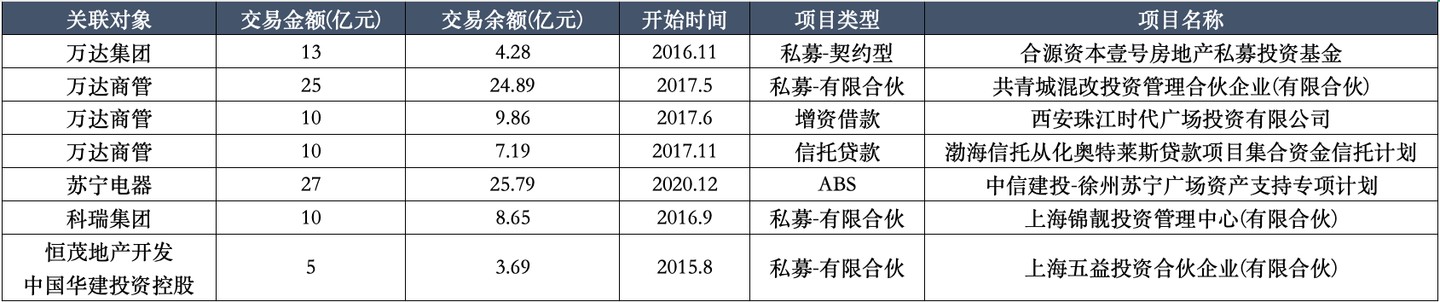
According to Xinfeng statistics, the aforementioned transactions involved amounts exceeding 25 billion yuan, with over 8.4 billion yuan in risk exposure still unresolved.
Shortly thereafter, the aforementioned document was removed from Baian Life Insurance's official website.
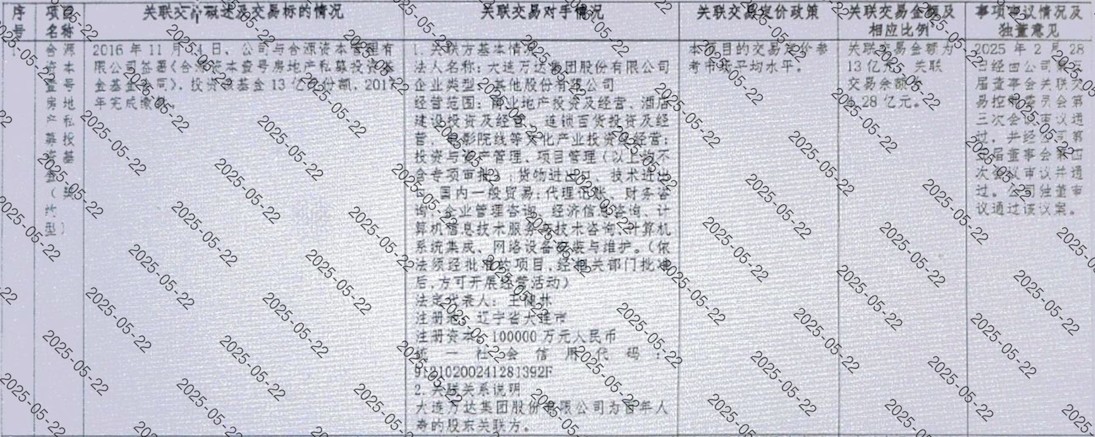
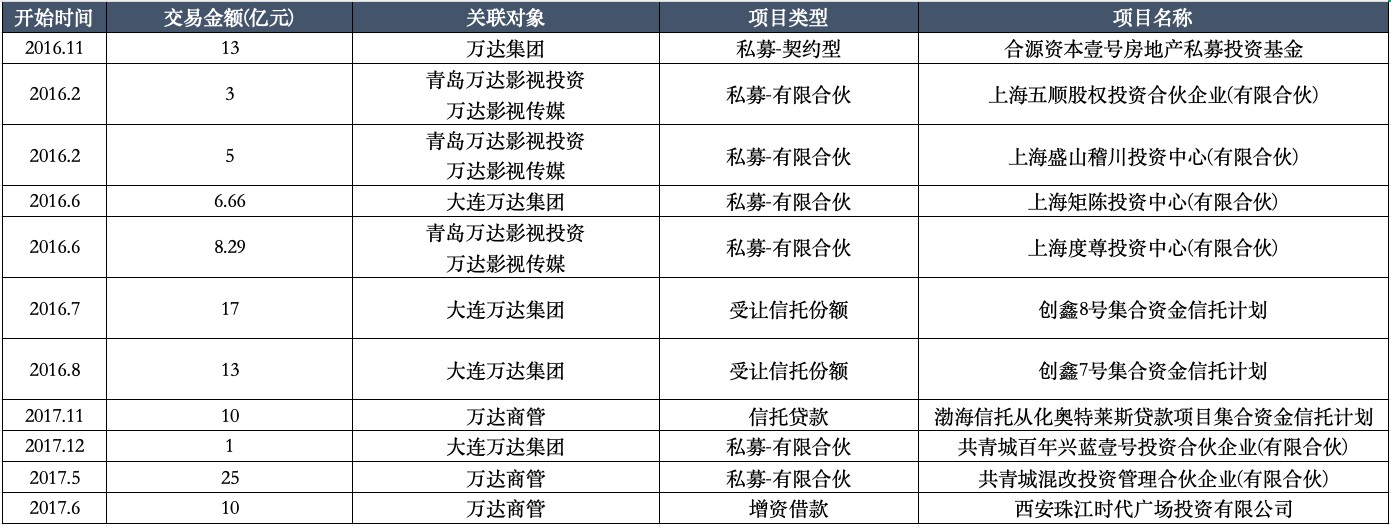
On the timeline, the 27 transactions were mainly concentrated between 2015 and 2020, involving a number of "real estate system" shareholders such as Wanda, Keri, and Hengmao Real Estate, who joined around 2014.
According to the rules at that time, significant related-party transactions must be approved by the board of directors and unanimously agreed upon by independent directors; subsequent disclosure of transaction structures and other penetrating information must occur within 10 working days.
However, Baian Life Insurance not only failed to disclose this in a timely manner but even submitted these 27 transactions for board review only in February 2025.
In the past five years, Baian Life Insurance has undergone multiple rounds of personnel reshuffling, with the positions of chairman and president remaining vacant for extended periods; currently, none of the board members overlap with those from 2020.
This means that the aforementioned transactions may also be old accounts for the current management.
Hidden Paths
The delayed disclosure reveals the concealment of funds in related-party transactions.
Xinfeng noted that the counterparties in Baian Life Insurance's aforementioned transactions were neither shareholders nor directly related enterprises, but rather through third-party channels primarily involving private equity funds and trusts;
Due to the non-disclosure of private equity fund transaction details and the underlying asset details of trust plans, coupled with the incomplete penetrating supervision at that time, tracing the related relationships is also difficult.
For example, in the 2.5 billion yuan transaction with Wanda Commercial Management, Baian Life Insurance disclosed information only about signing the "Qiongqing City Mixed Reform Investment Management Partnership (Limited Partnership) Partnership Agreement" with Qianhai Gaosouyi Asset Management;
However, various public channels did not show any connection between this fund and Wanda Commercial Management.
In 2017, regulators reported multiple violations of related-party transactions by Baian Life Insurance, but the main targets were subsidiaries rather than shareholders.
It wasn't until 2022 that regulators strictly investigated related-party transactions involving insurance funds, explicitly prohibiting illegal financing through trusts, asset management products, and other channels.
In the same year, Baian Life Insurance, with a registered capital of 7.79 billion yuan, saw its net assets plummet by 7.7 billion yuan, with both core and comprehensive solvency ratios approaching the red line;
Baian Life Insurance once explained that the profit and solvency were below expectations, rooted in a sluggish capital market and declining discount rates.
From publicly available data, the overall market value of stocks heavily held in A-shares (with a holding ratio among the top ten circulating shares) did not decline in 2022; instead, it showed a slight increase;
The decline in market value should be attributed to stocks with smaller holding ratios or those that could not penetrate Baian Life Insurance's balance sheet.
In the first quarter of the following year, Baian Life Insurance reported negative net assets, becoming a "problematic insurance company" that no longer publicly disclosed current reports Looking back from the current point in time, the impact of related party transactions is still profound.
Xinfeng statistics show that Baian Life has at least exposed a risk exposure of 8.4 billion yuan in the aforementioned transactions, and it may be quite complicated to settle these gaps now.
Among them, two investments related to Keri, Hengmao Real Estate, and Huajian Investment with a balance of 1.2 billion yuan have had their invested funds canceled;
Additionally, there are four transactions totaling 4.6 billion yuan related to the Wanda system, and one transaction of 2.6 billion yuan related to Suning Appliance, but the counterparties, which are currently mired in liquidity issues, are unlikely to realize a turnaround in the short term.
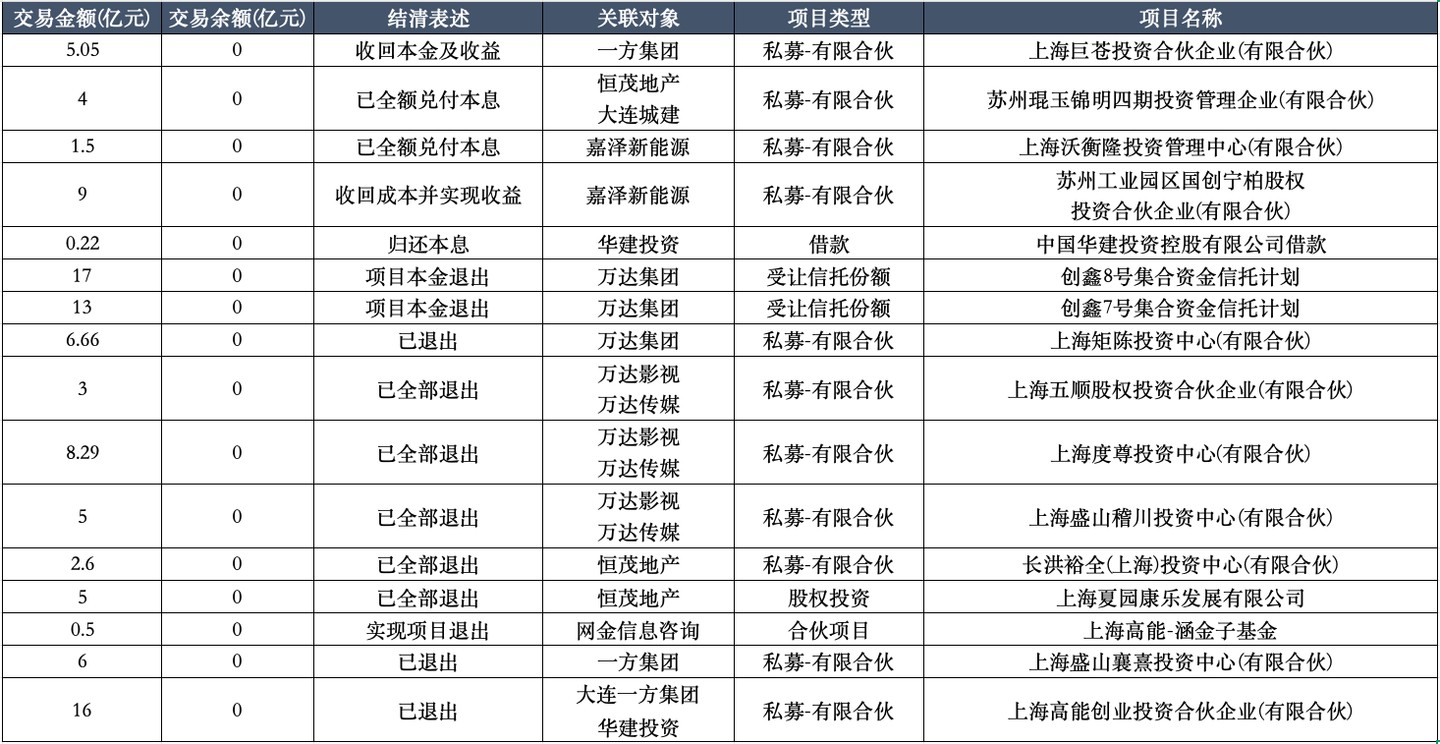
The situation is similarly grim for the remaining 20 settled transactions.
Xinfeng statistics show that only 9 transactions have returned the principal, of which 5 have realized profits;
Another 11 related transactions totaling nearly 7.2 billion yuan have exited, but the principal situation is unclear.
From various clues, it appears that the status of some transactions may not be optimistic.
For example, Baian Life invested 1.1 billion yuan to subscribe to the "Minsheng Tonghui Ju Xin No. 2 Asset Management Product" from 2016 to 2017, the underlying investment target of which was Shanghai Laishi, still controlled by Keri at that time.
In 2020, Keri indirectly lost control of Shanghai Laishi when it sold its subsidiary's equity, resulting in a zero balance relationship between the two;
The 1.1 billion yuan in related party transactions also presented an exit due to the exclusion of related parties by Shanghai Laishi.
However, based on the estimated holding period of the partnership fund in Shanghai Laishi, the loss amount of this investment may have approached 600 million.
Wanda's Influence
Baian Life, which has now fallen into the category of "problematic insurance companies," once had its moments of glory.
In June 2009, Baian Life was approved for establishment as the first Chinese-funded life insurance institution in Northeast China, with initial shareholders including Rongda Investment, Dalian Port Group, Xinguang Holdings, and Dalian Yifang, with registered capital reaching 1.11 billion yuan.
At that time, Baian Life was highly valued by local governments, with many local state-owned assets among its shareholders, and the first chairman was personally appointed by He Yongsheng, the director of the Dalian Insurance Regulatory Bureau.
In its early days, Baian Life could not escape the operational rule of "seven flat and eight profitable," continuously losing money between 2009 and 2014.

It was also during this period that life insurance licenses became targets for real estate companies due to their financing capabilities.
From the beginning, Baian Life had shareholders such as Dalian Yifang and Hengmao Real Estate clustered among its ranks;
After several years of equity transfers, the background of real estate shareholders became increasingly prominent, until Wanda took control in 2014, becoming the largest shareholder with a 11.55% stake; Hengmao Real Estate, Huajian Investment, Dalian Yifang, Keri, and seven other companies hold 10.26% of the shares, making them the second-largest shareholders.
The influence of Wanda may extend beyond the 11.55% equity stake in the industrial and commercial sector.
At that time, the actual controller of Dalian Yifang, Sun Xishuang, was the second-largest natural person shareholder of Wanda Commercial Real Estate, holding 6.3% of the shares and 4.2% of Wanda Film's shares; there were also media reports at that time that Wanda may have reached a controlling stake in Century Life.
Sources close to Century Life indicated that Wang Jianlin would leverage unique advantages to engage in "Internet +" finance, aligning with the plan to create an internet insurance ecosystem with Century Life.
After Wanda took over in 2015, Century Life successfully turned a profit, achieving seven years of stable profitability thereafter;
This was also the starting point for Century Life's intensive related-party transactions with real estate companies.
By comparing the equity cost of various real estate companies with the amount of related-party transactions, one can glimpse the immature stage of penetrating verification, and the immense financial potential that a single insurance license can leverage.
For example, in the case of Wanda, if we refer to the limited two public transactions during its acquisition process, the per-share price for acquiring Century Life's equity should be 1.23 yuan, with the overall equity cost around 1.1 billion yuan;
The related-party transaction amount of 11.195 billion yuan is estimated to be more than ten times the principal, and there is still a balance of 4.6 billion yuan unsettled.
Due to the lack of disclosure of specific shares involved in transactions with multiple shareholders, it is difficult to calculate the related-party transaction amounts for some shareholders;
If we roughly calculate using the average transaction amount (transaction amount/number of related shareholders) and the cost of 1.23 yuan/share, the transaction amounts for Keri, Dalian Yifang, Huajian Investment, and Hengmao Real Estate are 2.67 times, 2.47 times, 2.23 times, and 1.97 times their investment amounts, respectively.
In 2018, Wanda, which was mired in a liquidity crisis, began to sell assets and intended to transfer its Century Life equity for 2.718 billion yuan to Greentown China;
The following year, Century Life had three real estate company shareholders who planned to transfer 13.86% of their equity for 3.262 billion yuan to China Aoyuan.
Both transactions were not approved, and looking back at the severely damaged accounts, strict regulation may have allowed the acquirers to escape a disaster.
Wanda, which had no hope of selling its equity, hoped to further seek influence over Century Life, but this was also intercepted by regulators in a timely manner.
In 2021, after Century Life Chairman He Yongsheng voluntarily resigned, Wanda sent Dong Jianyue and Liu Zhaohui to take on the top positions, both of which were not approved, and the former was even dismissed shortly thereafter.
Today, Wanda has lost its board seat in Century Life amid the company's self-rescue efforts in recent years and has no chance of control.
A New Beginning
Regardless of the past, a new story has begun.
In 2022, under the guidance of regulators and local governments, Century Life gradually entered a risk-clearing mode.
In the following two years, Wang Xinhao, former vice president of Pudong Development Bank, was approved to serve as chairman of Century Life; Dai Wenhao, former vice president of Taiping Life Insurance who led the company's life insurance reform, was appointed as president of Century Life This ends the nearly three-year vacancy of the top two positions at Baian Life Insurance.
After the core executives are in place, Baian Life Insurance has launched a series of self-rescue measures:
First, in collaboration with Boston Consulting Group, it has developed the "Qihang Project" five-year strategy to create a value-driven operational ecosystem that meets market demands.
In 2024, it will launch the "Qihang New Partners" talent program to expand its individual insurance team;
It has also partnered with companies such as BGI Genomics, Shanghai Cell Therapy, Zhongyuan Xiehe, and Haier Cell Bank to plan "Insurance + Health."
Second, it is accelerating asset recovery and reducing equity assets at high levels.
Baian Life Insurance had previously made significant investments in A-shares, holding equity in companies like WanFeng AoWei, JiaZe New Energy, and MeiKaiLong.
Since the beginning of 2024, the stock price of WanFeng AoWei, which is involved in the "low-altitude economy," has been rising steadily;
From May to November of that year, Baian Life Insurance cumulatively reduced its holdings by 2.87% of the company's shares, cashing out approximately 1.34 billion yuan.
The long-standing issue of insufficient capital has also seen substantial progress.
At the beginning of 2024, Dalian Finance Bureau's Dalian Jinyun increased its capital in Baian Life Insurance by 110 million yuan, and Dalian Jinyun's subsidiary Dalian Rongda transferred its 10.12% equity in Baian Life Insurance to Dalian Jinyun without compensation;
As a result, Dalian Jinyun, with an 11.51% shareholding, surpassed Wanda to become the largest shareholder of Baian Life Insurance.
By the end of 2024, regulators approved a new batch of board member qualifications for Baian Life Insurance, including Zhang Zuowei and Jin Xin from Dalian Jinyun, as well as Hua Biqiong, who has rich experience in the restructuring management of New Light Holdings.
Although Wanda remains the second-largest shareholder, there is no longer any trace of its influence in the Baian Life Insurance board;
The recent concentrated disclosure of 27 significant related-party transactions also carries a sense of bidding farewell to the past and starting anew.
According to Baian Life Insurance's official website, its total assets are nearly 280 billion yuan, with 20 provincial-level branches and over 370 various branches, serving more than 150 cities.
Regarding its future strategy, Xinfeng contacted Baian Life Insurance, but as of June 4, there has been no response.
With limited information, the restructured Baian Life Insurance has shown a strong interest in retirement and wealth inheritance for high-net-worth clients.
In early 2024, Baian Life Insurance announced a tender for its Shanghai High-Value Customer Center, and subsequently began to use this center as a practice site for business development;
As of June 4, 2025, it has signed cooperation agreements with Everbright Pension Health Industry Development, Kunlun Trust, and Mercer Education at the Shanghai High-Value Customer Center, covering areas such as wealth management, inheritance, and education for the new generation.
Baian Life Insurance now seems to be gradually building its own family office business.
However, this sector is equally crowded.
According to incomplete statistics from Xinfeng, there are currently more than 10 insurance companies in mainland China, including Ping An, AIA, China Life, Sunshine, Dajia, and Taikang, that have formed their own family office brands;
Whether Baian Life Insurance can carve out a niche in high-value life cycle services remains to be seen over time
