


IDC: It is expected that by 2029, the market size of AI digital humans in China will reach 25.05 billion yuan

IDC expects that by 2029, the market size of AI digital humans in China will reach 25.05 billion yuan, with a market size of approximately 4.12 billion yuan in 2024, an increase of 85.3% compared to 2023. The CAGR from 2024 to 2029 is 43.5%. Major market participants include Baidu, Xiaoice, SenseTime, and others. The market size of 2D digital humans will reach 2.89 billion yuan in 2024, growing by 101.2%. Technological advancements and the acceleration of application ecosystems are driving the transformation of digital human technology and human-computer interaction
According to the Zhitong Finance APP, IDC recently released the report "China's AI Digital Human Market Share in 2024." The report shows that IDC data indicates that the market size of China's AI digital human market will be approximately 4.12 billion yuan in 2024, an increase of 85.3% compared to 2023; it is expected that by 2029, the market size will reach 25.05 billion yuan, with a CAGR of 43.5% from 2024 to 2029. Major market participants include Baidu (09888), Xiaoice, SenseTime, and Zhuiyi Technology.
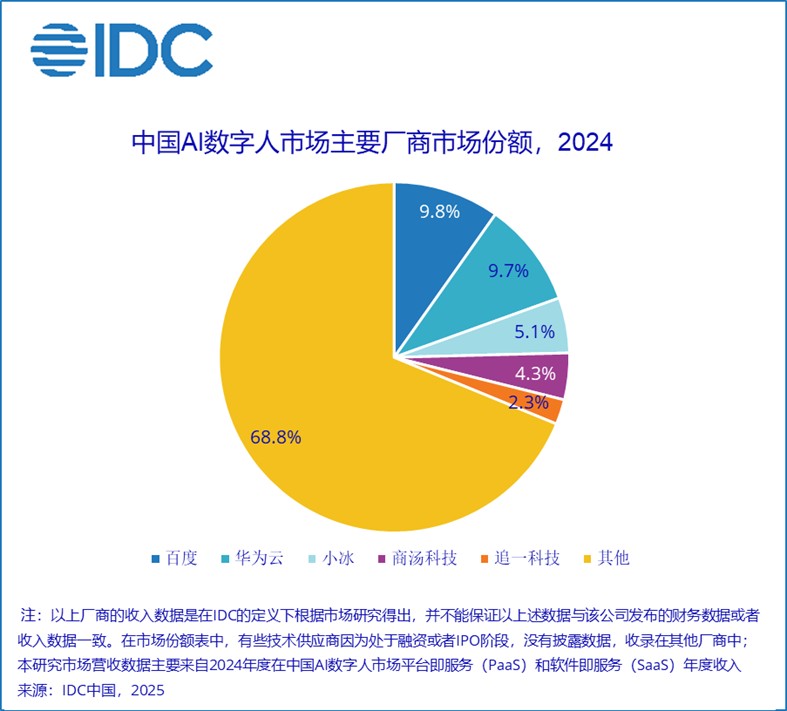
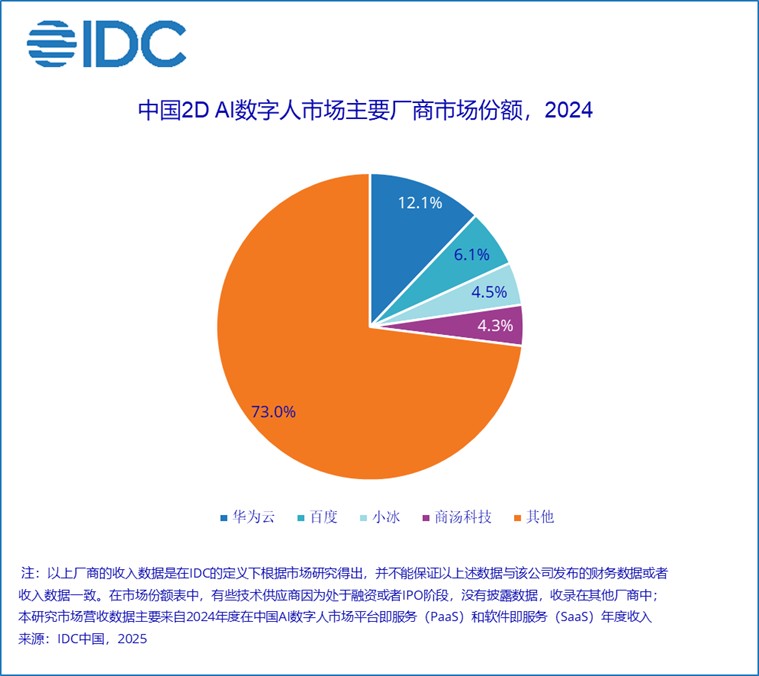
Due to the rapid implementation of the current 2D digital human market, this research report also separately segmented the market share of 2D digital humans— the market size in 2024 will reach 2.89 billion yuan, an increase of 101.2% compared to 2023. Major players in this sub-market include Huawei Cloud, Baidu, Xiaoice, and SenseTime.
Cheng Yin, the AI research manager at IDC China, stated that driven by generative AI and large model technology, the AI digital human sector is experiencing breakthrough development, with a comprehensive upgrade of the technical architecture—leading companies are building a new generation of digital human technology stack based on semantic and vertical domain large models, achieving a qualitative leap in interactive experiences for specific scenarios. Additionally, multimodal capabilities continue to break through, with key technological modules such as expression generation, motion capture, voice synthesis, and visual understanding reaching new heights through large-scale pre-training. Finally, the application ecosystem is accelerating popularization— as the process of technology democratization accelerates, the barriers to developing and using digital humans are significantly lowered, heralding the accelerated arrival of the "universal digital human" era. This trend will fundamentally change the paradigm of human-computer interaction and reshape the development pattern of the digital economy
