


Hong Kong leads the way with the "Stablecoin Regulation"! Which concept stocks will benefit? What opportunities lie ahead?

Hong Kong will pass the "Stablecoin Ordinance" in May 2025, with plans to implement it on August 1, becoming the world's first full-chain regulatory framework for fiat-backed stablecoins. This policy will bring compliance confidence to the stablecoin market and create new investment opportunities for the Hong Kong stock market. The implementation of the ordinance will attract global issuers, promote the development of digital banking, payment platforms, and blockchain infrastructure, and enhance Hong Kong's status as a virtual asset center
Introduction
TradingKey - In May 2025, Hong Kong officially passed the "Stablecoin Ordinance" and decided to implement it on August 1. This move marks a critical step for Hong Kong in the regulation of virtual assets. The bill serves as the world's first comprehensive regulatory framework for fiat-backed stablecoins, injecting compliance confidence into the stablecoin market and bringing a new investment theme—stablecoin concept stocks—to the Hong Kong stock market.
This article will delve into the core content of the "Stablecoin Ordinance," the list of beneficiary concept stocks, and their business logic, while also looking forward to future policy dividends.
Hong Kong's "Stablecoin Ordinance": Release of Policy Dividends
On May 30, 2025, the Hong Kong Legislative Council officially passed the "Stablecoin Ordinance," which regulates aspects such as the issuance and redemption of stablecoins. Key content includes:

Hong Kong has taken the lead over the United States by passing the GENIUS Stablecoin Act, which provides a first-mover advantage that helps attract global issuers to establish businesses in Hong Kong, driving the development of related industry chains including digital banking, payment platforms, and blockchain infrastructure, thereby enhancing Hong Kong's status as a virtual asset center; at the same time, it promotes the integration of stablecoins with the real economy, such as cross-border trade and payment settlement.
"Stablecoin Ordinance," GENIUS Act, and Digital Asset Basic Law
With the passage of Hong Kong's "Stablecoin Ordinance," the United States and South Korea are also accelerating the advancement of stablecoin-related legislation. On June 17 of this year, the U.S. Senate officially passed the GENIUS Act, which will next be submitted to the House of Representatives for a vote. If passed, it will be sent to President Trump. Currently, the market generally expects a very high probability of the bill's passage. U.S. Senator Hagerty stated in an interview that Trump is ready to sign the "GENIUS Act," and mentioned that the bill "could soon be on his desk."
On June 10, the ruling Democratic Party led by South Korean President Lee Jae-myung officially proposed the "Digital Asset Basic Law." This bill stipulates that as long as a South Korean company has a capital of at least 500 million won (approximately $370,000) and ensures refunds through reserves, it can issue stablecoins, laying the foundation for the compliant development of the Korean won stablecoin. According to a report by the Seoul Economic Daily on June 23, South Korean payment service provider Kakao has announced the launch of its "Korean Won Stablecoin" business.
The sequential advancement of stablecoin legislation in Hong Kong, the United States, and South Korea will help develop the crypto market for the Hong Kong dollar, U.S. dollar, and Korean won, creating a competitive relationship. Thus, these countries or regions will shape a friendly regulatory environment for crypto to attract talent and resources, which is conducive to promoting the growth of the stablecoin market. ** According to the current development trend, more countries or regions such as Japan and the European Union may join the competition in the future.
Stablecoin Concept Stocks: Who are the Policy Beneficiaries?
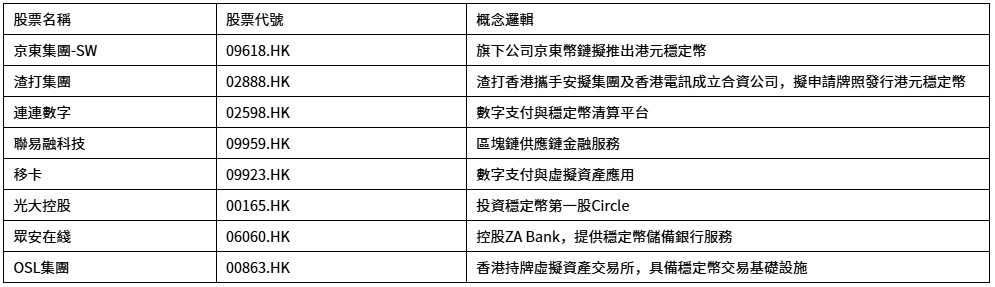
According to market data and brokerage research reports, the following Hong Kong stocks are considered core members of stablecoin concept stocks due to their layouts in payment clearing, blockchain infrastructure, reserve banking services, and RWA applications:
Investment Strategy: How to Layout?
The aforementioned Hong Kong stocks are all stablecoin concept stocks, but their correlation with stablecoins varies, so the policy benefits of stablecoins may have different impacts on them.
Similar to the first stablecoin stock Circle, JD Group and Standard Chartered Group are potential direct issuers of stablecoins. If they really obtain stablecoin issuance licenses in the future, they will directly benefit from the Hong Kong government's policy advantages. Therefore, they can be considered as short-term investment targets, but it is necessary to keep a close eye on policy dynamics and monitor whether they can obtain relevant licenses to adjust investment strategies in a timely manner.
Similar to the cryptocurrency exchange Coinbase (COIN), OSL, a virtual currency exchange under OSL Group, is the only compliant licensed and listed cryptocurrency trading platform in Hong Kong, and it is highly likely to become an important custodian and distribution channel for licensed stablecoins in the future, with sustainability. Therefore, mid-term layout can be considered.
Companies like LianLian Digital and Linklogis Technology, which focus on stablecoin payments and other applications or related parties, can be included in long-term opportunities. It is important to note that this classification is not absolutely fixed and needs to be adjusted according to policy changes and the business developments of the aforementioned companies.
Risks of Investing in Stablecoin Concept Stocks
Investing in stablecoin concept stocks, while possessing policy dividends and industry growth potential, also comes with certain risks. The following are the risks and investment suggestions compiled from market observations and expert recommendations:
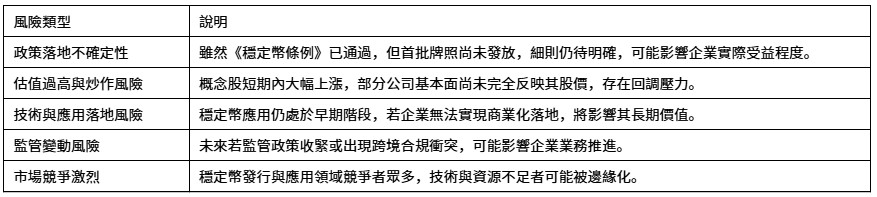 In the early stages of the policy, investors need to closely monitor policy direction and regulatory progress. Secondly, when selecting targets, priority should be given to companies directly related to stablecoin issuance and reserves, while being wary of concept hype. Of course, diversification of investments and risk control are also necessary.
Conclusion
The implementation of Hong Kong's "Stablecoin Regulation" injects a strong boost into the virtual asset market and brings new opportunities for Hong Kong stock investors. As the regulatory system improves and market demand expands, related companies are expected to stand out in the wave of digital finance, but various potential risks must also be taken into account
