The "Big Beautiful Act" has passed, and the wave of U.S. Treasury bond issuance is coming

Wallstreetcn
2025.07.05 02:43
portai
I'm PortAI, I can summarize articles.

To make up for the trillion-dollar deficit, the U.S. government is betting on short-term financing, and a grand performance testing the supply and demand of the $7 trillion market's existing funds has officially begun

With the formal implementation of the Trump administration's massive tax cuts and spending bill, the U.S. Treasury may soon initiate a "supply flood" of short-term government bonds to compensate for future fiscal deficits amounting to trillions of dollars.

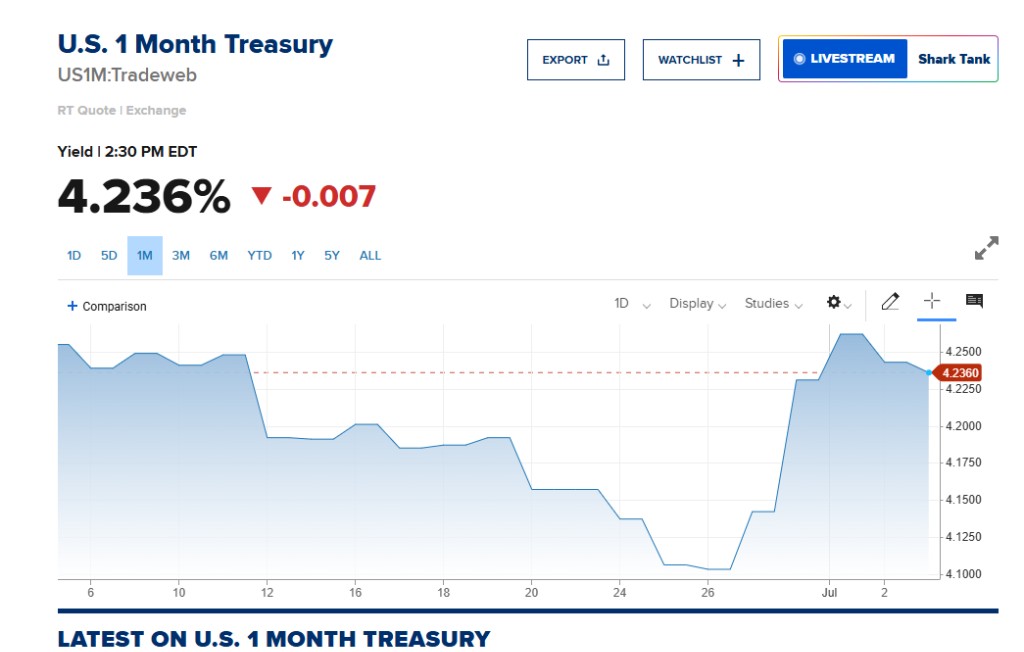
The market has already begun to respond to the anticipated supply pressure. Concerns about an oversupply of short-term government bonds have been directly reflected in prices—the yield on 1-month short-term government bonds has seen a significant increase since this Monday. This marks a shift in market focus from earlier concerns about the sell-off of 30-year long bonds to the front end of the yield curve.

Trillion-Dollar Deficit Looms: U.S. Short-Term Bond Market to Face "Supply Flood"

The implementation of the new bill brings with it a grim outlook for future fiscal conditions. According to estimates from the nonpartisan Congressional Budget Office (CBO), the bill will add up to $3.4 trillion to the national deficit for the fiscal years 2025 to 2034.

Faced with enormous financing needs, issuing short-term government bonds has become a cost-effective choice favored by decision-makers.

First, from a cost perspective, although the yields on short-term government bonds with maturities of one year or less have climbed above 4%, they remain significantly lower than the nearly 4.35% issuance rate of 10-year bonds. For the government, the lower immediate financing costs are a strong attraction, especially as interest expenses have become a heavy burden.

Second, this aligns with the clear preferences of the current administration. Previously, President Trump himself expressed a preference for issuing short-term notes rather than long-term bonds. Treasury Secretary Mnuchin also stated to the media that increasing the issuance of long-term bonds "makes no sense" at this juncture.

However, this strategy is not without risks. Relying on short-term financing may expose borrowers to the risk of fluctuating or higher future financing costs. An anonymous Canadian bond portfolio manager stated:

"Anytime you finance a deficit with extremely short-term notes, there is a risk of shocks occurring, which could put financing costs at risk."

For example, if inflation suddenly rises and the Federal Reserve has to consider raising interest rates, the cost of short-term financing will increase as Treasury yields rise. Additionally, an economic recession and shrinking economic activity could lead to reduced savings, thereby lowering demand for short-term notes.

Supply and Demand Showdown: Can $7 Trillion in Liquidity Absorb the Bond Issuance Surge?

As the supply gates are about to open, the market's capacity to absorb this influx becomes a new core issue. Currently, the market seems to be confident, drawing strength from the massive liquidity built up in the money market.

First, looking at the supply side. The U.S. Treasury Borrowing Advisory Committee (TBAC) currently recommends that the proportion of short-term government bonds to total outstanding debt should be capped at around 20%. However, Bank of America's interest rate strategist team predicts that to absorb the new deficit, this proportion may soon rise to 25%. This means the market needs to be prepared for a supply of short-term notes that far exceeds the official recommended levels The market's focus has thus dramatically shifted. Back in April and May of this year, investors' anxieties were centered around the sell-off of 30-year long-term government bonds and the risk of their yields soaring above 5%. Now, the spotlight has completely turned to another end: will short-term government bonds trigger new turmoil due to oversupply?

On the demand side, Matt Brill, North American Investment Grade Credit Head at Invesco Fixed Income, believes that the nearly $7 trillion in money market funds in the market are showing "persistent demand" for front end debt, and the U.S. Treasury seems to have realized this as well.

Mark Heppenstall, President and Chief Investment Officer of Penn Mutual Asset Management, is even more optimistic, stating:

"I don't think the next crisis will come from short-term government bonds. There are many people wanting to put capital to work, especially when real yields look quite attractive. You might see some pressure on short-term government bond rates, but there is still a lot of cash flowing in the market.

If problems do arise, the Federal Reserve will find ways to support any supply-demand imbalances."