


Trump "says goodbye to rehab, embraces the Golden Triangle," Bank of America Hartnett: Global stock markets All In! Until the bond collapse

Bank of America Chief Investment Strategist Hartnett believes that Trump's policy path is shifting from a "fiscal detox" model to a "fiscal carnival," which will pay for the huge bills by creating "a beautiful big bubble." Risk assets such as the stock market and cryptocurrencies have already clearly received this signal. He believes that only a severe sell-off in the bond market can end this feast
Bank of America Chief Investment Strategist Michael Hartnett has issued his latest and most aggressive viewpoint: a policy-driven global stock market melt-up is underway, and investors should adopt an "All In" strategy until long-term bond yields break through a critical "explosion point," triggering a market crash.
Hartnett points out that the core logic of the current market has fundamentally changed. He uses a metaphor to describe the policy path of the Trump administration: it is shifting from a fiscal "detox" mode to an unrestrained "gorge" mode. This embrace of massive spending will pay for the huge bills by creating "a beautiful big bubble," and risk assets such as the stock market and cryptocurrencies have clearly received this signal.
The extreme indifference of the market to policy risks is a key catalyst for this rally. Hartnett states that the MOVE and VIX indices, which measure bond and stock market volatility, are at their lowest levels since February 19, indicating that there is almost no fear of policy in the market.
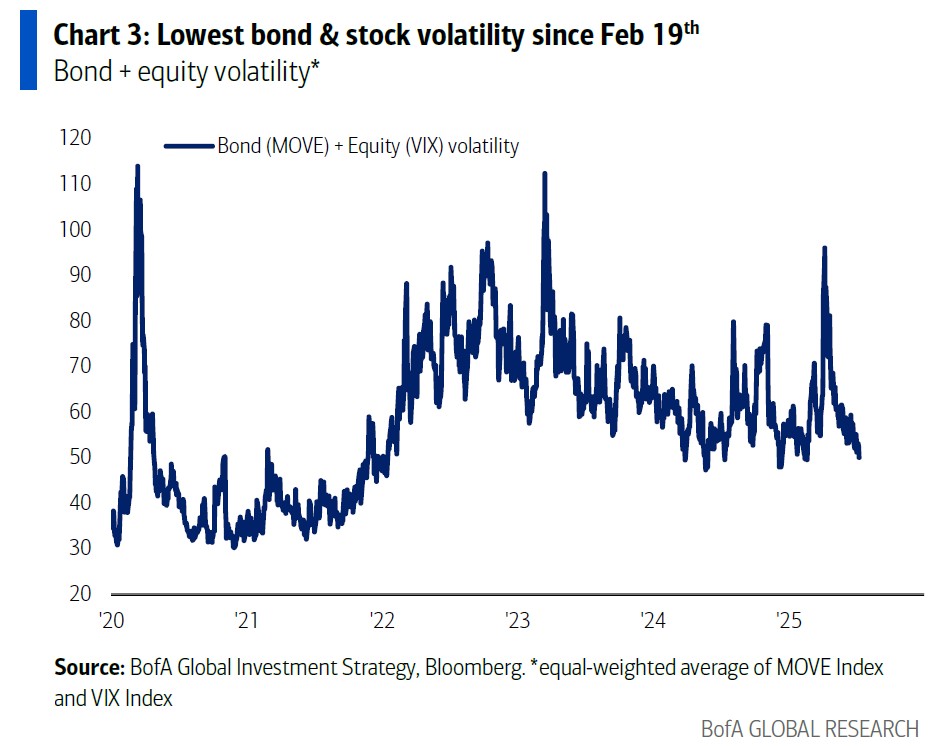
Therefore, his trading advice is clear and direct: maintain a full exposure to risk assets until key long-term Treasury yields reach "jailbreak" levels—specifically, when the U.S. 30-year Treasury yield exceeds 5.1%, the U.K. exceeds 5.6%, and Japan exceeds 3.2%. He believes that only a severe sell-off in the bond market can end this feast.
Everything Rises, Except Bonds
Hartnett notes that the current market sentiment can be summarized as "buy the election, sell the inauguration, buy tariff day," with price movements indicating that investors should rotate rather than retreat.
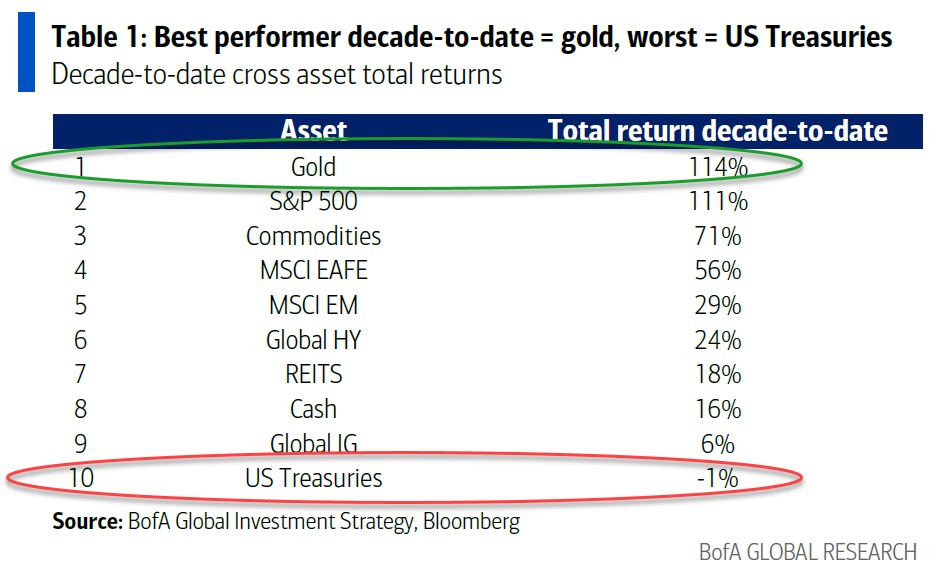
In Hartnett's asset allocation advice, bonds have become the least favored asset class. The trading logic of "Anything but Bonds" is spreading from the U.S. to the global stage. Over the past decade, gold has risen by 114% to become the best-performing asset, while U.S. Treasuries have fallen by 1% to the bottom.
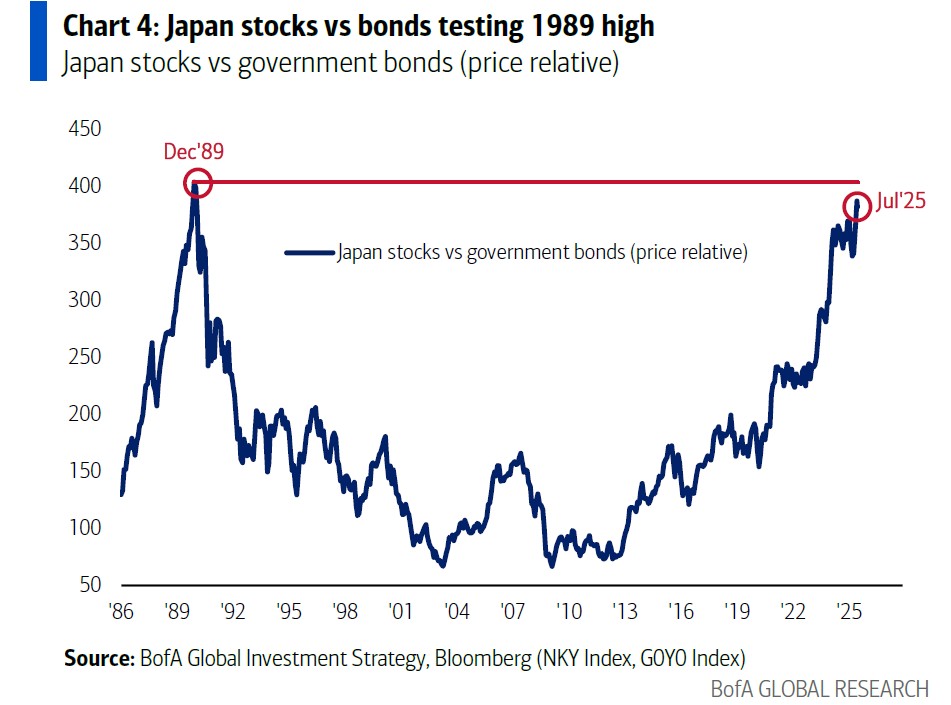
This trend is being confirmed globally. The ratio of European stocks to bonds has surpassed the highs of 2000, while the ratio of Japanese stocks to bonds is also testing the historical peak of 1989, marking the end of the long-term deflationary era in Europe and Japan.
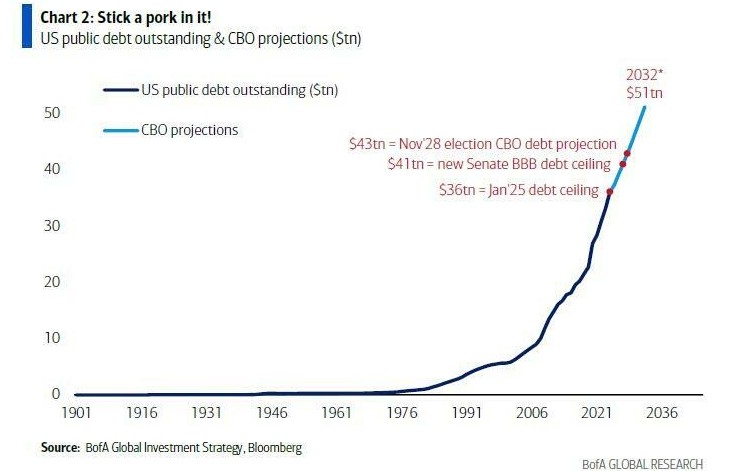
 Bank of America believes that the surge in U.S. debt issuance will push total debt to exceed $50 trillion by 2032. In the face of a large amount of new debt issuance, demand continues to decline until interest rates rise to a level sufficient to attract investors.
Hartnett stated that due to Trump's inability to cut spending, unable to reduce defense spending, unable to cut debt, and unable to significantly raise tariffs, the only way they can pay for "a beautiful big bill" is to create "a beautiful big bubble." This means that the U.S. will unleash an "epic deficit financing debt shock."
Therefore, Hartnett believes that the long-term bear market for the dollar has just begun, recommending an increase in allocation to commodities, cryptocurrencies, international markets, and emerging markets in the latter half of the 2020s.
Frequent Bubble Signals but Policies Remain Loose
Despite an extremely bullish stance, Hartnett also pointed out the increasing signs of bubbles in the market.
Hartnett found a general sense of optimism, even indifference, from recent client feedback. Investors "are not worried about the economy, and no one is talking about valuations."
He mentioned that Bank of America's Fund Manager Survey (FMS) has become an "excellent contrarian indicator," accurately marking several key turning points in the market over the past year.
If the upcoming July FMS survey shows extreme optimism, such as fund managers' cash levels below 4.0% and over 90% of respondents expecting an economic "soft landing" or "no landing," this would constitute a typical signal for profit-taking or a summer pullback. Hartnett warned that when price movements begin to ignore reliable trading rules, this in itself is a sign of a bubble, as he stated, "Greed is always harder to reverse than fear."
Meanwhile, there are clear divergences within the market: macro strategy analysts generally believe that government bonds are "on the verge of disorderly selling," while clients in the stock and credit markets are "turning a blind eye" to this. The latter remain optimistic because they believe the Trump administration needs an economic boom to face the midterm elections, thus closely following Bitcoin's breakout trend. Hartnett observed that investors generally expect second-quarter earnings reports to exceed expectations and believe this rally will continue until the Federal Reserve's Jackson Hole meeting in August, after which a "healthy pullback" will occur.
However, as long as policies remain "supportive," risk appetite will persist. Hartnett emphasized in conclusion that there is no "policy dragon" strong enough to overturn the market in the short term. The global policy environment remains loose, and central banks are still in a rate-cutting cycle. Although the fiscal stimulus in the U.S. has weakened compared to 2024, the tax reduction plan starting in 2026, along with increasing fiscal stimulus from Europe and NATO, will provide effective hedging More importantly, the market has formed a consensus that any negative macroeconomic impact from the increase in U.S. tariffs "can and will be quickly adjusted down" as long as the economy requires it. This implicit policy put option provides solid support for investors' risk appetite and has become the core driving force behind the continued rise of global stock markets in this round
