The United States announced the detailed version of the US-Japan agreement: Japan to invest $550 billion in the United States and procure $8 billion in American agricultural products

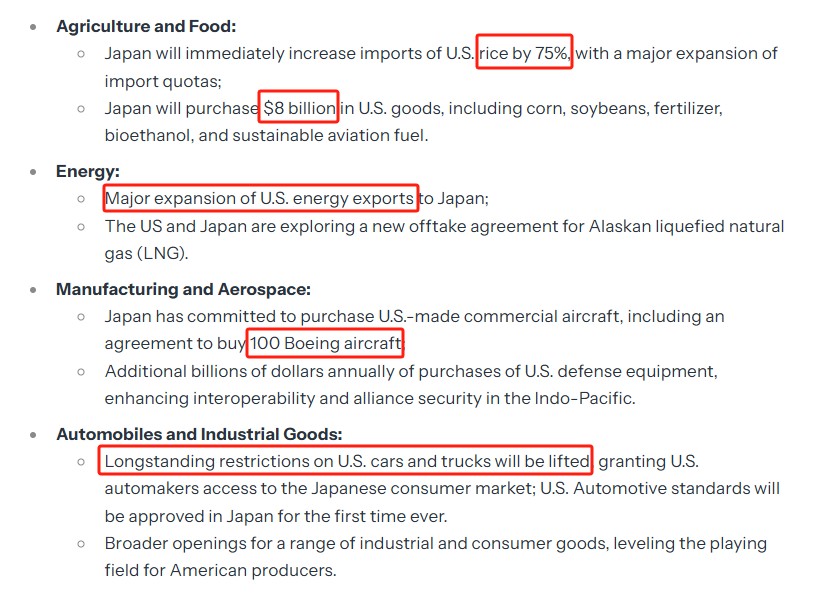
The White House confirmed that Japan will invest $550 billion in the United States through a newly established investment fund, marking the largest foreign investment commitment received by any country to date. Japan will immediately increase its import quota for U.S. rice by 75% under a zero-tariff minimum market access framework. U.S. automobiles will no longer be subject to long-standing restrictions and will be able to enter the Japanese consumer market, and U.S. automotive standards will also be recognized in Japan for the first time
The White House announced the detailed terms of the US-Japan trade agreement on Wednesday. This "unprecedented" agreement includes Japan's commitment to invest $550 billion in the United States and an $8 billion procurement plan for American agricultural products.
According to CCTV News, the US and Japan reached an agreement on tariff issues. Under the terms of the agreement, the US will impose a uniform 15% tariff on Japanese goods, including automobiles, which is lower than the 25% rate previously threatened by Trump. In exchange, Japan has committed to establish a fund of up to $550 billion for direct investment in the US, with investment directions led by the US side.
The agreement covers market access in key areas such as agriculture, energy, aerospace defense, and automobiles. In agriculture, Japan will immediately increase its import quota for US rice by 75% and purchase $8 billion worth of American agricultural products. In the aerospace sector, Japan has committed to purchasing 100 Boeing aircraft and other US-made civilian planes.
The Largest Investment Commitment in History: $550 Billion Fund Operation Model
The summary of the agreement released by the White House shows that Japan will establish a $550 billion investment fund to rebuild and expand America's core industries. This fund, referred to as the "US/Japan Investment Tool," is expected to create hundreds of thousands of jobs in the US.
As mentioned in a previous article, US Secretary of Commerce Gina Raimondo revealed that the fund's financing will include "equity, loans, and loan guarantees," with investment directions led by the US side, which will receive 90% of the profits from the investment.
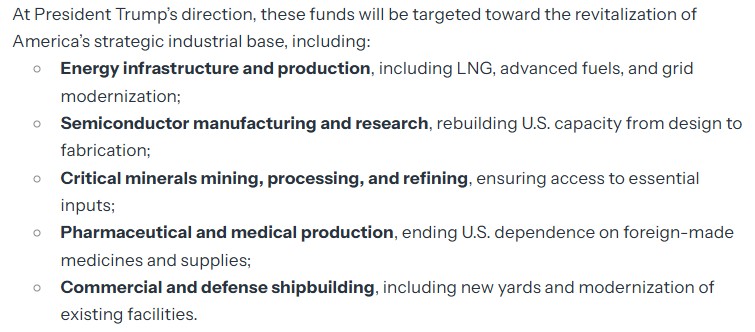
The agreement specifies that these funds will be directed towards the revival of America's strategic industrial base, including energy infrastructure and production, semiconductor manufacturing and R&D, critical mineral extraction and processing, pharmaceutical and medical product manufacturing, as well as commercial and defense shipbuilding.
Tariff Framework Adjustment: Uniform 15% Rate
As an important component of the agreement, the US will implement a uniform 15% tariff rate on imported goods from Japan.
According to a previous article, for automotive products, this rate includes an additional 12.5% tariff plus a 2.5% basic tariff. Compared to the previous 25% global automobile import tariff, this adjustment provides Japanese automobile manufacturers with some breathing room U.S. Treasury Secretary Janet Yellen clearly stated that Japan's ability to obtain a 15% preferential tax rate is due to its "willingness to provide this innovative financing mechanism." Tariffs on steel and aluminum will remain unchanged at 50%.
Major Breakthroughs in Agriculture, Expansion of Energy and Aviation Cooperation
According to the agreement, the U.S. and Japan have made progress in agriculture, energy, automotive, and aviation trade.
In particular, in the agricultural sector, Japan will immediately increase its import quota for U.S. rice by 75% under the zero-tariff minimum market access framework. The current total minimum market access for rice is 770,000 tons, of which about 350,000 tons are U.S.-produced rice. After the 75% increase, the import volume of U.S. rice will reach approximately 600,000 tons.
In addition, Japan has committed to purchasing a total of $8 billion worth of U.S. agricultural products, including corn, soybeans, fertilizers, bioethanol, and sustainable aviation fuel. This procurement commitment will provide significant market opportunities for U.S. agricultural exporters.
The agreement also addresses the long-standing issue of market access for U.S. agricultural products in Japan. Through this agreement, U.S. agricultural products will gain broader access to the Japanese market, breaking down trade barriers that have persisted for decades.
In the energy sector, the agreement includes a significant expansion of U.S. energy exports to Japan. The U.S. and Japan are exploring new purchase agreements for liquefied natural gas from Alaska, although specific timing and details have not yet been announced.
Breakthroughs have also been achieved in the aviation and defense sectors. Japan has committed to purchasing U.S.-made commercial aircraft, including an agreement for 100 Boeing planes. These commitments also include aircraft for which purchase contracts have already been signed. The agreement also confirms additional annual purchases of billions of dollars in defense equipment to enhance alliance security and interoperability in the Indo-Pacific region.
In the automotive and industrial products sector, U.S. cars will no longer be subject to long-standing restrictions and will be able to enter the Japanese consumer market, with U.S. automotive standards being recognized in Japan for the first time.
Additionally, Japan will provide broader market access opportunities for U.S. industrial and consumer goods, allowing U.S. manufacturers to gain a fairer competitive environment in the Japanese market.