


OPEC+ increases production, tariff impact, oil prices face significant downward pressure!

International crude oil prices fell again in August, with NYMEX WTI crude dropping to $65 per barrel on August 5, down 7.3% from the July peak; ICE Brent crude fell by more than 6.8%. OPEC+ approved an increase in production by 548,000 barrels per day on August 3, withdrawing voluntary production cuts and shifting towards market share competition. Although production cuts had previously supported oil prices, increased output in the U.S. and Africa has led to a loss of market share for OPEC+. The market is focused on whether OPEC+ will utilize the remaining capacity of 1.66 million barrels per day
After a brief rebound in July, international crude oil prices fell again in August, with NYMEX WTI crude dropping to $65 per barrel on August 5, down 7.3% from the peak reached in July; meanwhile, ICE Brent crude also saw a decline of over 6.8%. The previous rebound in oil prices was mainly driven by three factors: geopolitical risk premium, the peak summer travel season in the United States, and a decline in U.S. crude oil production. However, with OPEC+ fully withdrawing its voluntary production cuts, the impact of high tariffs from the U.S. on various economies and crude oil consumption, and the end of the summer travel season in the U.S., global crude oil surplus pressure is expected to resurface, leading to significant downward pressure on forward oil prices.
On August 3, OPEC+ officially approved an increase in production by 548,000 barrels per day during a video conference, completing the full withdrawal of large-scale production cuts for 2023 a year ahead of schedule. This increase will fully restore the 2.2 million barrels per day production cut agreed upon by eight member countries in 2023, which also includes additional quotas that the UAE is implementing in phases.
The reason OPEC+ withdrew the production cuts is that its strategy in the oil market has shifted from price defense to market share competition. From 2023 to 2024, while OPEC+'s voluntary production cuts have supported oil prices to some extent, the impact of energy revenue on fiscal improvement has been limited, due to the significant increase in oil production and exports from countries and regions such as the U.S. and Africa, which have captured OPEC+'s market share.
In the statement from the OPEC+ meeting at the end of July, OPEC+ cited a healthy economy and low inventories as reasons for its decision. OPEC+ retains a large amount of idle capacity, and the market is now closely watching whether the organization will utilize this capacity. Currently, OPEC+ still has another production cut plan of 1.66 million barrels per day. OPEC+ representatives have not provided more certainty regarding the future of this capacity. If Saudi Arabia is truly committed to pursuing market share, it may continue to push for the restart of the remaining 1.66 million barrels per day capacity regardless of price forecasts. Previous tanker tracking data has shown a significant increase in Saudi crude oil exports last month, leading the market to speculate that the country and other Gulf nations are seeking to reallocate supplies outside the region amid the conflict with Iran.
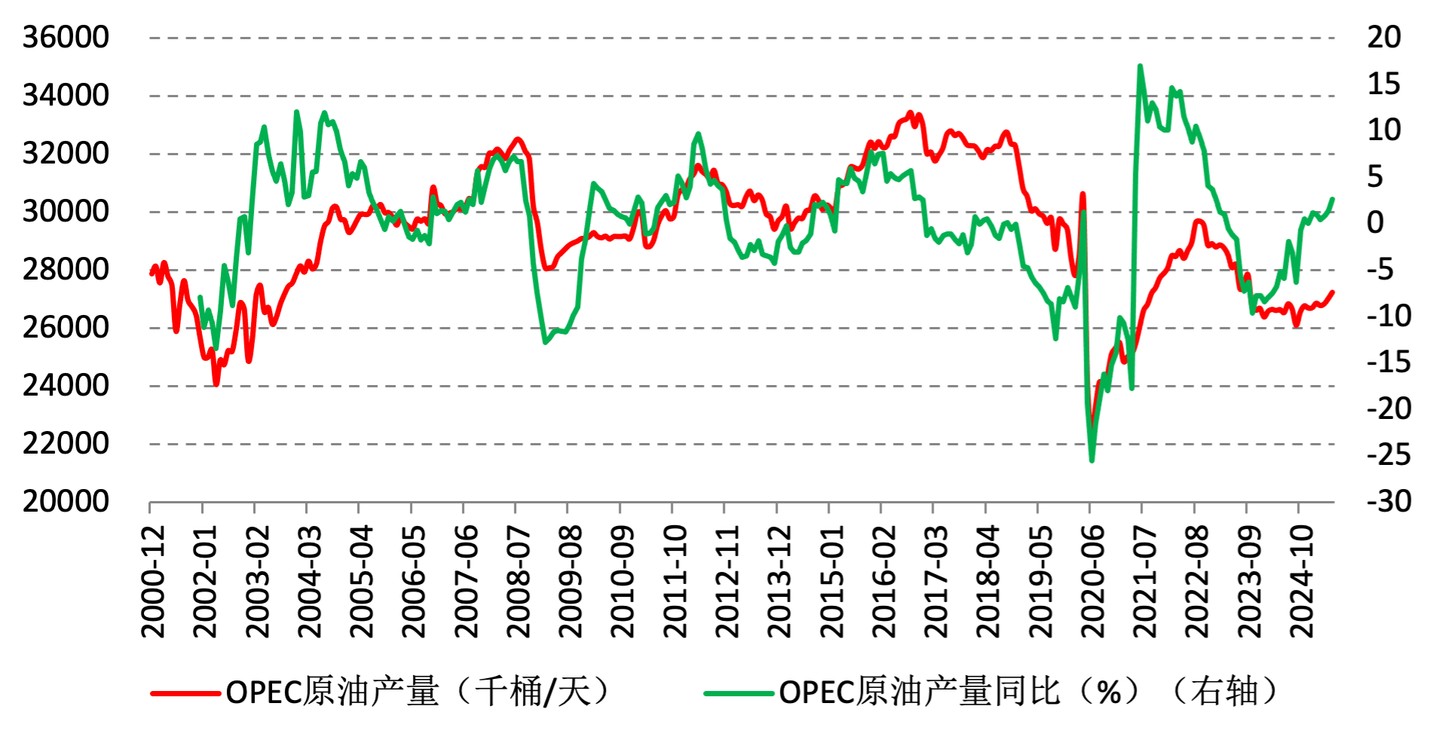
OPEC's July monthly report indicated that in June, OPEC+ total production was 34.69 million barrels per day, an increase of 451,000 barrels per day compared to May, slightly below the agreed production target of 34.81 million barrels per day. Among them, the production of eight voluntarily reducing countries increased by 394,000 barrels per day, slightly lower than the planned increase of 411,000 barrels per day, but the month-on-month growth rate accelerated compared to last month.
The chart shows the trend of OPEC crude oil production
 U.S. crude oil production and exports have seen a temporary decline, but OPEC+ increased production to offset the supply contraction caused by the drop in U.S. output. In July, U.S. crude oil production fell from June's peak due to a decrease in exports. According to data released by the EIA, as of July 25, U.S. crude oil production dropped to 13.314 million barrels per day, nearly flat compared to the same period last year, after peaking at 13.58 million barrels per day in March. Data from Baker Hughes shows that the number of oil rigs in the U.S. has continued to decline, falling to 410 on August 1, down from 482 a year earlier, with a peak of 488 this year. Although the increase in output per rig in U.S. shale oil has offset the decline in the number of rigs, this offsetting effect has weakened as the number of rigs decreases.
According to a report from the International Energy Agency (IEA), with OPEC+ raising its production target for August, global average crude oil supply is expected to increase by 2.1 million barrels per day this year, reaching 105.1 million barrels per day, with a potential further increase of 1.3 million barrels per day by 2026. Non-OPEC+ oil-producing countries are expected to increase production by an average of 1.4 million barrels per day and 940,000 barrels per day in the next two years, respectively.
Firstly, tariff shocks to the global economic outlook will ultimately lead to a slowdown in global crude oil demand growth. On July 31, Trump signed an executive order imposing tariffs of 10% to 41% on U.S. imports from dozens of economies that failed to reach a trade agreement by the August 1 deadline, including major partners like Canada and India. The International Monetary Fund (IMF) updated its World Economic Outlook, stating that due to the disruptions caused by Trump's attempts to reshape international trade rules, global economic growth is expected to slow from 3.3% last year to 3% by 2025, which will impact energy demand.
The IEA recently released its July International Oil Market Report (hereinafter referred to as "the report"), predicting that global average oil demand growth will be only about 700,000 barrels per day by 2025, marking the lowest increase since 2009. Global oil demand growth reached an average of 1.1 million barrels per day in the first quarter of this year but significantly slowed to an average of 550,000 barrels per day in the second quarter, with particularly weak performance in oil consumption in emerging markets. The report also forecasts that global oil demand growth will be 720,000 barrels per day in 2026, with total demand expected to reach 104.4 million barrels per day.
Secondly, the summer travel season in the U.S. has driven an increase in gasoline consumption, but high refinery utilization rates and declining exports have made the effect of U.S. crude oil destocking not very significant. Data shows that in June, global refinery crude processing increased by 1.7 million barrels per day month-on-month. The IEA expects that from July to August, due to seasonal factors related to increased oil consumption demand in the Northern Hemisphere summer, global crude processing will increase by another 2 million barrels per day, reaching a peak of 85.4 million barrels per day From the inventory perspective, according to the analysis by the International Energy Agency (IEA), global oil inventories are expected to accumulate significantly at a rate of about 2 million barrels per day in the fourth quarter, with the accumulation rate reaching 3 million barrels per day in the first quarter of 2026. The continued pressure on oil prices reflects that market concerns about oversupply outweigh the impact of geopolitical risks. The IEA's weekly oil report shows that for the week of July 25, U.S. crude oil inventories increased by 7.697 million barrels, gasoline inventories decreased by 2.724 million barrels, and distillate inventories increased by 3.635 million barrels. Among the inventory increases recorded in recent months, non-OECD countries added about 100 million barrels, with China alone accounting for 48 million barrels. Additionally, the so-called offshore floating storage of oil has also increased, adding 10.6 million barrels.
In summary, the bullish outlook for crude oil stems from the premium associated with geopolitical risks. In the near future, attention should be paid to the U.S. implementing secondary tariff sanctions on Russian oil, which could put Russia's daily maritime oil exports of 2.75 million barrels at risk, but this brings short- to medium-term disruptions, as India has not abandoned imports of Russian crude oil. With OPEC+ significantly increasing production, it is expected that the global crude oil landscape will return to a market share competition, and the pressure of crude oil oversupply will become evident in the fourth quarter and beyond
