Omdia: In the second quarter of 2025, the global smartphone market saw a slight decline of 0.1%, and market uncertainty continues in the second half of the year

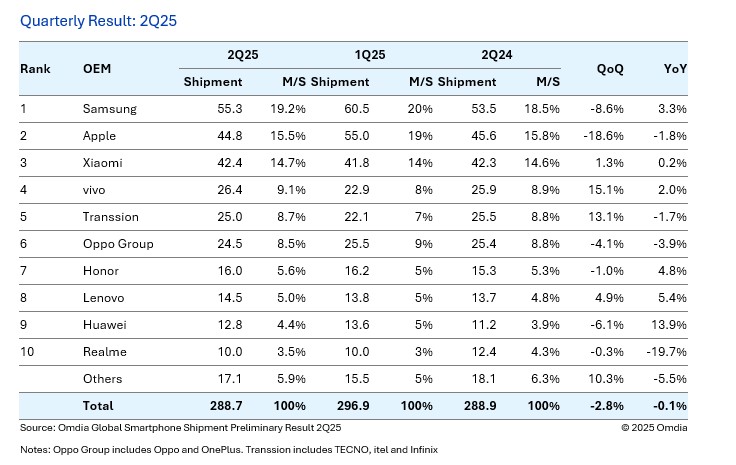
Omdia released a report stating that in the second quarter of 2025, global smartphone shipments slightly declined by 0.1%, reaching 288.7 million units, a decrease of 2.8% quarter-on-quarter. Samsung continues to lead the market, followed by Apple in second place and Xiaomi in third. The market faces macroeconomic challenges, with weak consumer demand prompting many manufacturers to lower production targets to avoid excess inventory. In the U.S. market, due to uncertainties in tariff policies, companies like Apple and Samsung have pulled inventory in advance. Sales of Apple's new iPhone have declined, while demand for lower-priced products remains strong
According to the Zhitong Finance APP, on August 26, Omdia reported that global smartphone shipments fell to 288.7 million units in the second quarter of 2025, a decrease of over 8 million units quarter-on-quarter, representing a decline of 2.8%. Compared to the second quarter of 2024, the year-on-year decrease was only 200,000 units, a decline of less than 0.1%.
Samsung remains at the top, mainly due to the shipment volumes of its high-end S series and low-end A series phones. Apple (AAPL.US), despite a slight decline in shipments, still holds the second position; Xiaomi (01810) maintains a very stable market share in third place. Vivo and Transsion (688036.SH) rank fifth, each with a market share of 9%.
The stagnation of the smartphone market over the past two quarters indicates that the industry is facing increasingly severe macroeconomic challenges—the post-pandemic replacement wave is fading, and consumer demand remains weak.
Many manufacturers had originally set higher targets for the second quarter, but had to lower production goals to avoid excess inventory. An exception is in the United States, where significant uncertainty exists regarding the tariff policies and timelines of the Trump administration, prompting suppliers like Apple, Samsung, and Motorola (Lenovo) to pull goods in advance throughout the quarter and maintain high inventory levels.

Samsung's shipments in the second quarter saw a slight year-on-year increase, thanks to balanced growth in both high-end and mid-to-low-end markets. To minimize the impact of increased tariffs in the U.S., Samsung increased its shipments to the U.S. for the second consecutive quarter, driving overall shipment growth in the second quarter.
Apple's sales declined after the launch of the iPhone 16e in the first quarter of 2025, due to its single-camera design reducing consumer value, and the Apple Intelligence feature not yet being realized, leading to diminished consumer interest in this new model. In contrast, the iPhone 15 and iPhone 13 continue to drive demand for Apple's lower-priced products.
Xiaomi's shipments remained basically flat year-on-year, with a slight increase of 100,000 units (an increase of 0.2%), rising from 42.3 million units to 42.4 million units. This demonstrates Xiaomi's market position built on its investment in the ecosystem and strong brand recognition.
With a surge in shipments in the Indian market, Vivo replaced OPPO to take fourth place and topped the charts in India in the second quarter of 2025. Meanwhile, many of Vivo's new product launches received strong promotion from channel partners in the region, while its main competitors, Xiaomi and Transsion, adopted a more cautious strategy.
Both Transsion and OPPO saw a decline in shipments in the second quarter of 2025, as the uncertainty of the overall economic environment had the most significant impact on the low-end market, with demand also affected by price sensitivity. At the same time, Transsion's inventory adjustments carried out over the past few quarters have been completed Honor, Lenovo (00992), and Huawei have all achieved strong growth this quarter. In particular, Huawei has continued its strong growth momentum since 2021, with an increase of 16.0%. Its main market remains China, where it has regained its top position and holds a strong share in the high-end market. Honor's sales grew by 2.0% compared to the second quarter of 2024, thanks to its continued expansion into new markets such as Latin America and Europe. Lenovo's sales increased by 5.6%, partly due to its adoption of a strategy similar to Samsung's and shipping to the U.S. market ahead of potential further impacts from tariffs.
Currently, the global political and economic macro environment remains highly uncertain, with trade protectionism leading to tariff wars and geopolitical tensions resulting in hot conflicts. This has caused global corporate investment to no longer actively expand, leading to a slowdown in global economic growth. Middle- and low-income households have seen a decrease in income, which has correspondingly reduced their smartphone consumption budgets. It is expected that the global smartphone market will experience negative growth by 2025.
Smartphone manufacturers are actively driving replacement demand among existing users through hardware innovation to maintain market size. By 2025, silicon-carbon anode material batteries will be commercially used on a large scale, with newly released smartphone batteries significantly increasing capacity and enhancing smartphone battery life. At the same time, smartphones are entering an era of thinness and lightness, with Samsung already releasing the new ultra-thin smartphone Galaxy S25 Edge, and Apple set to launch the ultra-thin design iPhone 17 Air this September, which will lead other Android manufacturers to follow suit in thin design. Additionally, foldable smartphones have entered an era of being under 9 millimeters thick, and Apple's upcoming foldable smartphone is expected to adopt a new folding structure design to eliminate crease marks, which will drive the market size of foldable smartphones to new heights by 2026