


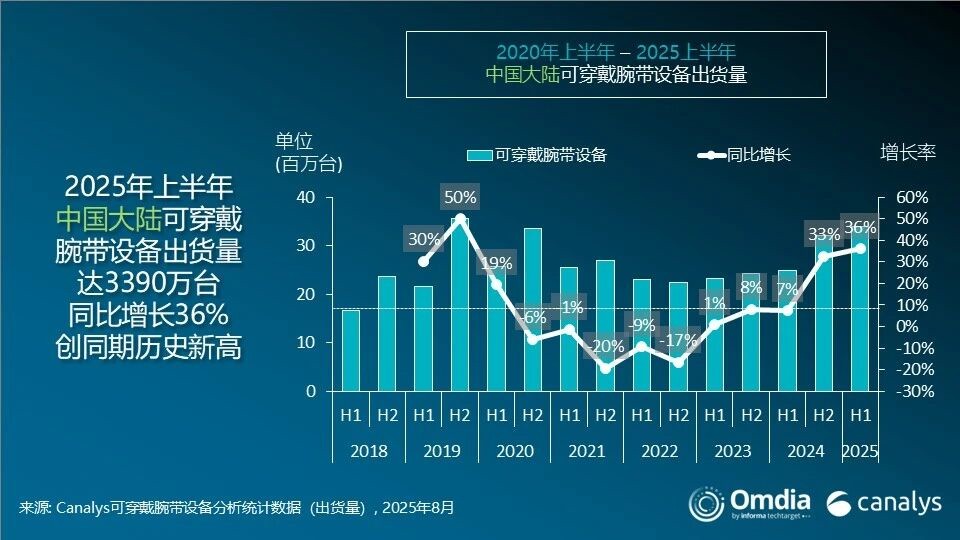
Canalys: In the first half of the year, the wearable wristband device market in mainland China reached a historical high, with a year-on-year shipment growth of 36%, reaching 33.9 million units

According to data from Canalys (now merged into Omdia), the shipment volume of wearable wristband devices in mainland China is expected to reach 33.9 million units in the first half of 2025, a year-on-year increase of 36%, setting a new historical high. Basic wristbands have become the fastest-growing segment with an 80% growth rate, with Huawei occupying 36% market share with a shipment volume of 12 million units. National subsidy policies and large promotional activities have effectively stimulated consumer demand, driving the consumption willingness for mid-to-high-end devices
According to the Zhitong Finance APP, Canalys (now merged into Omdia) data shows that in the first half of 2025, the shipment volume of wearable wristband devices in mainland China reached 33.9 million units, a year-on-year increase of 36%, continuing the strong growth of 33% in the second half of 2024. This growth trend marks a historical high for the shipment volume of wearable wristband devices in mainland China for the first half of the year, indicating that the market has entered a new development stage.
The basic wristband category has become the fastest-growing segment with an astonishing growth rate of 80%, serving as the main driving force behind the strong performance of the mainland market. Huawei leads the market with a shipment volume of 12 million units, accounting for 36% of the share; both manufacturers have achieved a milestone of over 10 million units in shipments for the first half of the year for the first time, with Xiaomi's year-on-year growth particularly impressive at 101%.
Claire Qin, a research analyst at Canalys (now merged into Omdia), stated: "The national subsidy policy has effectively boosted the demand for wearable wristbands by encouraging existing users to upgrade their devices, attracting new users, and even rekindling the interest of old users. The large '618' promotional event, combined with this, has lowered the purchase threshold for price-sensitive consumers and encouraged them to consider purchasing higher-priced basic watches and smartwatches, reflecting the 'lipstick effect.' This aligns with the recent development trend of wearable wristbands—devices priced between RMB 1,599 and RMB 2,999 (approximately USD 400) have seen price reductions driven by subsidy policies, further stimulating the consumption willingness for mid-to-high-end devices."
Cynthia Chen, a research manager at Canalys (now merged into Omdia), stated: "Manufacturers with a complete wearable device product portfolio perform better. The Huawei Watch GT series occupies a strong position in the basic watch market due to its deep integration of health management functions and high-end coaching services. Coupled with effective pricing strategies that bring prices below RMB 1,000 due to subsidy policies, this further strengthens the market competitiveness of this series."
Apple's online and offline direct sales channels participated in the subsidy program for the first time in the second quarter, indicating the importance of optimizing channel structure and strengthening official direct sales channels through policies, which helps maintain its market positioning in the high-end smartwatch segment.
Cynthia Chen concluded: "With the promotion of the National Health Commission's 'Health Management Year' initiative, public awareness of fitness has significantly increased, leading to a rise in demand for high-end sports watches. Although the scale of this segment is still not large, it accounts for 10% of the value of the wearable wristband market in mainland China, bringing higher profit margins for brands like Garmin and Gaochi, and providing a reference path for other manufacturers to achieve high-end transformation. As policies encouraging exercise continue to drive the fitness craze, manufacturers must seize the trend of localized fitness and launch AI coaching and intelligent guidance features suitable for individual and group users in different sports scenarios." These innovations can not only influence consumer behavior but also achieve continuous optimization of product functions through feedback and data analysis
