McKinsey's Heavyweight Report: Which Industries Are Most Impacted by AI?

According to the report, knowledge workers with high salaries and high education levels are most affected by AI. The time for AI to replace human work has been significantly advanced by 10 years. The AI revolution can bring about a growth of 2.6 trillion to 4.4 trillion US dollars to the global economy each year, which is equivalent to contributing to the GDP of a United Kingdom every year.
"The AI era" has officially arrived, and "artificial intelligence" has been included as a reason for corporate layoffs for the first time. Perhaps the wave of layoffs triggered by AI has just begun.
On June 14th, consulting firm McKinsey released a research report titled "The Economic Potential of Generative Artificial Intelligence". In the report, analysts studied 850 occupations (over 80% of the global workforce) in 47 countries and regions to explore the impact of AI on the global economy behind the exponential development of AI, which industries will be most affected, and which people will face the threat of unemployment.
The main contents of the report are as follows:
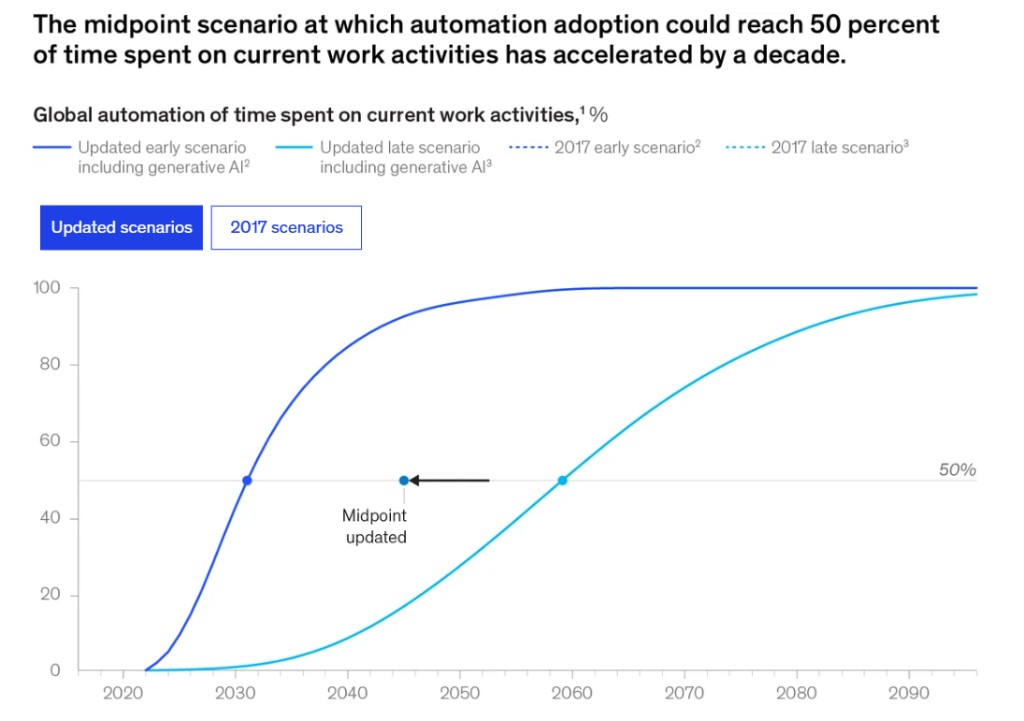
- The time for AI to replace human work has been brought forward by 10 years. Between 2030 and 2060 (with a midpoint of 2045), 50% of occupations will gradually be replaced by AI.
- AI can bring global economic growth of 26 trillion to 44 trillion US dollars per year, with productivity increasing by 0.1% to 0.6%, equivalent to the GDP of the UK each year.
- From a global perspective, AI is beneficial to the development of various industries, but it is detrimental to individuals, and the impact on high-salary, high-education cognitive workers is the greatest.
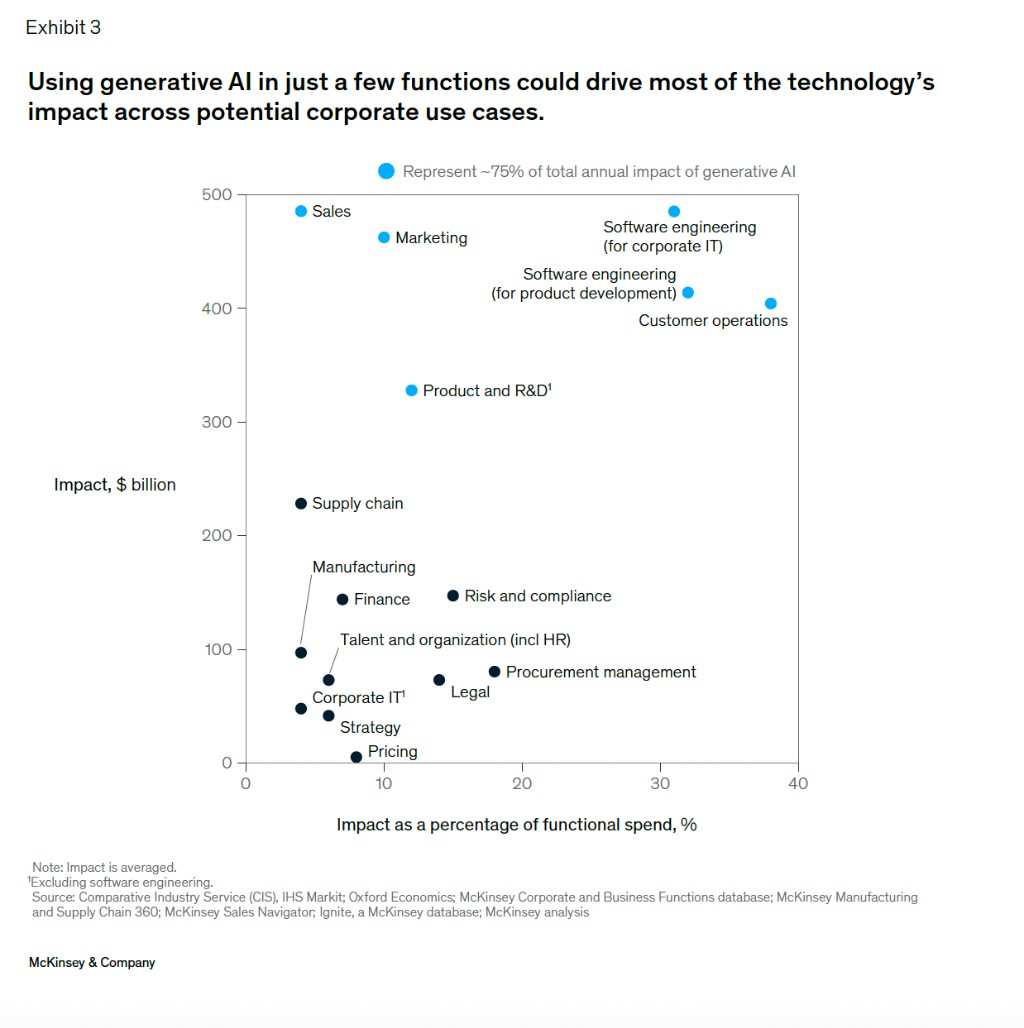
- The value growth brought by generative AI is mainly (about 75%) concentrated in four areas: customer operations, marketing and sales, software engineering and R&D, which also means that these four businesses are most affected by generative AI.
- The development of generative AI and other technologies may automate 60% to 70% of current jobs. Among them, the banking industry, high-tech industry, and life sciences are most affected.
AI will "contribute the GDP of the UK" to the global economy every year
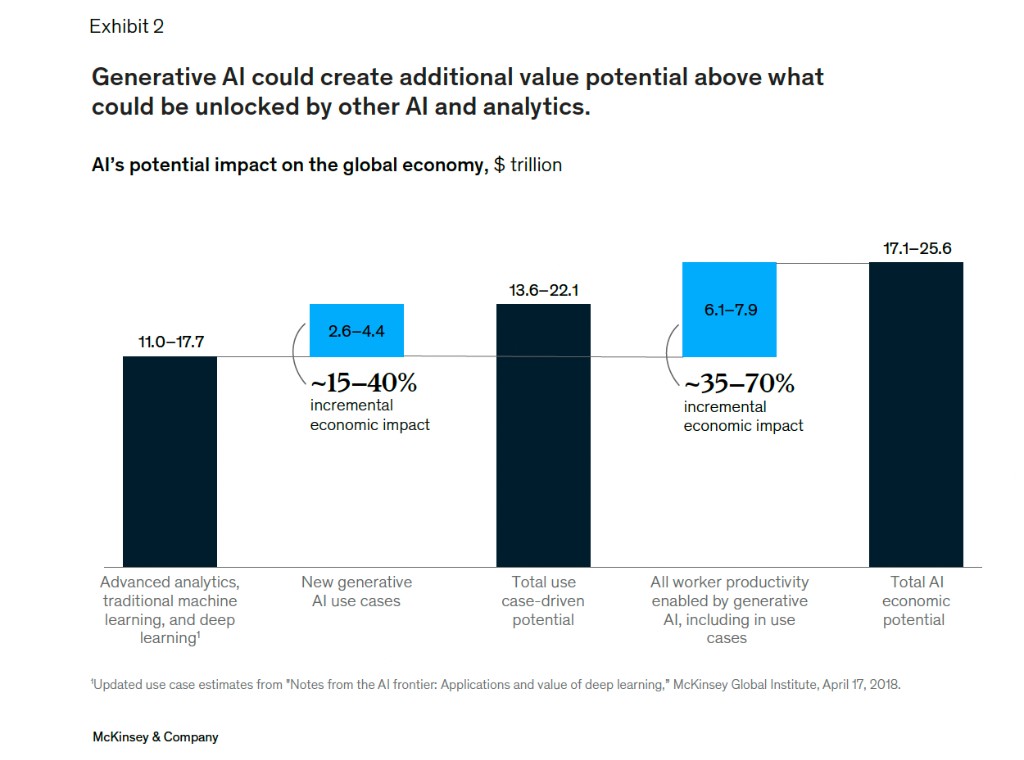
The report found that using generative AI in the 63 applications studied will bring global economic growth of 26 trillion to 44 trillion US dollars per year. And this prediction does not yet include all applications of generative AI. If the unexplored applications are included, the economic impact of generative AI may double:
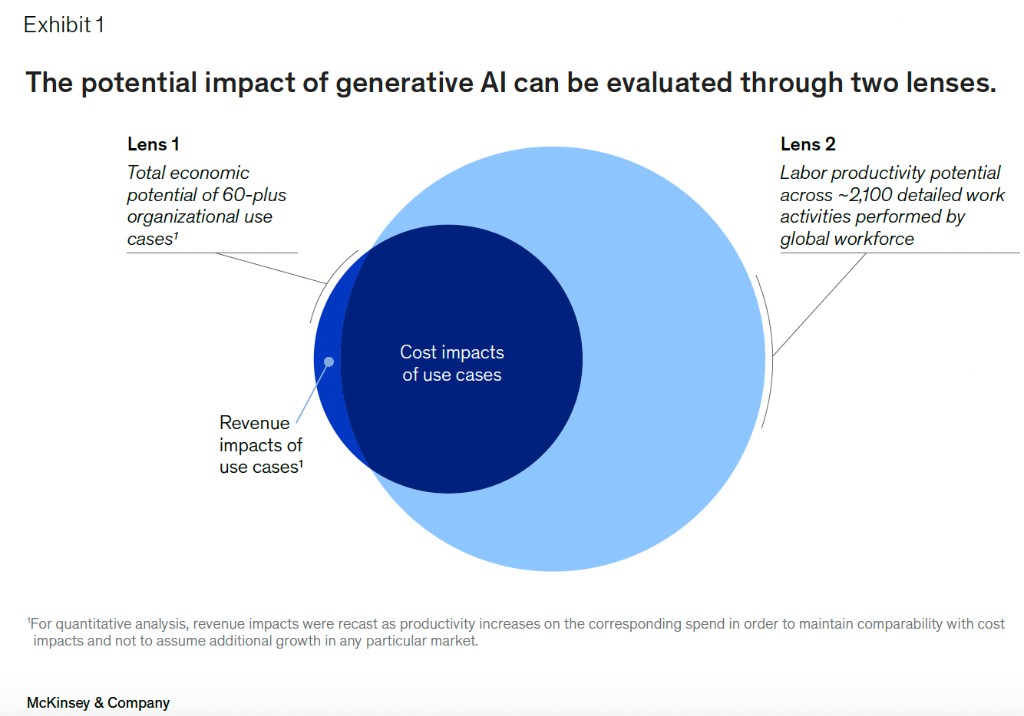
The study mainly includes two aspects: 1. The economic growth potential of more than 60 organizations using generative AI 2. The labor productivity potential of about 2,100 job activities worldwide.
McKinsey pointed out in the report that their research covers 16 business contents and concludes that if applied in various industries, it can contribute economic benefits between 26 trillion and 44 trillion US dollars per year, specifically: Our measurement standards include reducing the cost of generating content and the revenue generated by using AI to significantly improve content quality on a large scale. For example, in the marketing field, one use case is to apply generative AI to create personalized creative content such as emails.
This incremental increase is roughly equivalent to one year of GDP in the UK (which was $31 trillion in 2021).
We estimate that the economic value of non-generative AI will increase from $11 trillion to $17.7 trillion, an increase of 15% to 40%. (In 2017, we believed that artificial intelligence could bring economic value of $9.5 trillion to $15.4 trillion.)
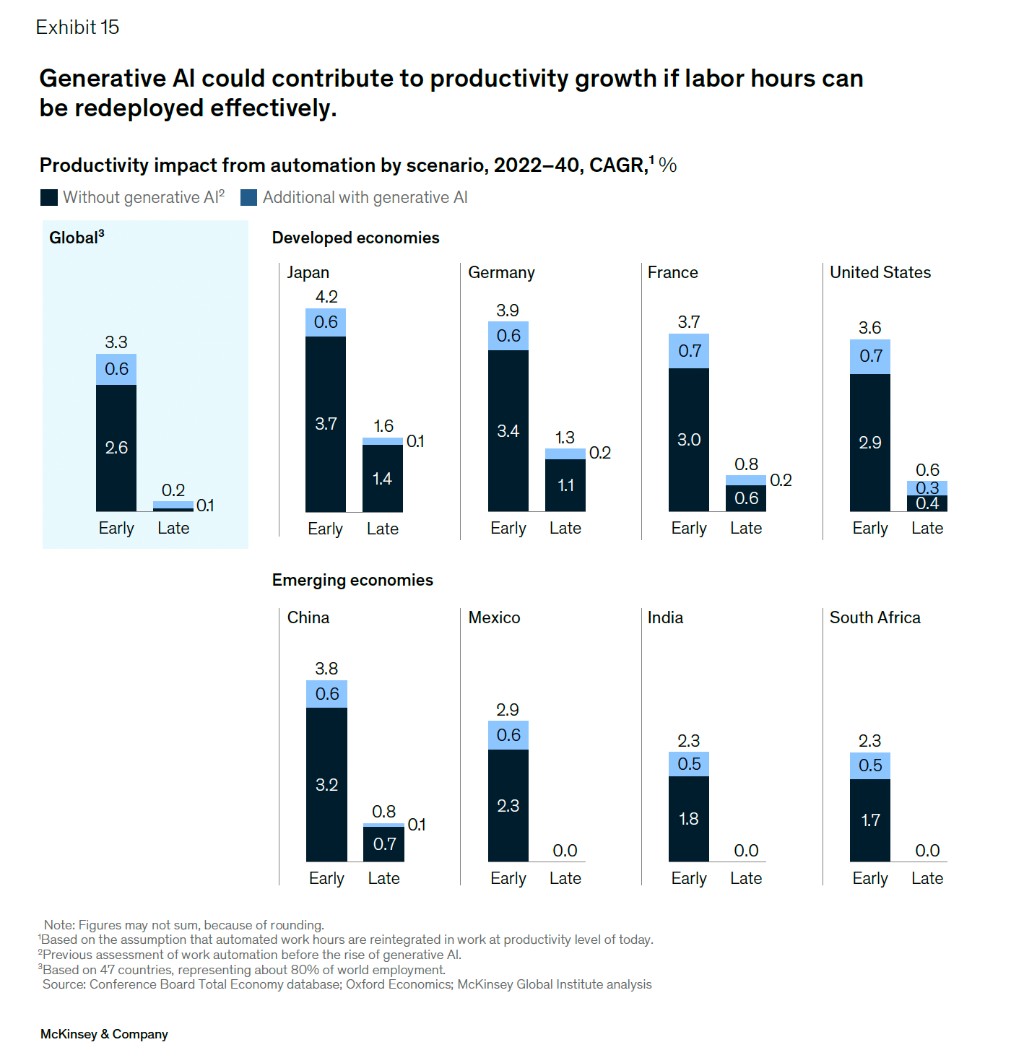
Looking specifically at each position, McKinsey's research covers 2,100 sub-job functions in about 850 professions. According to the degree of technology adoption and implementation, the report states that AI may affect all jobs worldwide and have an impact on all industries. In the next 20 years, generative AI can increase labor productivity by 0.1% to 0.6%.
The biggest "loser"? High-salary, high-education knowledge workers
McKinsey pointed out that although generative AI will affect all industries, especially for high-salary knowledge workers who were previously considered relatively unaffected by automation, they will be most affected.
McKinsey pointed out that 50% of occupations will gradually be replaced by AI between 2030 and 2060 (with a midpoint of 2045), which is 10 years earlier than their previous research.
Knowledge workers are most likely to be affected by automation, especially in professions that require decision-making and teamwork:
The previous generations of automation technology mainly involved data collection and processing, so the impact on knowledge workers was relatively small. However, the emergence of generative AI makes the role and tasks of "knowledge workers" perfectly match large language models (LLMs).
Because large language models are fundamentally designed to complete cognitive tasks, our application of large language models in professional knowledge has increased by 34 percentage points since 2017, and the potential for automating management and talent development has increased from 16% in 2017 to 49% in 2023.
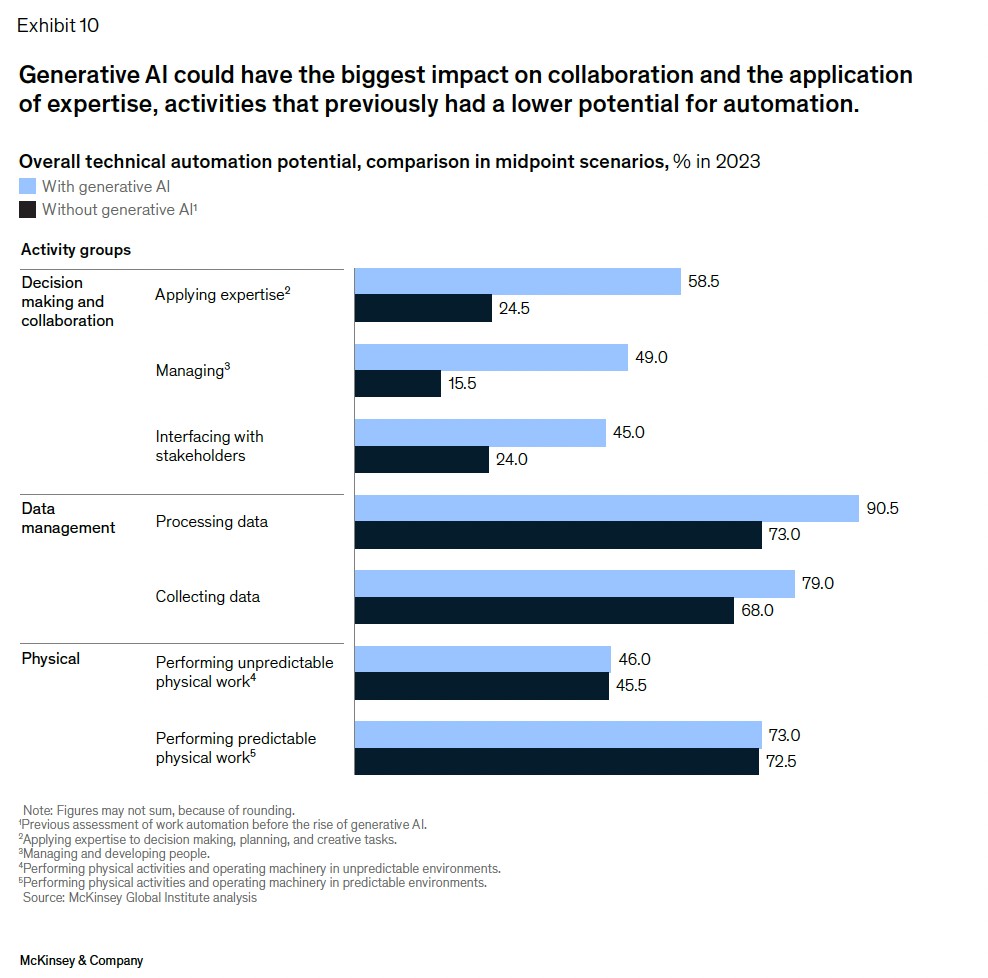
Therefore, McKinsey believes that many jobs involving communication, supervision, recording, and interaction with people are likely to be automated by generative AI, which undoubtedly accelerates the transformation of educators and white-collar workers engaged in creative work:
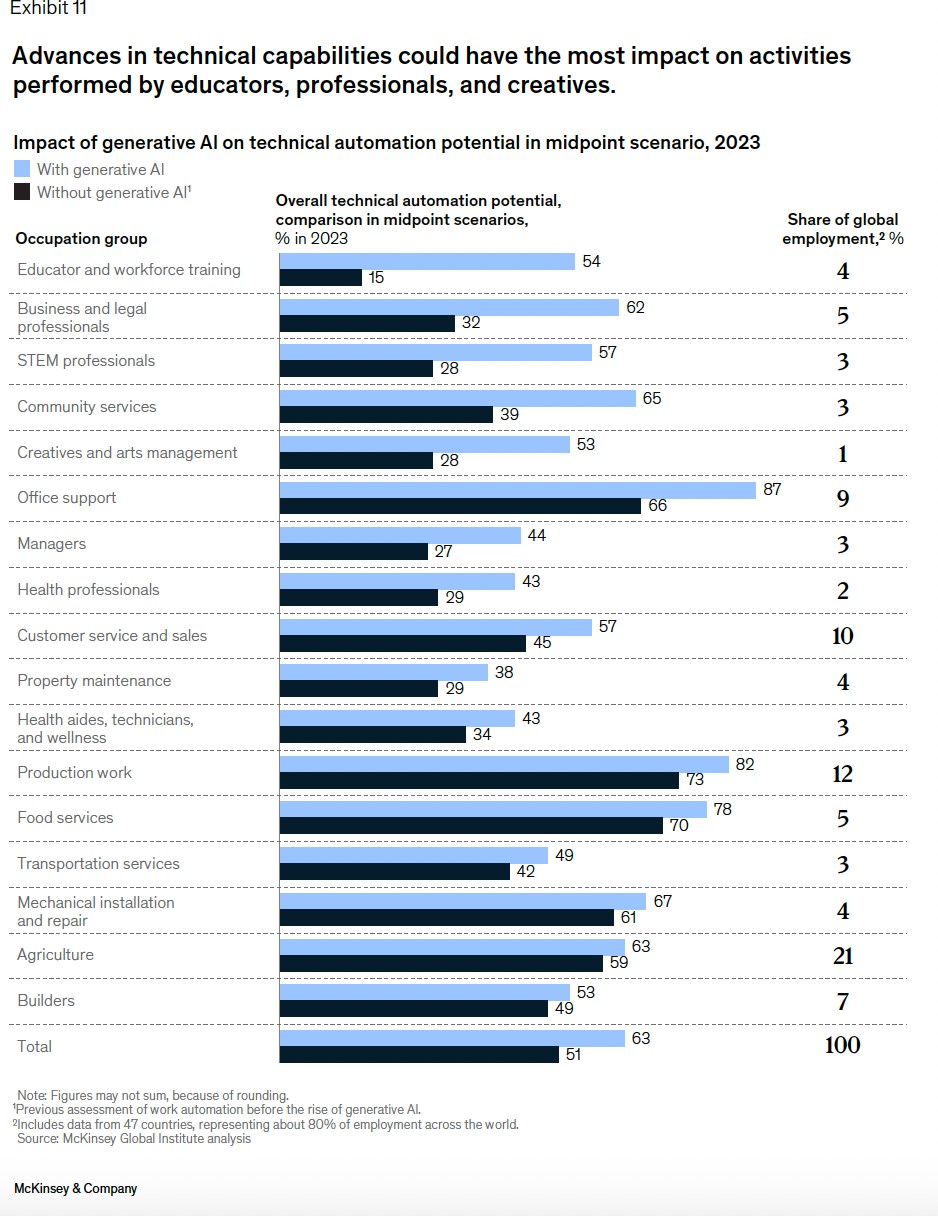
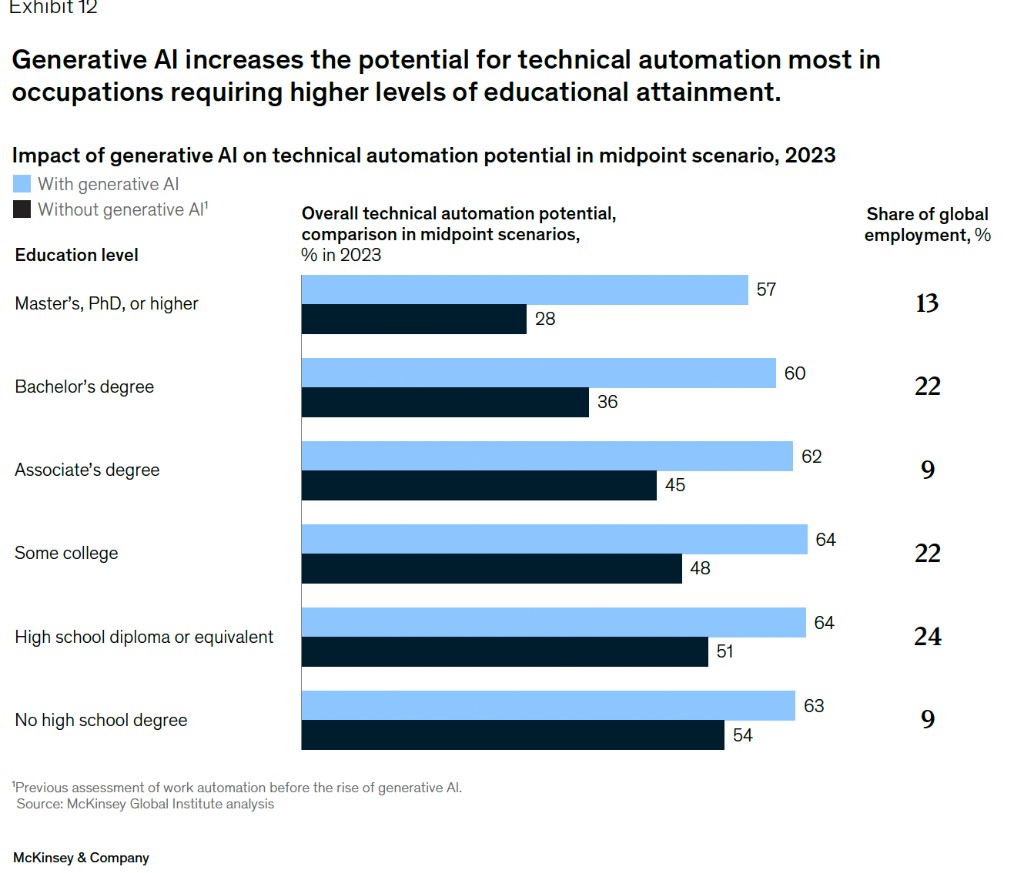
At the same time, McKinsey pointed out that in many previous productivity revolutions, people with higher education were often less affected, but the AI revolution will have a greater impact on highly educated people:
We believe that one explanation is that generative AI increases the potential for technological automation, and often the most demanding of technological automation is found in professions with higher levels of education.
We believe that another explanation is that for many years, degree certificates have been seen as a measure of skills, which will be challenged by generative AI. In the future, more people will advocate for a more skill-based approach to promoting workforce development, in order to create a more fair and efficient workforce training and matching system. Generative AI can still be described as a technology revolution that has a preference for skills, but the demand for skills is more nuanced.
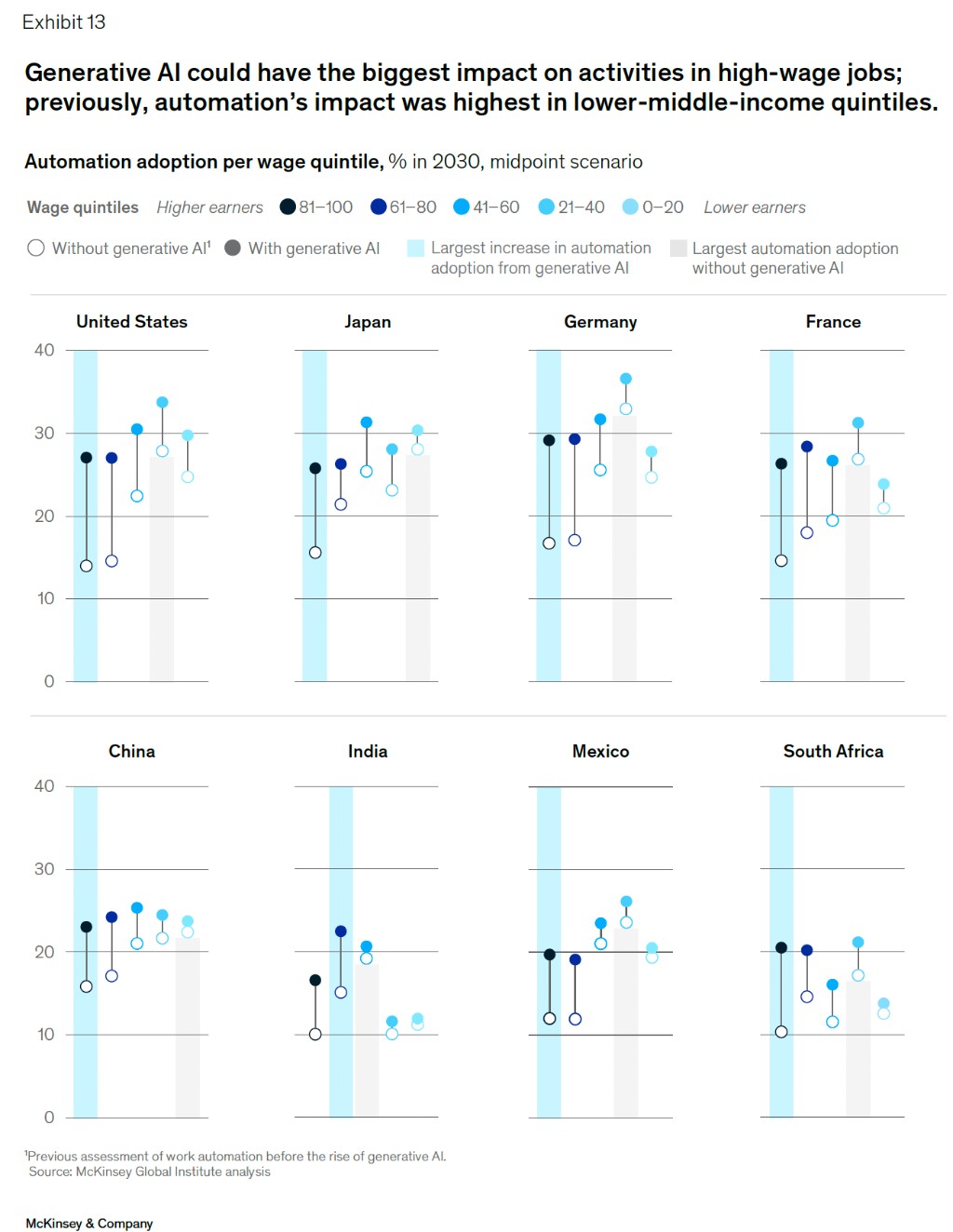
McKinsey emphasizes that it is worth noting that the previous generations of automation revolutions often had the greatest impact on professions with middle-income positions, and some economists compared this phenomenon to "hollowing out the middle layer". However, the emergence of AI may have the greatest impact on high-paying knowledge workers:
For low-paying jobs, low labor costs do not reflect the benefits of automation, and low-paying occupations that engage in labor activities are difficult to automate, such as picking delicate fruits.
However, due to the progress of generative AI in technological automation, these jobs that were previously considered relatively difficult to automate will be most affected.
AI Disrupts All Industries
McKinsey states that the impact of generative AI is mainly concentrated in four areas (accounting for about 75%): customer operations, marketing and sales, software engineering, and R&D. The development of generative AI and other technologies may automate 60% to 70% of current jobs. Among them, the banking, high-tech, and life sciences industries will be most affected: Due to the improvement of customer satisfaction by new technologies, it helps to make decisions and reduce fraud through better monitoring. Only the banking industry can generate an additional output of 200 to 340 billion US dollars by increasing productivity. This is equivalent to a 9% to 15% increase in operating profit.
In terms of product development, AI can increase productivity by 10% to 15%. Taking life sciences and chemicals as examples, artificial intelligence can generate potential molecules faster, accelerate the development of new drugs and materials, and this may increase the profits of pharmaceutical and medical product companies by up to 25%.
In terms of the impact on marketing productivity, generative AI can increase the economic value of marketing productivity by 5% to 15%. Through our analysis of the potential uses of AI in marketing, we found that in addition to the direct impact on productivity, it will also generate a chain reaction, increasing sales productivity by 3% to 5%.
Generative AI integrated into various applications can provide higher quality data insights, bring new ideas to marketing activities, and better target customer groups. The marketing department can shift resources to produce higher quality content for its own channels, which may reduce outsourcing expenses.
From the perspective of software engineering, generative AI directly affects 20% to 45% of annual software engineering expenses. This value mainly comes from reducing the time required for certain tasks, such as generating initial code, code correction and refactoring, root cause analysis, and generating new system designs. A study found that software developers using Microsoft GitHub Copilot completed tasks 56% faster than those who did not use the tool.
An internal empirical study conducted by McKinsey on software engineering teams found that the time required for engineers to generate and refactor code using AI after training was greatly reduced, and engineers generally believed that their work experience was improved, making work more enjoyable, processes more convenient, and easier to achieve a sense of accomplishment.
From the perspective of product development, we believe that generative AI can accelerate the time to market for products and bring productivity improvements and operational convenience in the following two aspects: optimizing product design and improving product quality.
The McKinsey summary states that the decline in global birth rates and aging populations will become obstacles to global productivity development, and the development of AI and other technologies can make up for the decline in the working population, greatly improve productivity, and accelerate the global economy. The speed at which developed countries adopt AI may also be faster:
Global economic growth from 2012 to 2022 is slower than the previous 20 years. We believe that one of the factors is long-term structural challenges, including declining birth rates and aging populations.
In many major countries, the number of labor force has been declining year by year. We believe that AI can re-plan the required working hours and promote productivity growth.